
THE FALL OF MERCURY (11)
By:
December 14, 2025
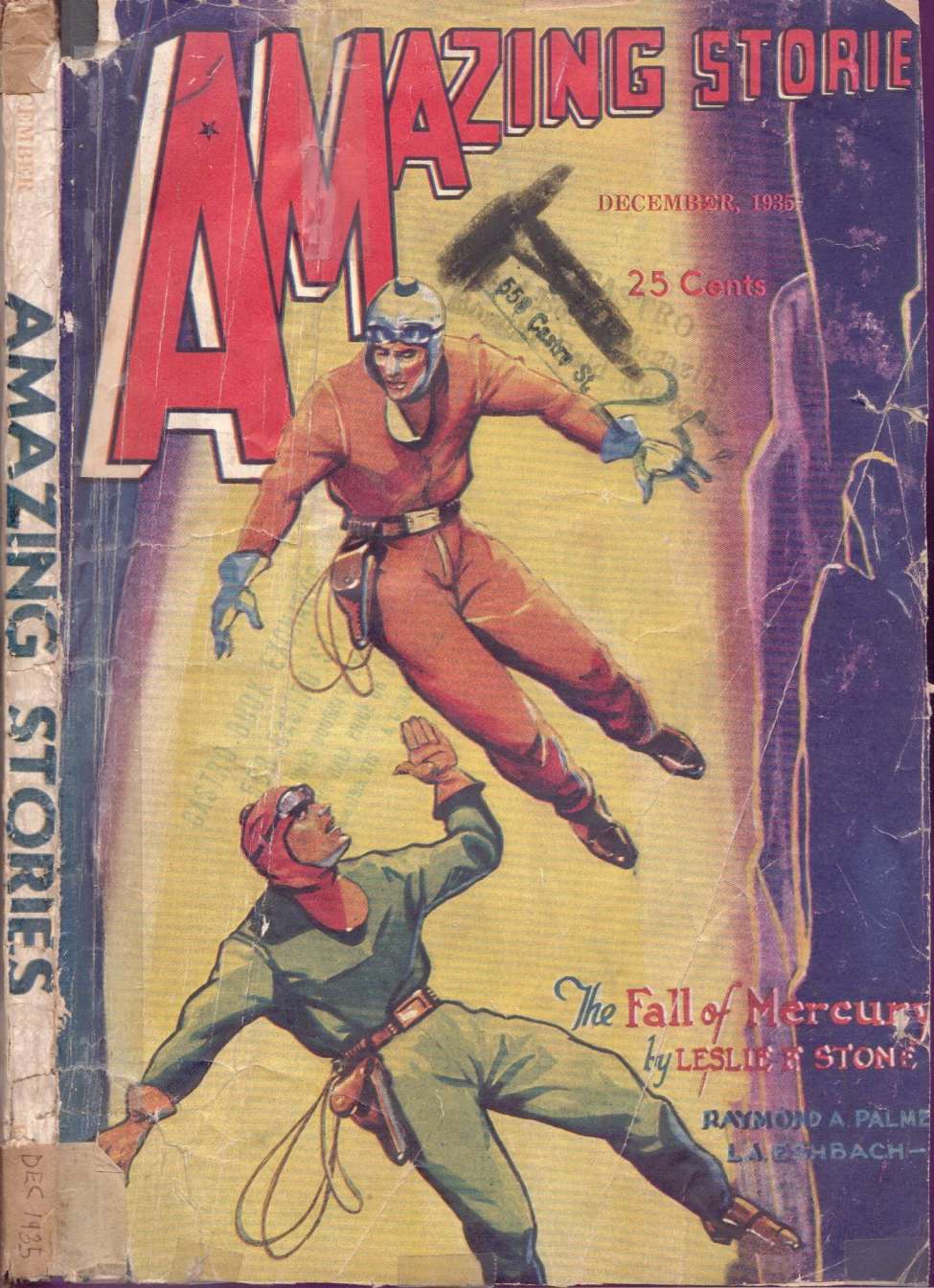
Leslie F. Stone was one of the first women science fiction pulp writers; her stories — including “The Fall of Mercury” (Amazing Stories, Dec. 1935), in which a Black hero uses super-science to destroy a white race bent on conquering the solar system — often featured female or Black protagonists. We are pleased to serialize this story for HILOBROW’s readers.
ALL INSTALLMENTS: 1 | 2 | 3 | 4 | 5 | 6 | 7 | 8 | 9 | 10 | 11 | 12.
CHAPTER XI
Fighting a World
The face of Ge Hurta on Saturn faded from our view, and Chen-Chak’s four hands flew over his controls, filling the great tubes above us with lively color, soft shades, pastels, fairy colors. Then suddenly they appeared overcome by new colors, dark reds, purples, deep midnight blues, glaring yellows, hideous greens, and through it all the giant’s fingers flew over the key-banks so swiftly they seemed to have a life of their own. We seemed forgotten.
“But no,” he spoke. “It is war to the end. Henceforth it must be either Saxta or Raxge, Saturn or Mercury. Raxge has fired the first shot. Ay! Feel that?”
As he spoke he took his hands from the controls and for a moment allowed the colors in the tubes to fade slightly. Forrest and I both felt it, a terrible pressure weighing us down in our chairs, a fierce tingling through our bodies, an inability to move a muscle.
I grew frightened. I wanted to cry out. But Chen-Chak unaffected by the power the Mercurians were pouring upon his ship returned to his keys. Instantly the tubes gave off evil colors, blacks, dirty browns, bilious greens and yellows. With their coming the force that had swept over Forrest and myself lifted and we were free again.
“It is my power against all of Mercury, for Saturn can not aid us now. Venus and Mars lay in the way, and would absorb all the forces Raxta, which is Saturn, could generate. It is because they know that the Raxgeu dare defy us!” exclaimed Chen-Chak.
Again we were forgotten, as fingers worked over the controls. colors in the tubes held steady. Th ecentral mirror was filled with the scene in the laboratory below, and I saw that all the tubes there were alive, the purple almost black. The Mercurians were gathered in excited groups, gesticulating wildly with their four hands. Now and then one broke from a group to run to a desk to work on paper or on a machine.
Sitting where I was I could see half Chen-Chak’s face. It was grim, set in tense lines. Now he pressed the bar under his left foot far down, depressing it to its full extent, and his face showed the strain put upon him. The tubes seemed wild, colors shot back and forth so quickly it was impossible to follow their flight. Then suddenly all color was gone, each tube was a solid spear of white, white light. Forrest and had to cover our eyes against the torture of that splendor. Somehow I managed to open my eyes again and focus them upon the mirror containing the Mercurian laboratory in miniature.
What had happened there? Why, they were in panic! Groups were running here and there, tiny men bent over machines, sometimes two or three were clinging to a single lever in an effort to depress it fully. I almost imagined I could hear their high shrill voices shouting with fear. A few, however seemed to have kept their heads, they were working over controls, just as Chen-Chak toiled, and the white light in the tubes over our heads grew momentarily dull. In response the Saturnian depressed the bar under his left foot even farther than before, his face showing again the terrific struggle that it all cost him.
It was Forrest who called my attention to what had occurred around us, for I had been too intent upon the laboratory scene and Chen-Chak to think of anything else. “Look,” breathed Forrest, “the walls of the ship are gone!”
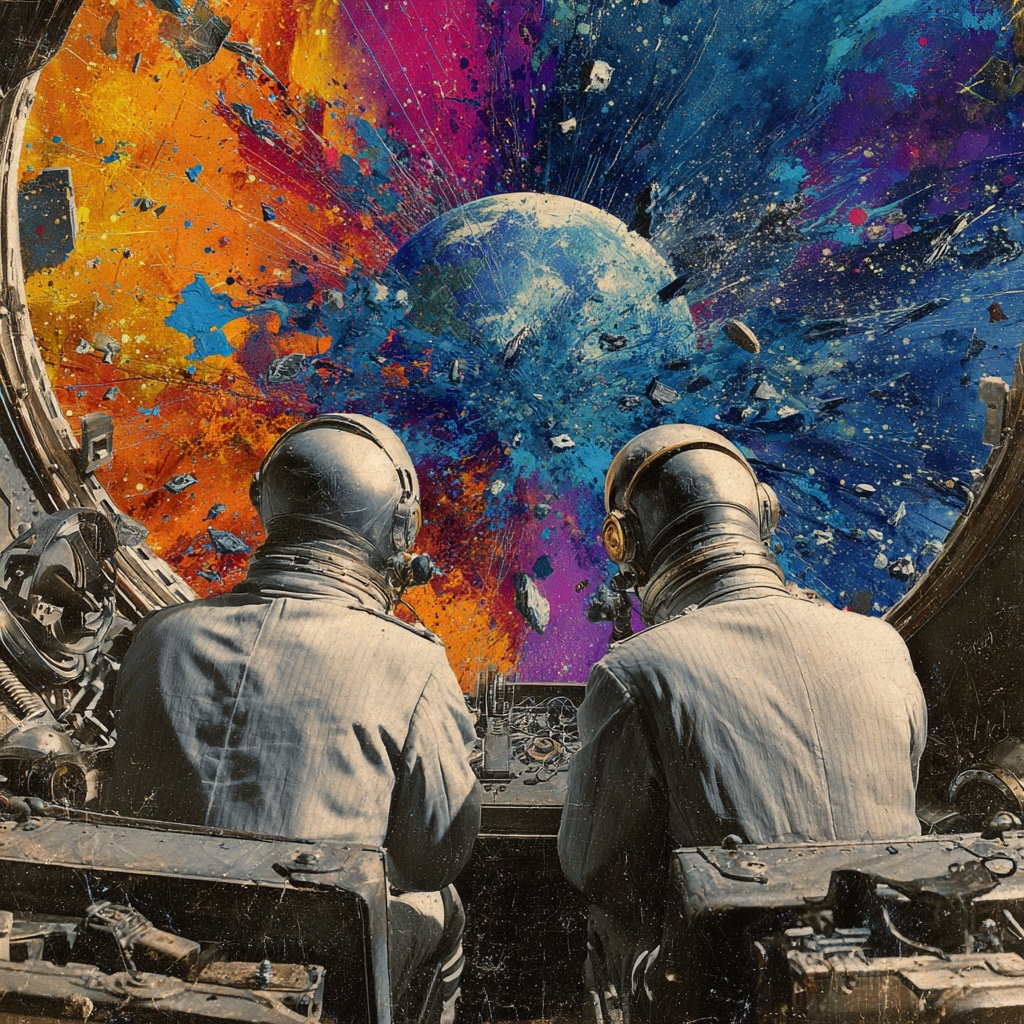
I followed the direction of his finger to see that he spoke the truth. The solid walls of the sphere were gone! Only the ball on which we sat, remained, suspended almost five hundred feet above the lonely twilighted world of Mercury. Where we sat we were at right angles to the surface, our bodies parallel with the livid soil. The strange black cliff that was the entrance to the inner world pointed its damning finger at us. On the horizon gleamed the orange ball that was the sun.
What new phenomenon this? “The Victory!! I cried. “It’s gone!”
“It is safe, never fear,” the deep booming voice of Chen-Chak assured us. “Your ship is on the other side of the ball. The walls are still about us, though they are invisible to you. We are simply in transit and whenever that occurs the walls appear dissolved. There is nothing to fear…
“In transit? You mean we are traveling?” I looked from Chen-Chak to the surface of Mercury hanging below us. I could have sworn it was unchanged in relation to ourselves.
“The sun, the sun!” Forrest clutched my arm as he cried out.
Hanging on Mercury’s horizon the sun looked like a great, bloated orange. Normally, it was two-thirds the size when seen from Tellus, but now it acted queerly. It seemed to be expanding!
But no, even as I stared, it dwindled again and was Mercury-normal. But wait. It had changed its place; it appeared to be swimming rapidly toward us; now it was high overhead. Mercury was rotating.
That was only the beginning of Sol’s queer antics, or rather Mercury’s antics, for that planet seemed to have gone wild. It rocked like a ship at sea; it danced frantically up and down; it spun weirdly so that the sun appeared first in one corner of the sky, now in another, and sometimes was not visible at all.
My eyes kept returning to Chen-Chak’s chromatism. I knew that in some way hands flew over the keys before him. Colors raced in the tubes over his black head, sometimes white, sometimes purple, red, yellow, black — every color of the spectrum, and many more it seemed to me, as several colors flowed together, combining into every sort of weird chromatism. I knew that in some way the Saturnian was accountable for the strange antics of Mercury, irreverently I thought of a dog shaking a bone.
I glimpsed the scene in the laboratory below again. There was no longer panic there. The little men were grimly manipulating their machines, only glancing now and then at a big screen I had not noticed before, which showed them the motions of their planet as they struggled for supremacy with the giant Saturnian.
I understood now what Chen-Chak was doing. He was dragging Mercury from its orbit…
And the motions of the sun grew wilder. Now it was twice its size, now it retreated rapidly, now Mercury spun like a top. There were moments when things seemed almost normal, the sun tottered, then swung back to almost normal position on Mercury’s horizon. The Mercurians were giving Chen-Chak a real fight, and all the while they kept his ship in leash. He was at checkmate, and unless he could control new forces the battle was lost. Suddenly the laboratory scene faded from the central screen over his face; the head of Ge Hurta on Raxta took its place. His booming voice spoke — a moment — and his face disappeared as Chen-Chak shook his head.
Thereupon, I saw him reach forward under the framework of his machine with his right foot, and he placed it on the second bar which he had disregarded up to the present. He pushed upon it with all his might, and in response the tubes overhead glowed with a new, bitter, fiery flame. Involuntarily my eyes went to the sun. A cry rose in my throat. For the sun was falling, falling upon us.
I could not tear my eyes away. All thought left me as I stared in unbelief at the great ball of flame racing toward us at unguessed speed. It was terrific, horrible, soul-stirring.
What was Chen-Chak about? What was the order from his Heig-Rau? Was the intention to throw Mercury into the sun?
Again I looked to the Saturnian, and was startled anew. There sat Chen- Chak at his controls, unperturbed, playing on his bank of keys as if in some pleasant studio far away from strife and world-ruin. His face was quiet now, the heavy lines that had etched themselves there were gone, and I could have sworn I heard him humming. He was humming. In the silence around us we could hear a soft murmur like that of a mother crooning to its babe, a cat purring in the sun.
And all the while the sun grew more massive. It filled our sky; its horrible fire tinting the landscape below with a lurid flame from hell. Mercury spun at a terrific rate. Day, night, twilight had become one. The planets were a blur of light in the sky. It was the end, I told myself, the end of everything!
Fascinated I could not tear my eyes from the sky. It was a kaleidoscope of varying shades of light. The sun was a deep yellow. And still grew larger, nearer, rushing at us with awful velocity.
“DON’T LOOK AT THE SUN,” roared Chen-Chak, but the warning was useless to me. Unable to look more I had dropped my head between my arms, covered my face with my hands and awaited the death I was certain would come.
An age seemed to pass over me, and yet nothing happened. At length I dared to lift my head, to open an eye, looking at Chen-Chak instead of the sun. He still sat on his stool, unruffled, hands moving slowly this way and that. The fire in the tubes was a vicious red, but I could look at them unblinkingly.
The central screen still showed the Mercurian laboratory. The little men knew doom was upon them. They no longer tended their machines, but stood with arms folded staring grimly at their own screen that showed them the sun, a mass that overflowed the mirror. The Lilliputian who had defied Ge Hurta stood before a smaller screen in which a black face showed. Glancing sideways, I realized that an enlargement of the same face showed in one of the screens before Chen-Chak. Chen-Chak addressed him again in their common language.
The little Mercurian was without emotion. At a word from Ge Hurta he sneered, arrogance written upon his ugly face. Ge Hurta said a single word, the Mercurian shrugged his donble shoulders. Now I felt a new power surge through the sphere upon which we sat.
I dared a half glance at the sun that filled all the sky, one side cut sharply by the bulge of Mercury. More rapidly than before we were falling toward it. It was no longer globular, its shape was indefinitely defined, broken by the great out-spreading arms of the mighty prominences, some reaching as far as 300,000 miles from the surface, while all around stretched the corona, a glorious halo of pearly light pushing millions of miles into space.
I found myself remembering all I knew of the sun. The photosphere, the apparent surface of the sun that bounded it, the reversing layer lying above the photosphere, a layer or sheet of gases from five hundred to a thousand miles thick, called by that name because it produces a reversed or absorption spectrum, containing the many terrestrial substances such as calcium and iron in vaporous state, and above that the chromosphere, another layer of gas from five to ten thousand miles deep, the color-sphere. At the times of a total eclipse of the sun as seen from Tellus, it is the chromosphere that appears as a brilliant fringe whose outer surface is covered with leaping flames. These are the eruptions of the sun-spots called prominences which break up into it and ascend to great heights.
And we were falling into that awful furnace. That was certain. We were close to the corona by now, and it would be a matter of a few minutes before we should enter it at the rate we were going.
I thought of Mercury. Insulated as we seemed to be from the sun’s glare and heat, by the unique forces Chen-Chak controlled, we were as comfortable as if we sat in our drawing room at home, but was Mercury insulated? Wouldn’t the refrigerating units be over-taxed to the cracking point? I looked at the place where Mercury should have been.
I had grown used to the vision of us apparently suspended five hundred feet above the planet but that five hundred feet had stretched to a thousand, was widening more. And the planet swayed, wobbled!
And something was happening around us. The air was growing dark, black, a haze enfolded us. It was reminiscent of something I had known in the past, the far past. I remembered. The walls of Chen-Chak’s space-ship, those suspended forces, whatever they were — were closing about us. Mercury and the sun were blotted from our eyes.
For minutes on end we seemed tottering on the brink of some horrible abyss, I could feel the sphere turning under me, turning faster, faster, the whole spaceship was turning, turning. Again Chen-Chak’s hands few over his controls, and the blackness grew, while the tubes above him were filled with pulsing waves of black. Next came the sensation of falling, as if the control ball had dropped from under me. I had a last vision of Chen-Chak — tensely grim, every line in his body, every muscle clearly penciled in my eyes, then the sickness came.
It was the same sickness I had experienced when Chen-Chak expanded our bodies on our entrance to the sphere, only it was sickness intensified a thousand times. Every bone in my body seemed crushed; I felt that giant hands tore at my flesh, twisted it into a thousand shapes. Something pounded my skull so it rang like a mighty gong, and every reverberation was hell itself. I died an uncounted number of deaths. I scarcely knew when the surcease from pain came.
RADIUM AGE PROTO-SF: “Radium Age” is Josh Glenn’s name for the nascent sf genre’s c. 1900–1935 era, a period which saw the discovery of radioactivity, i.e., the revelation that matter itself is constantly in movement — a fitting metaphor for the first decades of the 20th century, during which old scientific, religious, political, and social certainties were shattered. More info here.
SERIALIZED BY HILOBOOKS: James Parker’s Cocky the Fox | Annalee Newitz’s “The Great Oxygen Race” | Matthew Battles’s “Imago” | & many more original and reissued novels and stories.