
THE WORLD’S END
By:
February 19, 2026
A series dedicated to poems, published c. 1900–1935, the Radium Age sf-adjacent themes of which include: dystopia and utopia, far-out mathematics and the fourth dimension, Afro-futurism, catastrophe, future war, new technologies, scientific breakthrough, dehumanization, cosmic awe, disenchantment and unseen forces, unknowable aliens and singularity. Research and selection by Joshua Glenn; thematic index here.
“Fly with me then to all’s and the world’s
end
And plumb for safety down the gaps of
stars;
Let the last gulf or topless cliff befriend,
What tyrant there our variance debars?”
Alas, how hope for freedom, no bars bind;
Space is like earth, rounded, a padded cell;
Plumb the stars depth, your lead bumps
you behind;
Blind Satan’s voice rattled the whole of Hell
On cushioned air what is such metal worth
To pierce to the gulf that lies so snugly
curled?
Each tangent plain touches one top of
earth,
Each point in one direction ends the world.
Apple of knowledge and forgetful mere
From Tantalus too differential bend.‘
The shadow clings. The world’s end is here.
This place’s curvature precludes its end.
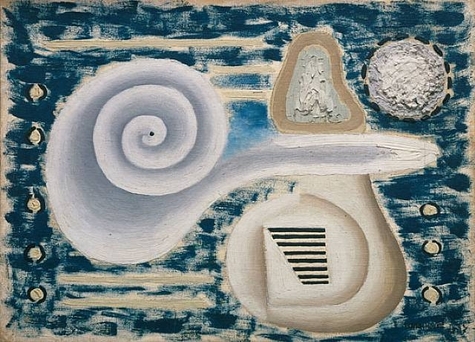
— Empson’s “World’s End” was first published in 1928 under the title “Relativity.” The poet uses Einstein’s theory of general relativity as a metaphor for an unrequited love affair. Written during Empson’s time at Cambridge, the conceit of the poem is that of a lover attempting to escape his romantic troubles by fleeing to “the world’s end”… only to discover that the curved nature of spacetime makes escape impossible. If you travel far enough, you’ll wind up right back where you began.
PS: One suspects that the poem’s opening line references this exchange from James Wimsett Boulding’s 1873 verse play Mary, Queen of Scots:
DARNLEY: You can escape only by flight.
QUEEN: And will you fly with me?
DARNLEY: Ay, to the world’s end.
RADIUM AGE PROTO-SF POETRY: Stephen Spender’s THE PYLONS | George Sterling’s THE TESTIMONY OF THE SUNS | Archibald MacLeish’s EINSTEIN | Thomas Thornely’s THE ATOM | C.S. Lewis’s DYMER | Stephen Vincent Benét’s METROPOLITAN NIGHTMARE | Robert Frost’s FIRE AND ICE | Aldous Huxley’s FIFTH PHILOSOPHER’S SONG | Sara Teasdale’s “THERE WILL COME SOFT RAINS” | Edith Södergran’s ON FOOT I HAD TO… | Robert Graves’s WELSH INCIDENT | Nancy Cunard’s ZEPPELINS | D.H. Lawrence’s WELLSIAN FUTURES | & many more.