
THE PLANETARY MESSENGER (2)
By:
November 18, 2026
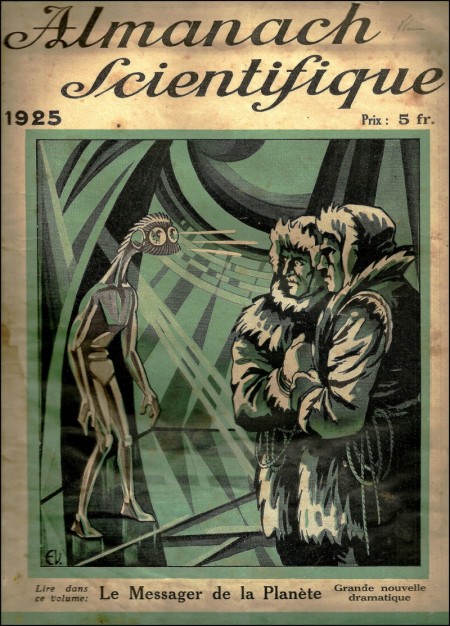
“Le Messager de la planète” (1924) is an early example of a first-contact narrative. Written by the prolific French pulp author José [Joseph] Moselli — known at the time primarily for his serialized adventure novels, and for the post-apocalyptic 1925 proto-sf novel La fin d’Illa — the story describes what happens when Antarctic explorers encounter a stranded visitor from Mercury. It was serialized in Sciences et Voyages, specifically in their L’Almanach Scientifique series. HILOBROW’s Josh Glenn has translated it into English. HiLoBooks is pleased to serialize this story for HILOBROW’s readers.
ALL INSTALLMENTS: 1 | 2 | 3 | 4 | 5.
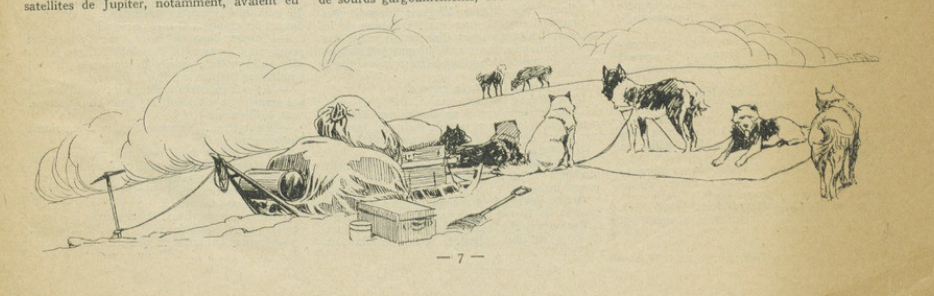
In a few moments, the dogs were unharnessed and tied up, and the sled was stashed in a hollow in the ground. Then, using their ice knives, the explorers carved blocks of ice to construct a sort of conical hut to serve as a shelter.
The sky, meanwhile, had grown slightly darker. The dogs, having finished their ration of smoked salmon, distributed by Kobyak, were letting out low growls.
Inside the hut, the spirit stove had been lit. A kettle, suspended above it, was whistling softly…
The hurricane, suddenly, unleashed itself with unprecedented violence. Within seconds, swirling masses of thick snow came crashing down from the blackened sky, while the dogs’ eerie howling mingled with the shrieking of the gale.
The hut, sturdily built, didn’t budge. A long hour passed. Having finished their meal, the three men had lit their pipes and were smoking in silence.
Kobyak suddenly stood up. In response to Wallens’s silent questioning, he pointed to the opening at ground level, through which the explorers had entered the ice hut: the snow had completely blocked it.
The opening had to be cleared; otherwise, asphyxia would soon follow. The Indian, before the scientists, had realized this!
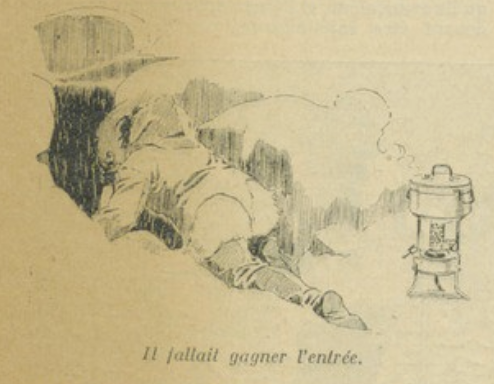
Armed with his snow knife, he slowly carved a path through the wall of ice. Within minutes, he had dug a sort of tunnel and disappeared into it.
Wrapped in their thick sleeping bags [sacs de couchage], Ottar Wallens and Olaf Densmold, stretched out side by side, had not exchanged a word. There was nothing they could do, but wait.
The formidable roar of the storm reached their ears, no longer muffled, but distinct and close at hand.
Amid the whistling of the gusts, terrifying detonations rang out, drowning out the barking of the wretched dogs as they howled in mortal terror.
“Kobyak must have completely cleared the opening!” said Wallens.
The roar of the hurricane drowned out his voice.
An icy blast, finding its way through the hole into which the Indian had vanished, made the stove’s flame flicker.
A brief, but distinct, shudder shook the hut. And the sound of explosions ceased.
The dogs barked more loudly.
A few minutes passed. Kobyak did not reappear.
The two scientists remained silent. They believed that the Indian was clearing a wide perimeter around the hut’s entrance, so he wouldn’t have to start over.
But an hour passed, then two… Ottar Wallens saw that Densmold had fallen asleep. He was snoring. The geologist checked his watch and saw that it had stopped.
He felt a strange, intense anxiety tighten his throat, so violent that he turned to his companion and shook him awake.
“What is it?” asked Densmold, straightening up, his brow furrowed [sourcils froncés].
“Kobyak went out more than three hours ago, and he hasn’t reappeared!”
“Three hours?”
“At least! My watch has stopped!”
Instinctively, Densmold pulled out his own:
“Mine too!” he noted, astonished. “At two-eleven…”
“At two-eleven, mine too!” said Wallens, slipping out of his fur sleeping bag as quickly as he could.
The stove, nearly empty, was producing nothing but a flame devoid of heat.
Ottar Wallens shivered and took a few sips of the scalding tea from the marmite pot hanging above the stove.
Then, having snatched up a flashlight from a small crate, he held it up to the barometer.
He started in alarm: The column of alcohol was bubbling inside the glass tube — dropping, rising, registering eight hundred millimeters, seven hundred and fifty, seven hundred, all within the same minute!
“Come and look, Densmold!” shouted Wallens, his voice sounding so strange that, for a second, the astronomer thought he had gone mad.
When he, too, saw the strange agitation of the alcohol, he was frozen with astonishment.
“A… telluric… phenomenon… an aurora borealis. Amazing!” he murmured.
“We ought to find out what’s become of Kobyak,” pointed out Wallens.
The astronomer did not reply, lost as he was in deep thought.
Without repeating himself, Wallens slipped into the passage the Indian had cut through the wall of ice.
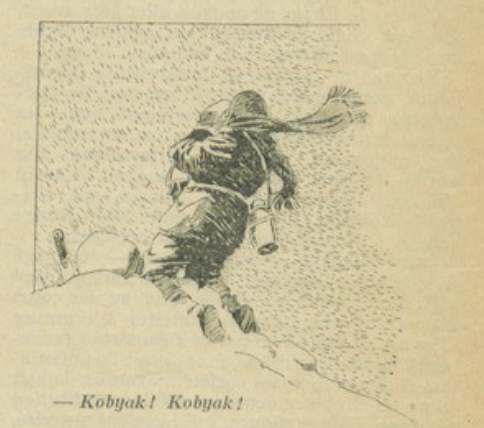
Crawling on hands and knees, he rounded a sharp bend [coude brusque] to the left and emerged, two meters further along, beneath thick columns of fine, dense snow that gusts of wind were swirling about diabolically.
The darkness was absolute; yet, toward the southeast—an approximate direction!—Ottar Wallens thought he could spy a faint, greenish [verdâtre] glow, which seemed to rise from the ground.
Was it an illusion? A mirage? A new phenomenon of refraction? The geologist, his head bowed against the violent wind, asked himself.
The thought of Kobyak snatched him from his speculations. He called out to the Indian at the top of his voice. He saw nothing moving, heard nothing.
The dogs were no longer yowling.
Only one sound persisted: the tremendous whistling of the gusts…
“Kobyak! Kobyak!”
Nothing.
Ottar Wallens’s concern was gradually turning into anxiety—an anxiety bordering on terror—all the more so because he was gripped by a kind of bizarre malaise. It seemed to him that a powerful vibration was shaking the ground beneath his feet and the very air he breathed.
He stiffened. He called out again.
With no more success.
In the darkness, he made his way toward the sled which, on the flat ground just a few paces from the hut, formed a huge white mound.
He soon reached it.
As he passed the dogs, he heard a few faint barks that reassured him slightly.
Stopping in front of the sled, he called out again. His shouts were as futile as before. The vibrations he felt were growing increasingly intense. It now seemed to him that a violent trembling was shaking his body, the ground, and the snow.
“I’m going mad!” he thought.
Having closed his eyes, he opened them again and saw nothing abnormal—except, however, for that greenish glow which, toward the southeast, seemed to emanate from the earth itself.
“Kobyak! Kobyak!” he called out again.
Only the gusts of wind answered him.
The dogs had fallen silent.
Suddenly, Ottar Wallens was seized by fear—a terrible fear, a panicked fear—the fear of going mad in that snow-veiled darkness.
It seemed to him that terrible dangers were lying in wait. He summoned all his sang-froid and, slowly, made his way back toward the hut.
He had some trouble finding the entrance again, as the snow had already begun to block it. He cleared the opening and, slipping into the passage, worked his way inside the cabin.
Sitting on a crate, his elbows on his knees, Olaf Densmold was gazing at an object that he held in his hand.
“Hasn’t Kobyak come back?” the geologist asked rather foolishly, even though he could clearly see that his colleague was alone in the hut.
“No!” Densmold said curtly, looking up. “But my compass has gone haywire [affolée]… Completely. The needle isn’t indicating any direction anymore… It’s pointing straight at the ground, as if we were right over the magnetic pole…”
“Yes… yes…” Wallens murmured, preoccupied.
“What? Did you want to say something?”
“Er… no!… But a moment ago, I sensed certain vibrations… and I saw… something green… a green glow, very close by…”
“Ah!”
“Yes… Not far from the sled!” Wallens specified.
“And Kobyak?” asked Densmold, after a brief silence.
“Not a trace. I called out to him several times… I went all the way to the sled… I walked past the dogs… He isn’t there!”
“Fallen into the snow, no doubt, and buried!” grumbled Densmold. “That compass worries me… coming after the barometer… which is bubbling more and more! Strange!”
“And our watches have stopped!… Didn’t you feel that vibration? I felt as if I were drunk a moment ago!”
“Maybe… I couldn’t say…” murmured the astronomer.
The wind must have lost some of its force, for its roaring [mugissements] could barely be heard.
Ottar Wallens sat down in front of the camp stove.
“Best to wait for daylight!” he concluded. “It won’t be long!”
Densmold remained silent. He kept observing the large compass he held in his hand.
“I wonder what that means!” he murmured at last. “It looks as if the compass is shifting back and forth from each side of the magnetic equator… Look, Wallens!”
“The needle!… It points now east, now west!… Curious!”
“Curious!” repeated the geologist. “But… Kobyak? Do you think he’s dead?”
Without answering, Olaf Densmold gave a brief shrug.
Ottar Wallens shivered:
“It’s cold!” he murmured. “If Kobyak is dead, we’re going to be in a bit of trouble… regarding the sled… and the dogs that need tending!”
“The compass is what worries me more! How are we to find our way?…”
“We have spare compasses…”
“Which must be going haywire, just like that one!…”
“The stars…”
“Yes, steering by them; but what if there’s fog?… Or perhaps the phenomenon is only temporary? It will be interesting to discovert the cause and describe it!…”
“Let’s wait for daybreak!” concluded Wallens. “It won’t be long now!”
Having said that, the geologist slipped into his sleeping bag and tried to sleep, but without success. Densmold, still seated on the crate, continued to observe his compass.
Wallens suddenly saw him drop to his knees, crawl into the passage connecting the hut’s interior to the outside, and disappear.
He returned less than ten minutes later:
“It’s daylight!” he growled. “I’ve found Kobyak!”
“You… Where is he?”
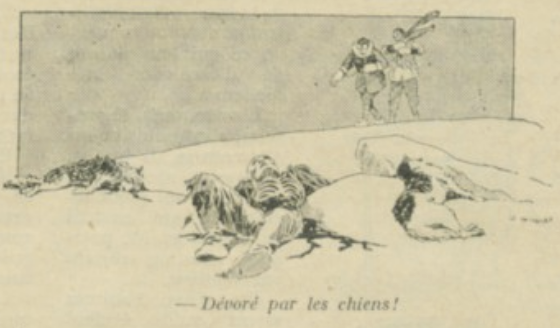
“Dead. Devoured by the dogs! I killed two of the beasts to make them drop the remains… Rage overwhelmed me! I was wrong! Come and see. The storm has passed!”
Stunned, and still gripped by a nagging unease, Ottar Wallens slipped out of his sleeping bag, tightened his furs, and followed the astronomer out.
Outside, there was absolute calm. Nothing remained of the night’s ferocious hurricane. A lugubrious grey-yellow light illuminated the ice pack.
In a few steps, the two men reached the dogs.
On the ground, amidst blood-stained snow, Kobyak’s shapeless remains were visible.
The dogs, sitting on their haunches, motionless, ears pricked, eyes bloodshot, muzzles quivering, seemed uneasy.
They did not move as the scientists approached.
“The… the thing! Did you see it?” Wallens asked, extending his arm toward the southeast.
He had just remembered the greenish glow he had glimpsed during the night. It had vanished.
Olaf Densmold turned around. He was still holding his compass:
“The thing?” he repeated. “Yes!… It’s repelling the magnetic needle! Come on!”
Leaving the dogs behind, the two men skirted the white mound formed by the snow-covered sled and, guided by the magnetic needle, strode forward quickly. They covered about a kilometer without discovering anything.
The thing, whatever it was, lay further away than they had thought.
They were beginning to doubt its existence when, having climbed a rise in the icy surface, they made out, a few meters away, a cavity roughly shaped like a funnel, about fifteen meters in diameter and twice as deep.
They approached it.
FRENCH PROTO-SF TRANSLATIONS BY JOSH GLENN: Raymond Roussel’s LOCUS SOLUS [excerpt] | Noëlle Roger’s THE NEW ADAM [excerpt] | Alfred Jarry’s THE SUPERMALE [excerpt] | Jean de La Hire’s THE MYSTERY OF THE XV [excerpt] | José Moselli’s THE PLANETARY MESSENGER.
RADIUM AGE PROTO-SF: “Radium Age” is Josh Glenn’s name for the nascent sf genre’s c. 1900–1935 era, a period which saw the discovery of radioactivity, i.e., the revelation that matter itself is constantly in movement — a fitting metaphor for the first decades of the 20th century, during which old scientific, religious, political, and social certainties were shattered. More info here.
SERIALIZED BY HILOBOOKS: James Parker’s Cocky the Fox | Annalee Newitz’s “The Great Oxygen Race” | Matthew Battles’s “Imago” | & many more original and reissued novels and stories.