
THE PLANETARY MESSENGER (1)
By:
November 12, 2026
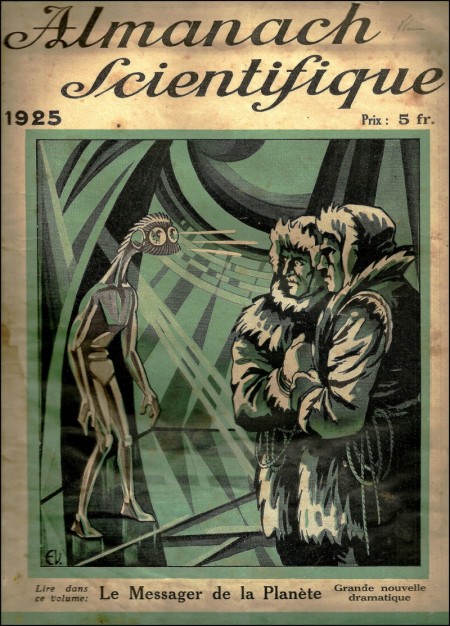
“Le Messager de la planète” (1924) is an early example of a first-contact narrative. Written by the prolific French pulp author José [Joseph] Moselli — known at the time primarily for his serialized adventure novels, and for the post-apocalyptic 1925 proto-sf novel La fin d’Illa — the story describes what happens when Antarctic explorers encounter a stranded visitor from Mercury. It was serialized in Sciences et Voyages, specifically in their L’Almanach Scientifique series. HILOBROW’s Josh Glenn has translated it into English. HiLoBooks is pleased to serialize this story for HILOBROW’s readers.
ALL INSTALLMENTS: 1 | 2 | 3 | 4 | 5.
Bundled [emmitouflés] in thick furs, from the sole of his feet to the top of his skull, Ottar Wallens, the geologist, and Olaf Densmold, the astronomer, trudged slowly across the ice field.
Ahead of them, about fifty meters ahead away, a sled driven by Kobyak, an Alaskan Indian, glided over the white expanse.
Beyond that, nothingness: frozen snow, blocks of ice, and a flat, grey sky.
There was not a breath of wind, yet the temperature stood at twenty-eight degrees below zero.
The three men — the geologist, the astronomer, and the Indian — had left their ship, the three-masted Sirius, eleven days earlier; the vessel had carried them from Bergen to Wilkes Land.
The Sirius had made its way to the 70th parallel until it was forced to halt at the edge of the pack ice [banquise].
The expedition’s goal was not strictly to reach the South Pole, but to get as close as possible and to supplement the meteorological, astronomical, and geological observations made by Amundsen and Shackleton.
Since the Sirius could go no further, the two expedition leaders had decided to strike out [s’enfoncer] across the pack ice.
In addition to numerous scientific instruments — including a small wireless telegraph unit [appareil de télégraphie sans fil] — they carried six weeks’ worth of provisions of all kinds, lightweight yet sophisticated [perfectionné] camping gear, and weapons; all of this was securely lashed to a sled pulled by twelve Alaskan dogs driven by Kobyak, a gigantic Native American [Peau-Rouge] hired in Nome, in western Alaska.
Ottar Wallens — the geologist — was forty-two years old. He was a sturdy fellow [gaillard] with a slight stoop, a round face, and a short nose supporting a pair of tortoiseshell-framed glasses. He was brusque and quick to lose his temper. A member of the Royal Academy of Christiania and numerous scholarly societies, he had authored several authoritative works on the geological structure of the arctic continents.
His companion, Olaf Densmold, had just turned fifty-one. He was lean and bony [osseux], with a face shaped like a ship’s prow and small, round, piercing black eyes. Taciturn by nature, he would go days without speaking. His work—particularly on the satellites of Jupiter — had garnered immense acclaim; he was regarded as one of the foremost living mathematicians.
During the long voyage aboard the Sirius from Bergen to Wilkes Land — lasting nearly two months — the scientists, who were already acquainted, had fully bonded — or at least, had grown accustomed to one another. Both men, moreover, had equal stakes in the success of the expedition that bore their names…
And now, side by side, they advanced across the bleak [morne] pack ice.
They spoke little. Since setting out, they had had time to share everything — their pasts, their projects, their ambitions, their frustrations [déceptions]. And no setback had occurred.
It was late September — the antarctic spring. For a few hours, each day, a pale sun would appear.
Olaf Densmold would record a few astronomical observations of no great significance, and then they would move on. Marching, camping, eating, resting — life was forever the same.
Kobyak was as taciturn as Densmold; when he spoke, it was to his dogs, either to encourage or threaten them. The crack of his whip-lash constituted, in fact, his primary form of communication [discours]…
The sled had already left behind the region reached by previous explorers.
It was now advancing into the unknown. An unknown as monotonous as it was bleak. No plants. No trees. Nothing. Ice. In places, the terrain was a flat plain [plaine unie]; further on, there were gigantic blocks of extraordinary, tortured shapes: perfect cubes, veritable frozen waves, dunes, and pyramids — all of it slashed [coupé] by precipices and fissures with breaks so clean they seemed carved by a machine. Some of these chasms were several meters wide; they had to be skirted [contourner]. Their depths ranged from ten to a hundred meters or more. Sometimes from them rose muffled gurgling sounds [gargouillements], revealing the action of melting water. Elsewhere, the ice gave way under the explorers’ weight, which forced them to pay close attention to following the sled’s tracks. Because the dogs’ instincts never failed them.
… That day, they had already been traveling for four hours and the stage of the journey promised to be a satisfactory, untiring one. The still air made the cold quite bearable. And the ice’s surface was smooth enough. Yet, for the past few moments, Kobyak — who, typically, marched with his head down — had been lifting his face toward the pale sky and turning it right and left, like someone sniffing the wind [flaire le vent].
“The guide looks strange, doesn’t he?” suddenly grumbled Ottar Wallens, to his companion. Densmold’s only reply was a fatalistic shrug [haussement d’épaules], as if to indicate that Kobyak’s face was of no concern to him.
“And yet the barometer is high!” Wallens continued. “I don’t think a storm is threatening us!”
Again a shrug from Densmold.
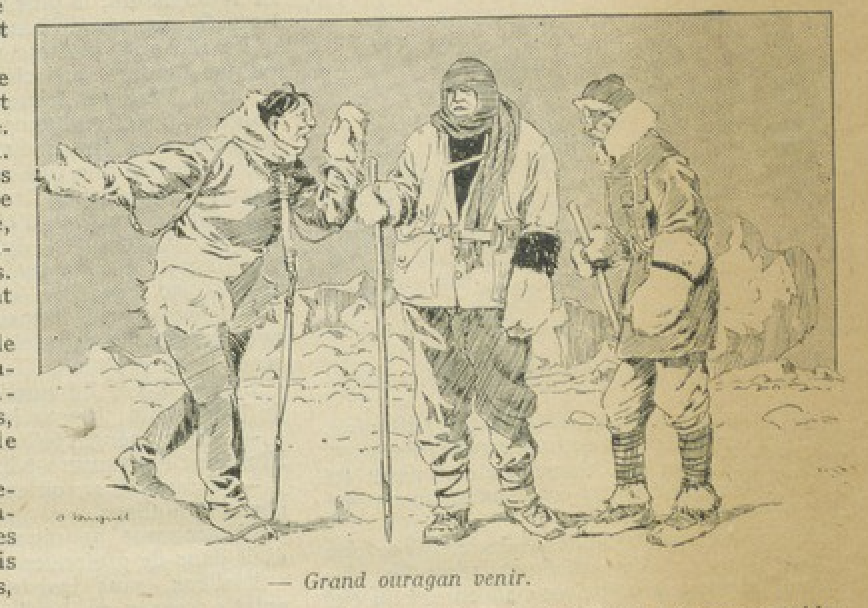
At that precise moment, Kobyak let out a sort of whistle that brought the dogs to an abrupt halt. The Indian, turning around, waited for the two scientists to catch up with him. They did so.
“Well?” Wallens asked curtly.
“Camp! Shelter. Big storm — big storm coming!” said Kobyak. “Not good!”
Without a word, the two Norwegians approached the sled and checked the barometer mounted on it.
It indicated fair weather. But the alcohol, in the glass tube, was dropping with terrifying rapidity.
Truly, they had to make camp.
The three men set about doing so.
FRENCH PROTO-SF TRANSLATIONS BY JOSH GLENN: Raymond Roussel’s LOCUS SOLUS [excerpt] | Noëlle Roger’s THE NEW ADAM [excerpt] | Alfred Jarry’s THE SUPERMALE [excerpt] | Jean de La Hire’s THE MYSTERY OF THE XV [excerpt] | José Moselli’s THE PLANETARY MESSENGER.
RADIUM AGE PROTO-SF: “Radium Age” is Josh Glenn’s name for the nascent sf genre’s c. 1900–1935 era, a period which saw the discovery of radioactivity, i.e., the revelation that matter itself is constantly in movement — a fitting metaphor for the first decades of the 20th century, during which old scientific, religious, political, and social certainties were shattered. More info here.
SERIALIZED BY HILOBOOKS: James Parker’s Cocky the Fox | Annalee Newitz’s “The Great Oxygen Race” | Matthew Battles’s “Imago” | & many more original and reissued novels and stories.