
RADIUM AGE 2025
By:
December 30, 2025

Under the direction of HILOBROW’s Josh Glenn, in 2022 the MIT Press launched its RADIUM AGE series of proto-sf reissues from 1900–1935.
In these forgotten classics, sf readers will discover the origins of enduring tropes like robots (berserk or benevolent), tyrannical supermen, dystopias and apocalypses, sinister telepaths, and eco-catastrophes. With new contributions by historians, science journalists, and sf authors, the RADIUM AGE book series recontextualizes the breakthroughs and biases of these proto-sf pioneers, and charts the emergence of a burgeoning literary genre.
RADIUM AGE SERIES UPDATES: 2022 | 2023 | 2024 | 2025 | 1Q2026. FULL SERIES INFO.
Below, please find updates on the RADIUM AGE project from this past year.
During 2025, the RADIUM AGE series published the following titles.
J.D. BERESFORD
Introduction by TED CHIANG
(March 4, 2025)
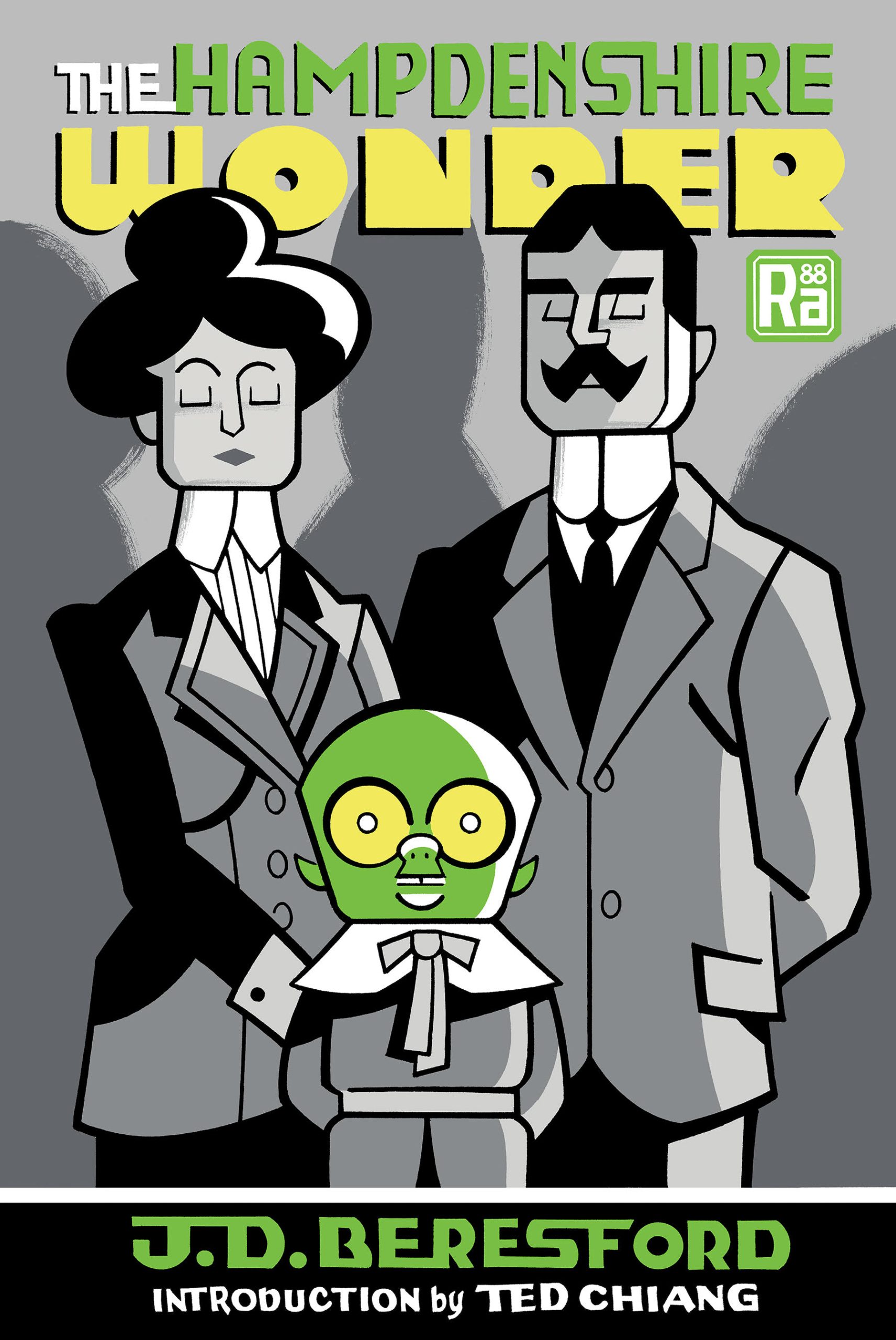
In this pioneering science-fictional treatment of superhuman intelligence, a mutant wonder child’s insights prove devastating.
Science fiction luminary Ted Chiang introduces The Hampdenshire Wonder, one of the genre’s first treatments of superhuman intelligence. Victor Stott is a large-headed “supernormal” mutated in the womb by his parents’ desire to have a child born without habits. Unable to deal with the child’s disenchanting insights, his adult interlocutors seek to silence him… perhaps permanently.
“In The Hampdenshire Wonder Beresford explores anxieties about human evolution and the limits of knowledge. Is Victor Stott our evolutionary successor or simply a vulnerable boy in a provincial town? A threat or a victim?” — John Kessel
“Extravagance… but of so remarkable a character that it keeps you almost spell-bound. What follows is philosophy, psychology, poetry, allegory, what you will.” — The Bookman (1911)
“A novel which, in point of originality, both of conception and execution, is the most remarkable that has been published for some time. A wonderful effort of vision and imagination. It is a book that counts.” — Morning Post (1911)
“Mr. Beresford reveals himself as a man who has something to say very distinct and different from the ordinary rut of novelists, something that amounts almost to a message.” — English Review
“A clever and curious book.” — The Book Monthly (1911)
“A thoughtful and original novel.” — The Athenaeum (1911)
“The striking originality of the book is what first catches the reader’s attention; afterwards it is held by the quiet, truth-compelling manner of the telling.” — Pall Mall Gazette (1911)
“Mr. Beresford has done a very difficult thing extremely well. He has written a story which anyone can read with pleasure, and in which the philosophic reader will find a rich vein of meaning and suggestion.” — Westminster Gazette (1911)
Press for MITP’s edition of The Hampdenshire Wonder includes the following…
“However you interpret Beresford’s touching short novel, it remains, like its protagonist, a wonder.” — The Washington Post
“What makes the Radium Age series so valuable is how it illuminates the origins of science fiction tropes we take for granted. The Hampdenshire Wonder tackles transhumanism decades before it became a preoccupation of science fiction and posthumanist philosophy.” — Mark Frauenfelder, Boing Boing
“One of the earliest exemplars in SF of the genius unbound, the more-than-human intellect whose insights are sublime and terrible. […] The Hampdenshire Wonder has more than just historical value, and earns this latest reprint.” — Niall Harrison, Locus
“The great Ted Chiang contributed a new introduction to this edition of J. D. Beresford’s novel The Hampdenshire Wonder. It’s about a superhuman child whose observations of — and detachment from — the rest of humanity lead to alarm and the collapse of his family.” — Reactor
Ted Chiang’s introduction to The Hampdenshire Wonder was published by Literary Hub. Excerpt: “Not only does Victor Stott frighten the ignorant and superstitious, he induces a profound terror in the educated and intellectual. Seen in this light, the first novel about superintelligence is actually a work of horror SF, a cautionary tale about the dangers of knowing too much.”
J.D. BERESFORD (1873–1947) was an English dramatist, journalist, and author. A great admirer of H.G. Wells, he published the first critical study of Wells’s scientific romances in 1915. In addition to The Hampdenshire Wonder (1911), an early and influential proto-sf novel about super-intelligence, his genre novels include A World of Women (1913), Revolution (1921), and The Riddle of the Tower (1944, with Esmé Wynne-Tyson).
TED CHIANG‘s fiction has won four Hugo, four Nebula, and six Locus Awards, and has been reprinted in Best American Short Stories. His first collection Stories of Your Life and Others has been translated into twenty-one languages, and the title story was the basis for the Oscar-nominated film Arrival. His second collection Exhalation was chosen by The New York Times as one of the 10 Best Books of 2019.
Originally published in 1911. Cover illustrated and designed by Seth. See this book at The MIT Press.
JOHN TAINE
Introduction by S.L. HUANG
(March 4, 2025)
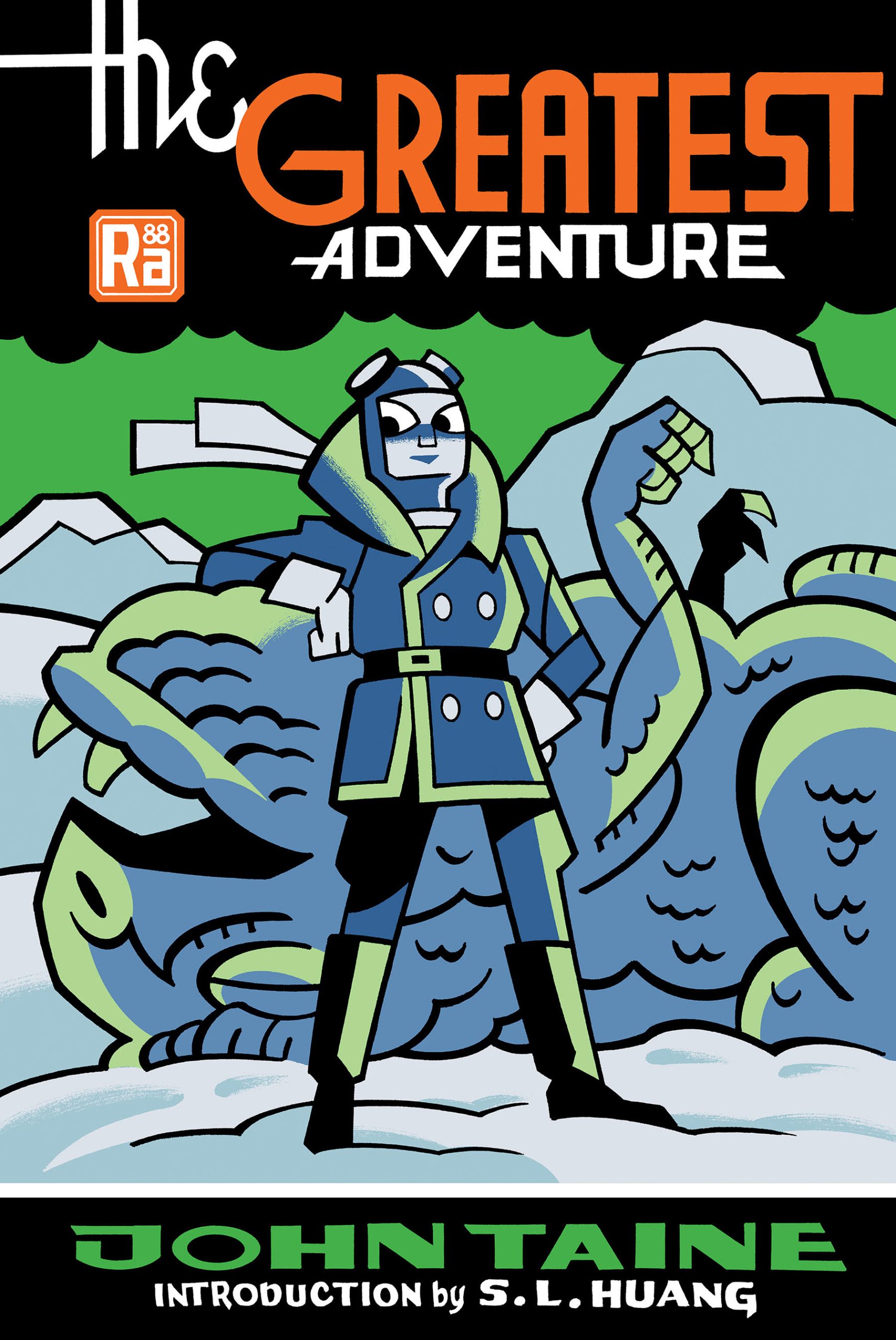
Intrepid aviatrix Edith Lane and her explorer companions discover remnants of an elder race… in Antarctica! Can they set things right before mutated life-forms, both animal and vegetal, run amok and threaten the planet? The Greatest Adventure is a tale of horror by John Taine — the pseudonym of mathematician Eric Temple Bell — that is not without moments of humor.
“The Greatest Adventure is both a rousing adventure and a pioneering work of environmental fiction reflecting concerns over extractivism, the role of science in warfare, and the future of scientific inquiry.” — Siobhan Maria Carroll
“Anyone who has enjoyed [Arthur Conan Doyle’s Lost World] will be amply rewarded by reading Taine’s The Greatest Adventure. Mr. Taine’s splendid imagination has given us quite a number of wonderful books.” — Amazing Stories (September 1929)
“A mixture of H. Rider Haggard, Conan Doyle, Roy Chapman Andrews, and a bottle of excellent gin.” — California Tech (1929)
“Generally considered one of John Taine’s better novels. Because of the strong theme and Taine’s known worrying about genetic engineering, perhaps intended as a cautionary tale as well as an adventure.” — Everett F. Bleiler, Science-Fiction: The Early Years.
Press for MITP’s edition of The Greatest Adventure includes the following…
“What makes the Radium Age series so valuable is how it illuminates the origins of science fiction tropes we take for granted. The Greatest Adventure reveals the literary DNA of Lovecraft’s cosmic horror.” — Mark Frauenfelder, Boing Boing
“When mathematician Eric Temple Bell wasn’t writing nonfiction under his given name, he was exploring the world of science fiction under the pseudonym of John Taine. A new edition of Taine’s novel The Greatest Adventure revisits this tale of genetic engineering gone overboard in Antarctica; S.L. Huang wrote the introduction.” — Reactor
ERIC TEMPLE BELL (1883–1960) was a mathematician who taught at the California Institute of Technology. The eponym of Bell polynomials and Bell numbers of combinatorics, his 1937 book Men of Mathematics would help to inspire Julia Robinson, John Forbes Nash Jr., Andrew Wiles, and other future mathematicians. Writing as “John Taine,” he published many proto-sf novels, several of which — including 1929’s The Greatest Adventure — involve scientifically precipitated, yet out-of-control evolution.
S.L. HUANG is a Hugo-winning, bestselling author who justifies an MIT degree by using it to write eccentric mathematical superhero fiction. Huang is the author of the Cas Russell novels from Tor Books, including Zero Sum Game, Null Set, and Critical Point, as well as the new fantasies Burning Roses and The Water Outlaws. Huang’s stories have appeared in Analog, F&SF, Nature, and elsewhere. Huang is also a Hollywood stunt performer and firearms expert, with credits including Battlestar Galactica and Top Shot.
Originally published in 1929. Cover illustrated and designed by Seth. See this book at The MIT Press.
SUPERHUMANS OF THE RADIUM AGE
Edited & Introduced by JOSHUA GLENN
(August 19, 2025)
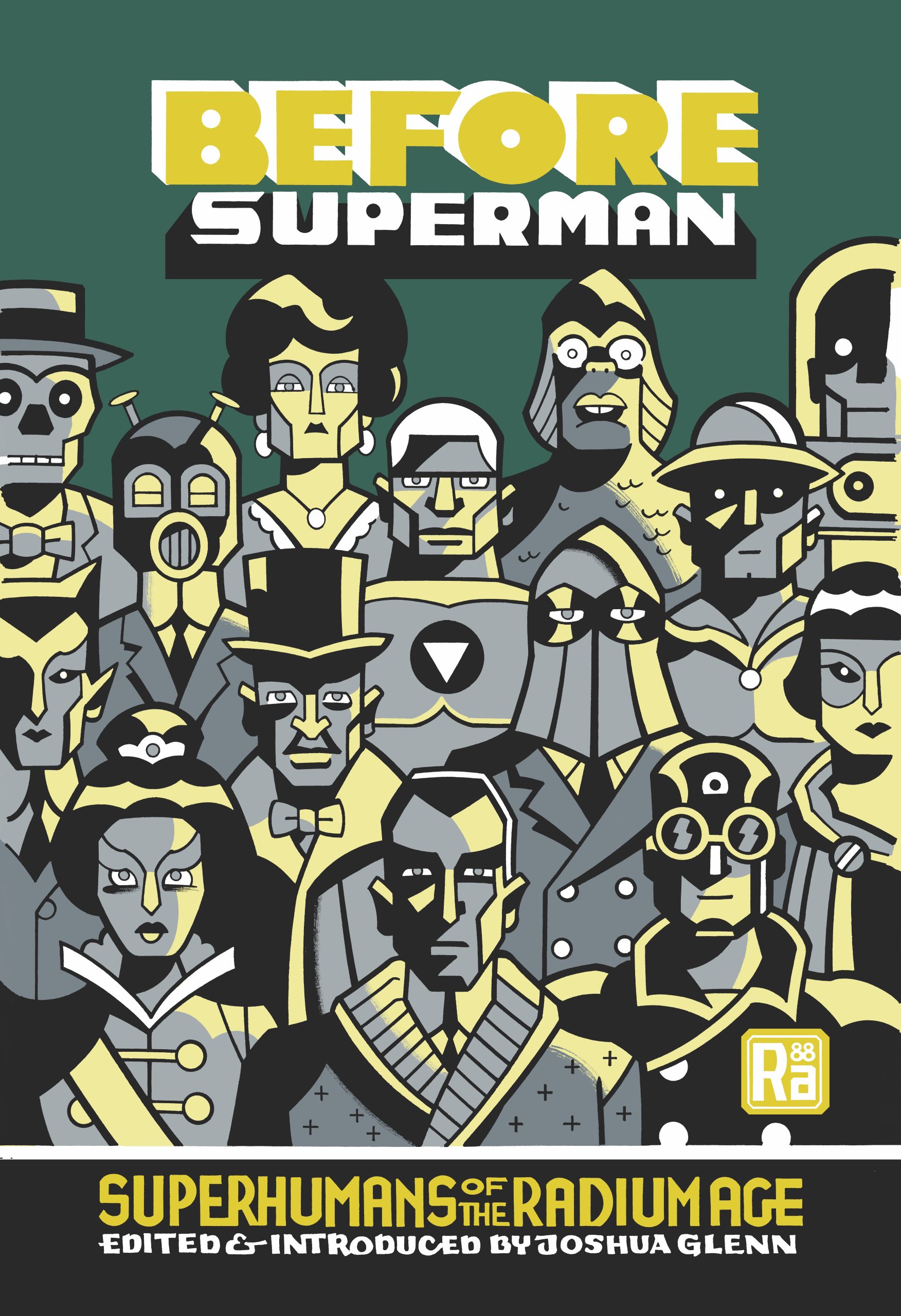
Introducing the weird and wonderful ancestors of today’s comic-book and cinematic superheroes….
Science-fictional narratives about superhumans — humans who’ve evolved into creatures stronger, smarter, and more gifted than we have any reason to be — first showed up during the genre’s emergent Radium Age. Originally published between 1902 and 1928, the stories and excerpts anthologized by Joshua Glenn feature the likes of Thomas Dunbar, one of the first lab-created superhumans — dreamed up by a teenaged Gertrude Barrows, later well-known to sf fans as “Francis Stevens.” Thanks to George Bernard Shaw and H. Rider Haggard, meanwhile, we’ll make the acquaintance of Zoo and Yva — superwomen who contemplate the extermination of us mere mortals. Alfred Jarry’s André Marcueil, a scientist who develops a super-sexual capacity, is punished for this transgression; and Marie Corelli’s Young Diana, having been rendered super-alluring via a rejuvenation experiment, seeks revenge on a sexist society.
Hugo Gernsback gives us Ralph 124C 41+, a benevolent super-genius inventor who dwells atop a New York skyscraper. But M.P. Shiel tells the story of Hannibal Lepsius, a homeschooled prodigy turned amoral tech-bro; and Karel Čapek gives us Rudy Marek, an inventor who, having developed wonder-working powers, wonders whether civilization will survive his latest invention. Thea von Harbou’s genius scientist, Rotwang, is even less conscientious in his scheming; as is Arthur Conan Doyle’s ever-irascible Professor Challenger, here in one of his final outings. Finally, Jean de La Hire’s Nyctalope, a popular French super-powered crimefighter character, makes an appearance; and so does Edgar Rice Burroughs’s Tarzan of the Apes… though reduced to miniature size.
Radium Age superhumans… assemble!
“The tales collected here by Joshua Glenn offer a rich origin story for the ‘superhuman,’ a sci-fi trope that would go on to launch a million comic books… and which, in our era of the more-than-human AI, is a prescient one.” — Ann Nocenti, Marvel and DC comic book writer
Press for Before Superman includes the following…
“What are the modern-day equivalent to the heroes of myth and legend? For some, the answer is superheroes.” — from Reactor’s list of Can’t Miss Indie Press Speculative Fiction for July and August 2025.
“Examining the ways that humanity could be transformed in all sorts of terrifying ways. I’m looking forward to digging into this one.” — Transfer Orbit
“Provides essential background on the rise to dominance of superhumans in pop culture.” — Toronto Star
“A smart selection of various types of authors (well-know, lesser known, sometimes almost forgotten, some also translated from the French or the German) as well as a cunning mix of independent short stories and fragments of larger novels. […] Before Superman is a joyful as well as thought-provoking volume of an excellent series, insightfully presented by Joshua Glenn. The book is of great interest for all SF lovers but also to all literary and cultural historians, who can only feel encouraged to rethink some of their labels and periodization tools.” — Jan Baetens, for Leonardo Reviews
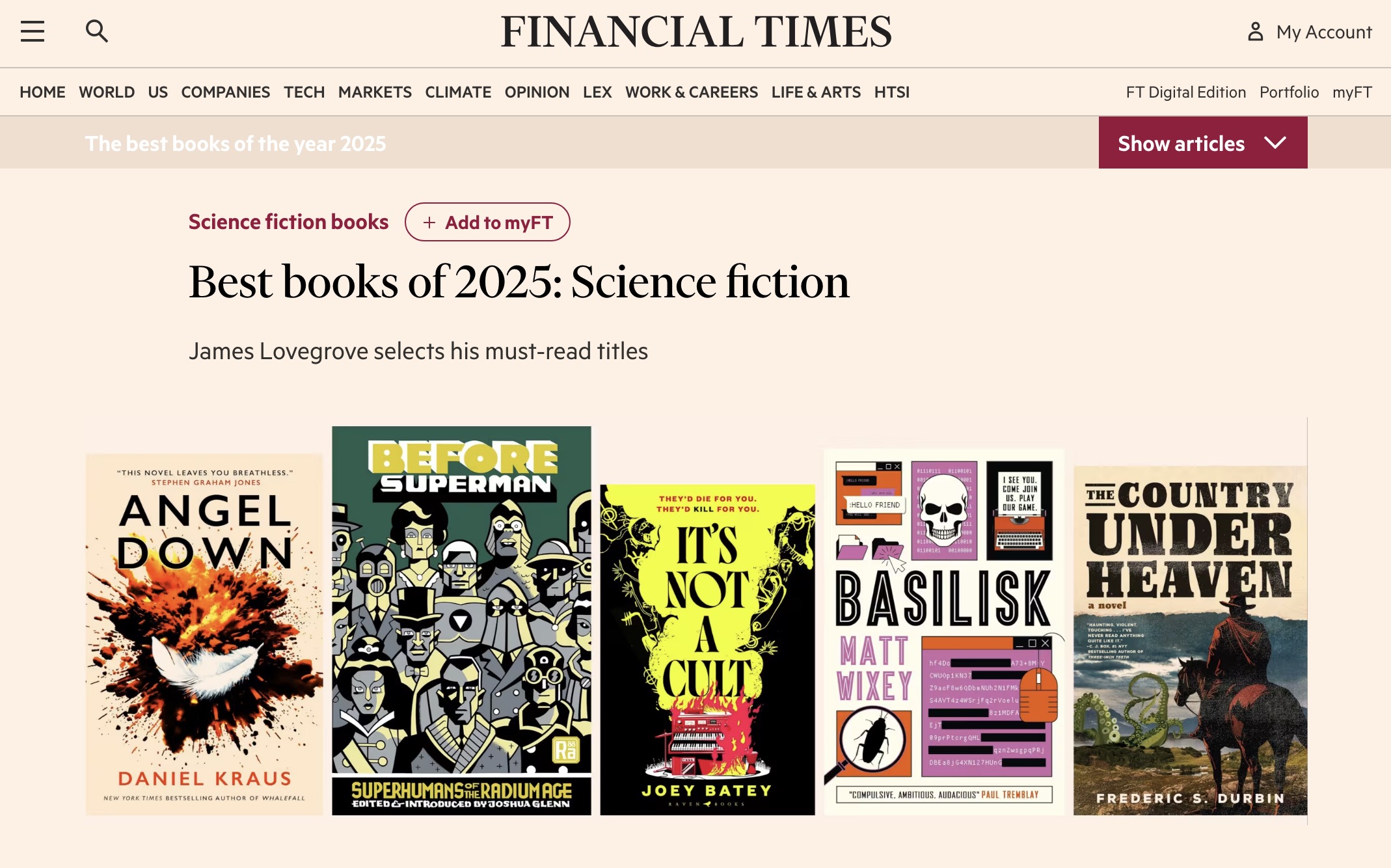
“Stories about superhumans from an era before they achieved comic-book ubiquity…. Sheer retro bliss, no spandex.” — James Lovegrove for the Financial Times, Five Best SF Books of 2025.
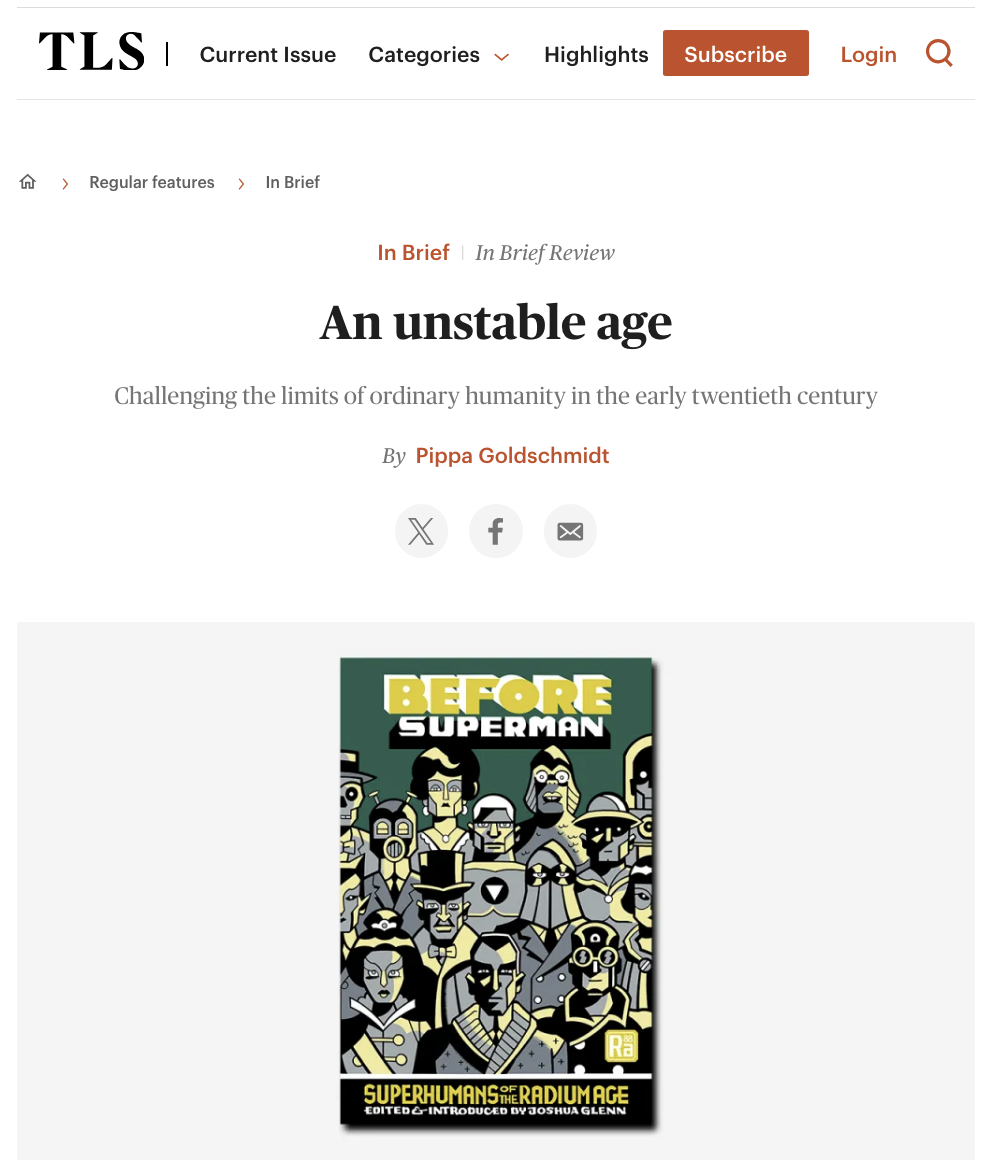
“As in so much speculative fiction set in imagined futures, these superhumans shed a light on the age in which they were conceived. Rather than strengths, they reveal its anxieties and preoccupations.” — Pippa Goldschmidt, Times Literary Supplement
JOSHUA GLENN is a consulting semiotician and editor of the websites HiLobrow and Semiovox. The first to describe 1900–1935 as science fiction’s “Radium Age,” he is editor of the MIT Press’s series of reissued proto-sf stories from that period. He is coauthor and co-editor of various books including, most recently, Lost Objects (2022).
EDGAR RICE BURROUGHS is best known for his stories featuring Tarzan of the Apes, one of fiction’s all-time most successful characters. He was also a prolific proto-sf author whose popular Barsoom series, beginning with A Princess of Mars (1912/1917), would prove influential on science fiction’s planetary romance subgenre.
KAREL ČAPEK (1890–1938) was a Czech litterateur and anti-totalitarian absurdist who achieved his most memorable effects when working in a science-fictional mode. He is best known for his 1921 proto-sf play, R.U.R.: Rossum’s Universal Robots, and his novels The Absolute at Large (1922), Krakatit (1924), and War with the Newts (1936).
MARIE CORELLI (Mary Mackay, 1855–1924) wrote popular bestsellers, many of which featured sf elements (interstellar travel, advanced technology), and all of which aimed to reconcile Christian teachings with Western esotericism. In addition to The Young Diana (1918), her Radium Age proto-sf writing includes the novel The Secret Power (1921).
ARTHUR CONAN DOYLE (1859–1930) was a Scottish physician and author who in 1887 introduced Sherlock Holmes, arguably the best-known fictional detective. Doyle’s proto-sf series of Professor Challenger adventures include The Lost World (1912) and The Poison Belt (1913); both have been reissued in a single volume by The MIT Press.
HUGO GERNSBACK (1884–1967) was an American editor and magazine publisher. Amog his publications—which gave E.E. “Doc” Smith, Fletcher Pratt, Edmond Hamilton, Jack Williamson, and others their start—was the pioneering sf magazine, Amazing Stories, as well as Wonder Stories. It was Gernsback who popularized the term “science fiction.”
H. RIDER HAGGARD (1856–1925) was an English author known for adventure fiction and science-fantasy romances set in exotic locations, predominantly Africa. Considered a pioneer of the Lost World subgenre, he is best remembered for King Solomon’s Mines (1885), She (1886–1887), and these novels’ various sequels, prequels, and crossovers.
THEA VON HARBOU (1888–1954) was a German writer best known for the screenplays she developed with director Fritz Lang. Lang’s Metropolis (1927) and Harbou’s 1925 novelization were written simultaneously; she also collaborated with Lang on the proto-sf films The Girl in the Moon (1929) and The Testament of Dr. Mabuse (1933).
ALFRED JARRY (1873–1907) was a French absurdist writer and philosopher best known for the play Ubu roi (1896) and its sequels, and for his development of the mock-science of ’pataphysics, which he’d adumbrate entertainingly via Gestes et opinions du docteur Faustroll, pataphysicien (1911). His most science-fictional work is Le surmâle (1901).
JEAN DE LA HIRE (Adolphe d’Espie, 1878–1956) was a prolific French author of popular fiction. His works of proto-sf interest include La Roue Fulgurante (1908) and L’Europe future (1916). He is best known for the proto-superhero Nyctalope sequence, seventeen stories in all—from Le Mystère des XV (1911) to L’Énigme du Squelette (1955).
GEORGE BERNARD SHAW (1856–1950) was an Irish-born playwright, critic, and political activist who espoused utopian socialism and “creative evolution” (via eugenics). In addition to his proto-sf play Back to Methuselah: A Metabiological Pentateuch (1921), his works of sf interest include Man and Superman (1903) and Buoyant Billions (1948).
M.P. SHIEL (1865–1947) was a Montserrat-born British writer whose proto-sf works include The Purple Cloud (1901), The Lord of the Sea (1901), The Last Miracle (1906), The Isle of Lies (1909), and The Young Men Are Coming! (1937). He has received attention as a writer of partial Black ancestry, and as a novelist of Caribbean origin.
FRANCIS STEVENS (Gertrude Barrows Bennett, 1884–1948) was the first American woman to publish widely in fantasy and science fiction; she was an important influence on A. Merritt and others. Her proto-sf novel The Heads of Cerberus (1919) and several proto-sf stories were reissued by The MIT Press in a collection edited by Lisa Yaszek.
Originally published 1902–1928. Cover illustrated and designed by Seth. See this book at The MIT Press.
MARIETTA S. SHAGINYAN
Translated & Introduced by JILL ROESE
(August 19, 2025)
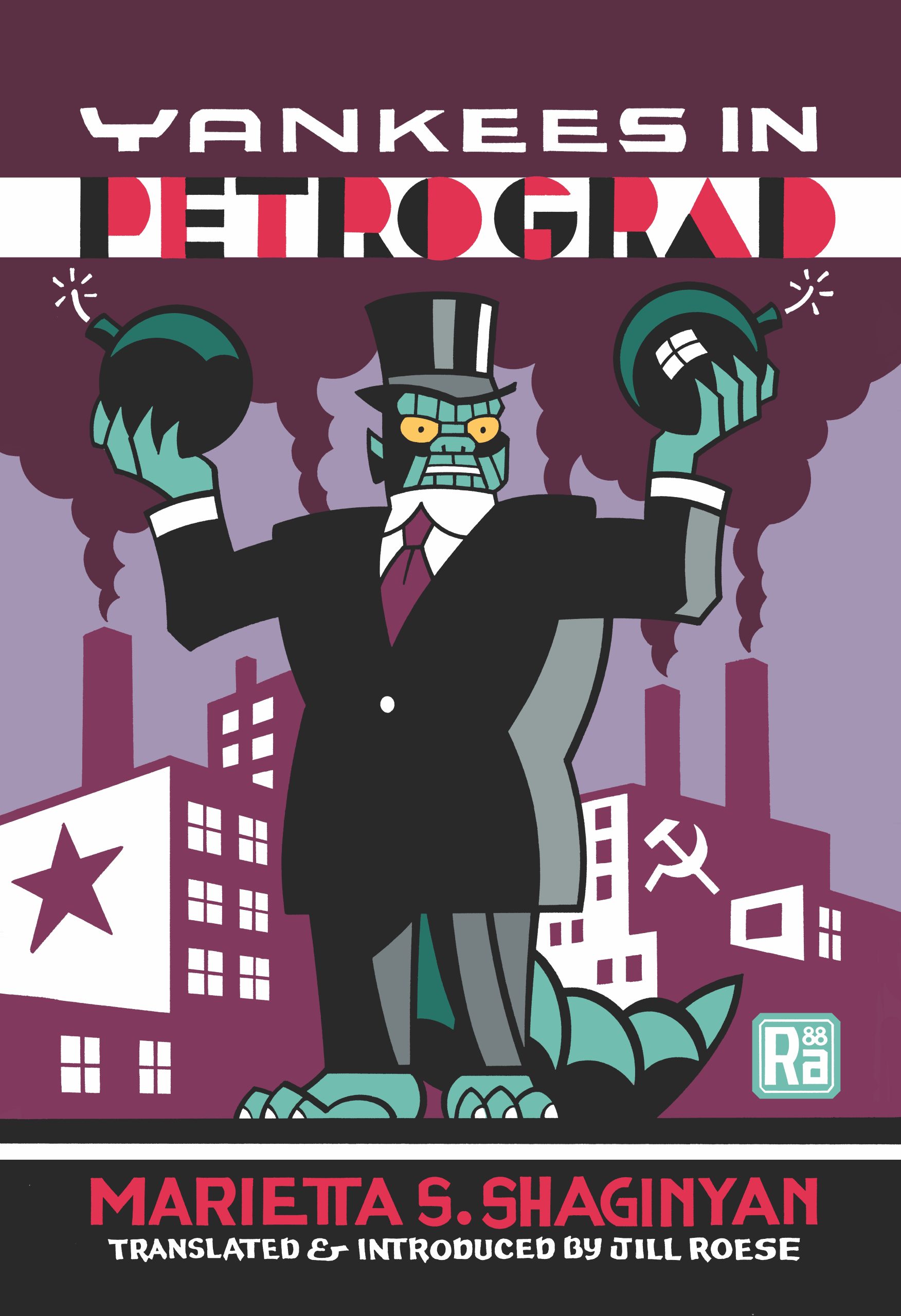
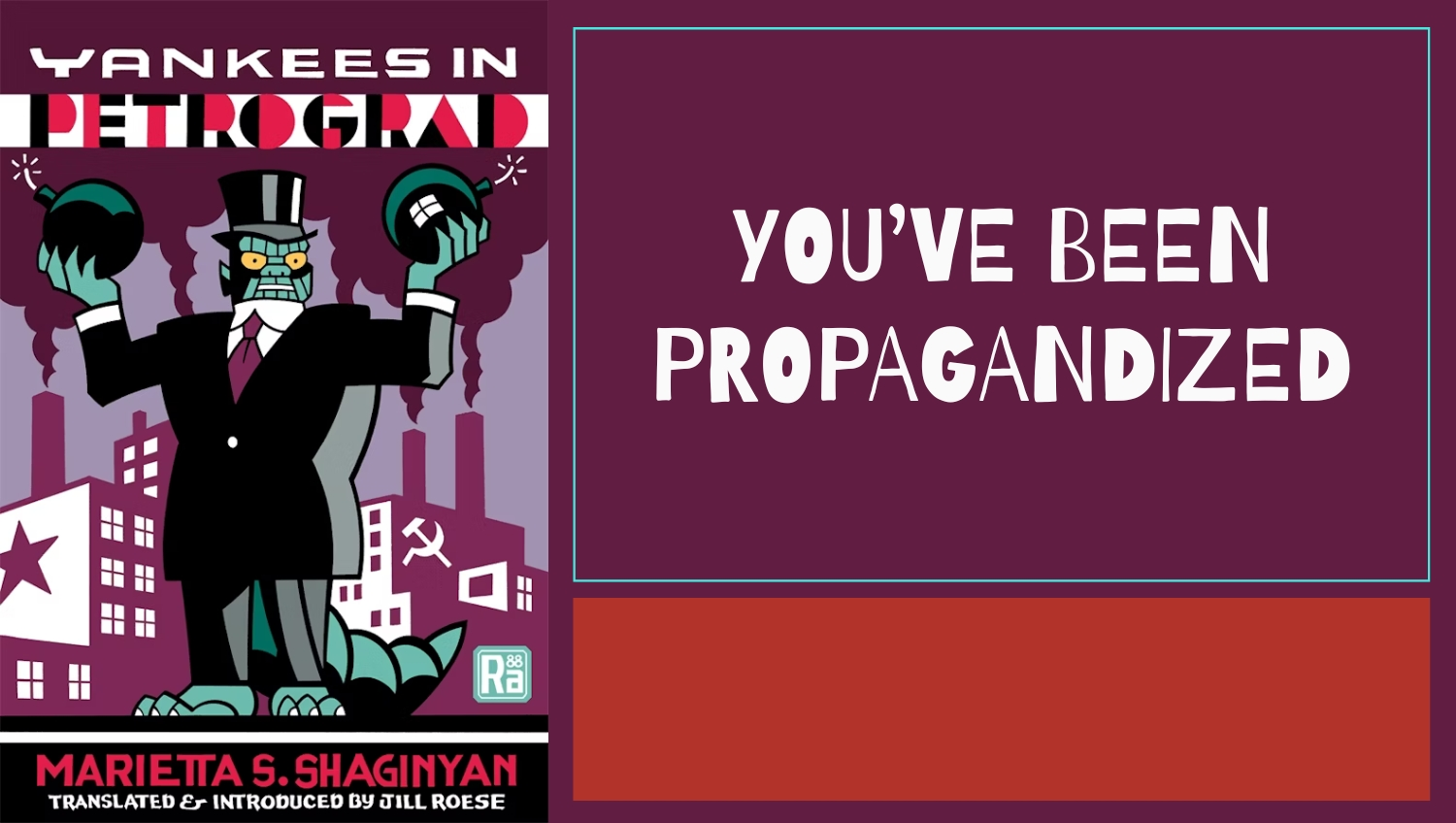
When a capitalist cabal plots to assassinate Lenin, can quick-witted American workers ride to the rescue before it’s too late?
In Yankees in Petrograd, the Russian author Marietta S. Shaginyan (writing under the American nom de plume “Jim Dollar”) gives us a crime/espionage adventure with science fiction elements… including Petrograd’s spacetime-bending public transportation and electrical forcefields protecting Soviet Russia against its foes. Despite these awesome technologies, the world’s first proletarian state is threatened by a fascist organization that will stop at nothing — including kidnapping, mesmerism, and infiltration — to assassinate Vladimir Lenin and his fellow Communist leaders! Enter Mike Thingsmaster, American tradesman and leader of a secret global organization defending the interests of the proletariat, who tasks his network with foiling this nefarious plot.
Shaginyan’s novel, serialized in 1924 with covers decorated by Alexander Rodchenko’s photomontages, proved wildly popular with the Soviet reading public, which followed its dizzying plot breathlessly. Settings constantly shift and characters assume multiple identities; scenes of danger, intrigue, and melodrama are interspersed with moments of comic relief. Can Thingsmaster and his allies — including a robber baron’s scion who converts to the cause of Revolution, an alluring masked woman, a doctor investigating a disease that causes fierce anti-communists to revert to proto-human form, a chimney sweep, an intelligent dog, and the General Prosecutor of Illinois — succeed in thwarting the fascists? You’ll have to wait until the final chapter to find out.
A satire of the sort of thrillers then appearing in Black Mask and similar American pulps, Yankees in Petrograd is an over-the-top, pro-communist thrill ride.
“A novel of our time, in which major events succeed each other with purely cinematographic speed… In Jim Dollar’s novel we see nothing but action.” — Nikolai Meshcheryakov, “Foreword to the First Edition” (1924)
“Marietta Shaginyan’s Yankees in Petrograd is a time capsule — a rollicking, mixed-genre, socialist antidote to Ayn Rand. It’s great to have it in this new edition.” — Keith Gessen
Press for MITP’s edition of Yankees in Petrograd includes the following…
“The fight between cartoonish commies and vaudeville villains makes for good satire. Laughing, you try to imagine the reactions of the novel’s first readers. Theirs must have been the laughter of the victors. The Soviet experiment may eventually have failed, yet it started on a wave of joyous enthusiasm.” — Times Literary Supplement
“Yankees in Petrograd shows us both the promises and the failures of the Soviet project: the dream of a liberated future and the enduring force of racism, sexism, and other systems of oppression even under socialism.” — Ancillary Review of Books.
JILL ROESE is author of the Marietta S. Shaginyan entry in the Dictionary of Literary Biography. Her translation of Shaginyan’s 1931 Soviet production novel Gidrotsentral’ (Hydrocentral) into English is in progresss. Her academic interests also include Soviet prose of the 1920s-30s. An independent scholar, she received her doctorate in Slavic Languages from Columbia in 2017.
MARIETTA S. SHAGINYAN (1888–1982) was a pre-revolutionary and Soviet-era writer whose career spanned eight decades and nearly 80 books. She enjoyed close friendships with Russian luminaries of her day, including Viktor Shklovsky and Sergei Rachmaninoff. She is best known for Orientalia (1913), a collection of poetry; the proto-sf Soviet detective series collectively titled Mess—Mend, including Yankees in Petrograd (1924), published under the American-style pseudonym “Jim Dollar”; and a four-volume work (1959–1974) on the life and family of Lenin.
Originally published 1924. Cover illustrated and designed by Seth. See this book at The MIT Press.
Here at HILOBROW, during 2025 Josh continued to share his Radium Age-related research. For example…
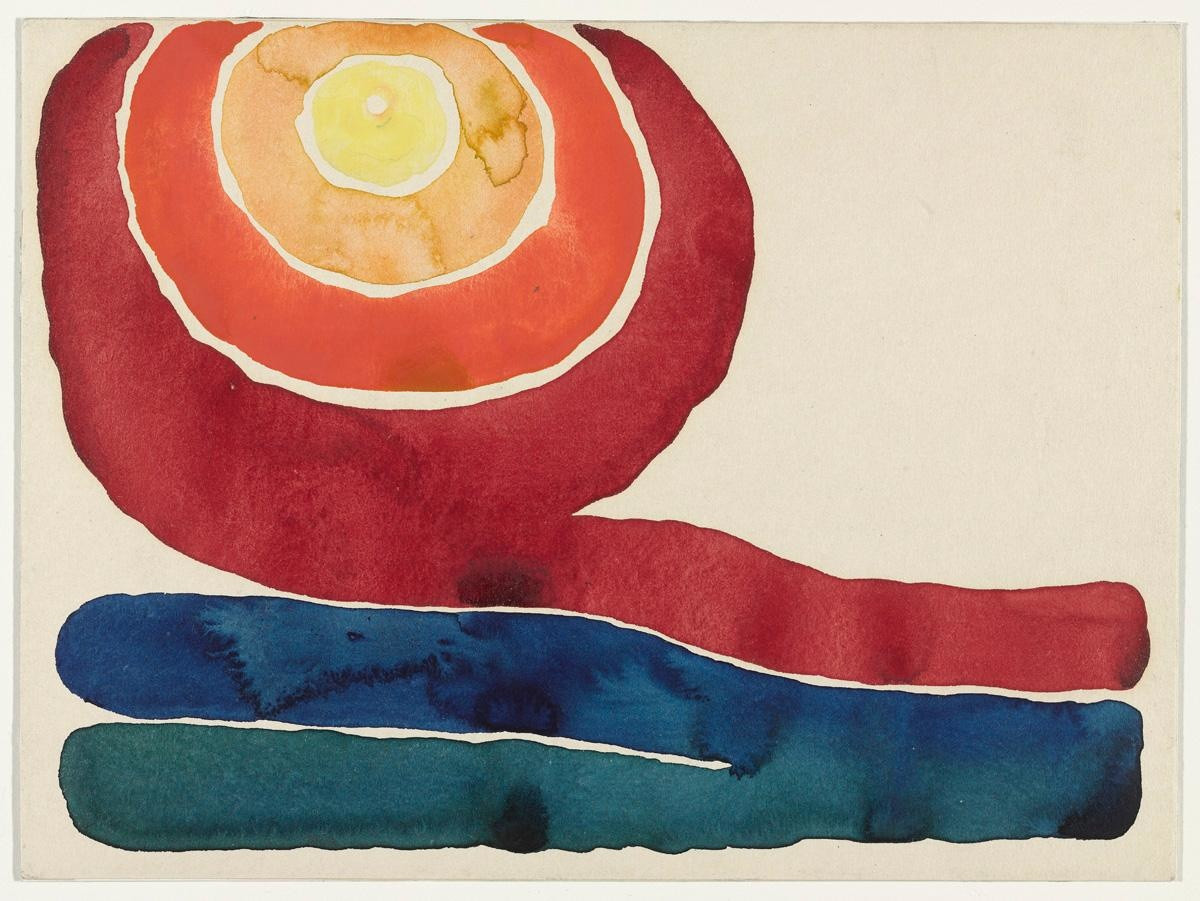
HILOBROW published further installments in the series RADIUM AGE POETRY. Here’s a sampling of the 2025 lineup:
Valery Bryusov’s THE VOICE OF OTHER WORLDS | Olaf Stapledon’s “IF MAN ENCOUNTER…” | Maurice N. Corbett’s BLACK KINGDOMS OF THE FUTURE | Zinaida Gippius’s ELECTRICITY | Álvaro de Campos (Fernando Pessoa)’s TIME’S PASSAGE | Archibald MacLeish’s THE END OF THE WORLD | Hirato Renkichi’s MACHINE | Conrad Aiken’s MORNING SONG OF SENLIN | Hart Crane’s TO BROOKLYN BRIDGE | Farfa’s THE MECHANICAL TRIANGLE | Kochia Tseng’s FIRE IN THE SKY | Angela Weld Grimké’s TENEBRIS | Mykola Bazhan’s AERO-MARCH.
Josh has surfaced ~470 proto-sf-adjacent poems thus far, and published ~200 of them here at HILOBROW. To see the RADIUM AGE POETRY lineup, organized thematically, please visit this page.
Here at HILOBROW, as we have been doing for a decade now, during 2025 we serialized some of Josh’s favorite Radium Age proto-sf stories and novels. Here’s the 2025 lineup:
- Joseph Conrad and Ford Madox Ford’s The Inheritors (1901)
- Naomi Mitchison’s “The Goat: Cardiff, A.D. 1935” (1929)
- Frank L. Pollock’s “The Skyscraper in B Flat” (1904)
- Christopher Blayre’s “Aalila” (1921)
- George S. Schuyler’s Black No More (excerpt, 1931)
- Algernon Blackwood’s “Playing Catch” (1924)
- Robert Gilbert Wells’ Anthropology Applied to the American White Man and Negro (1905, excerpt)
- W.E.B. Du Bois’ “Princess Steel” (1908–10, excerpt)
- Noëlle Roger’s The New Adam (1926, excerpt), trans. Josh Glenn
- Lillian B. Jones’ Five Generations Hence (1916, excerpt)
- Leslie F. Stone’s “The Fall of Mercury” (1935)
- Leopoldo Lugones’ “Yzur” (1906)
- Alfred Jarry’s The Supermale (1902), excerpt, trans. Josh Glenn
- Fernande Blaze de Bury’s The Storm of London (1904), excerpt
- Marita Bonner’s The Purple Flower (1928)
Here’s a sampling of 2025 series publicity:
- In February, The Inhumans was longlisted for the British Science Fiction Awards’ Best Collection award.
- The March 2025 issue of Locus included Niall Harrison’s review of the MIT Press’s edition of The Hampdenshire Wonder. “One of the earliest exemplars in SF of the genius unbound, the more-than-human intellect whose insights are sublime and terrible. The Wonder, as the child is primarily known, devours entire libraries of philosophy and science, eventually expounding a theory-of-everything that (of course) cannot be recreated on the page, but implies what [Ted] Chiang calls (brilliantly) in his introduction a kind of “cognitive heat death,” a point beyond which learning, and perhaps therefore living, becomes irrelevant.”
- In March, Ted Chiang’s introduction to The Hampdenshire Wonder was published by Literary Hub. Excerpt: “Not only does Victor Stott frighten the ignorant and superstitious, he induces a profound terror in the educated and intellectual. Seen in this light, the first novel about superintelligence is actually a work of horror SF, a cautionary tale about the dangers of knowing too much.”
- On May 2, the 2025 Locus Awards top ten finalists were announced. The Radium Age series’ The Inhumans and Other Stories: A Selection of Bengali Science Fiction (Bodhisattva Chattopadhyay, trans. and ed.), was announced as a top ten finalist in the Anthology category. Very cool!
- In June Strange Horizons published a review of the MIT Press’s edition of J.D. Beresford’s The Hampdenshire Wonder. Excerpt: “This is another worthy reprint from the Radium Age team. Reading The Hampdenshire Wonder in a United States co-ruled by a neglectful father with his own fantasies about superhuman intelligence, I was struck by its quiet yet vivid strain of horror.”
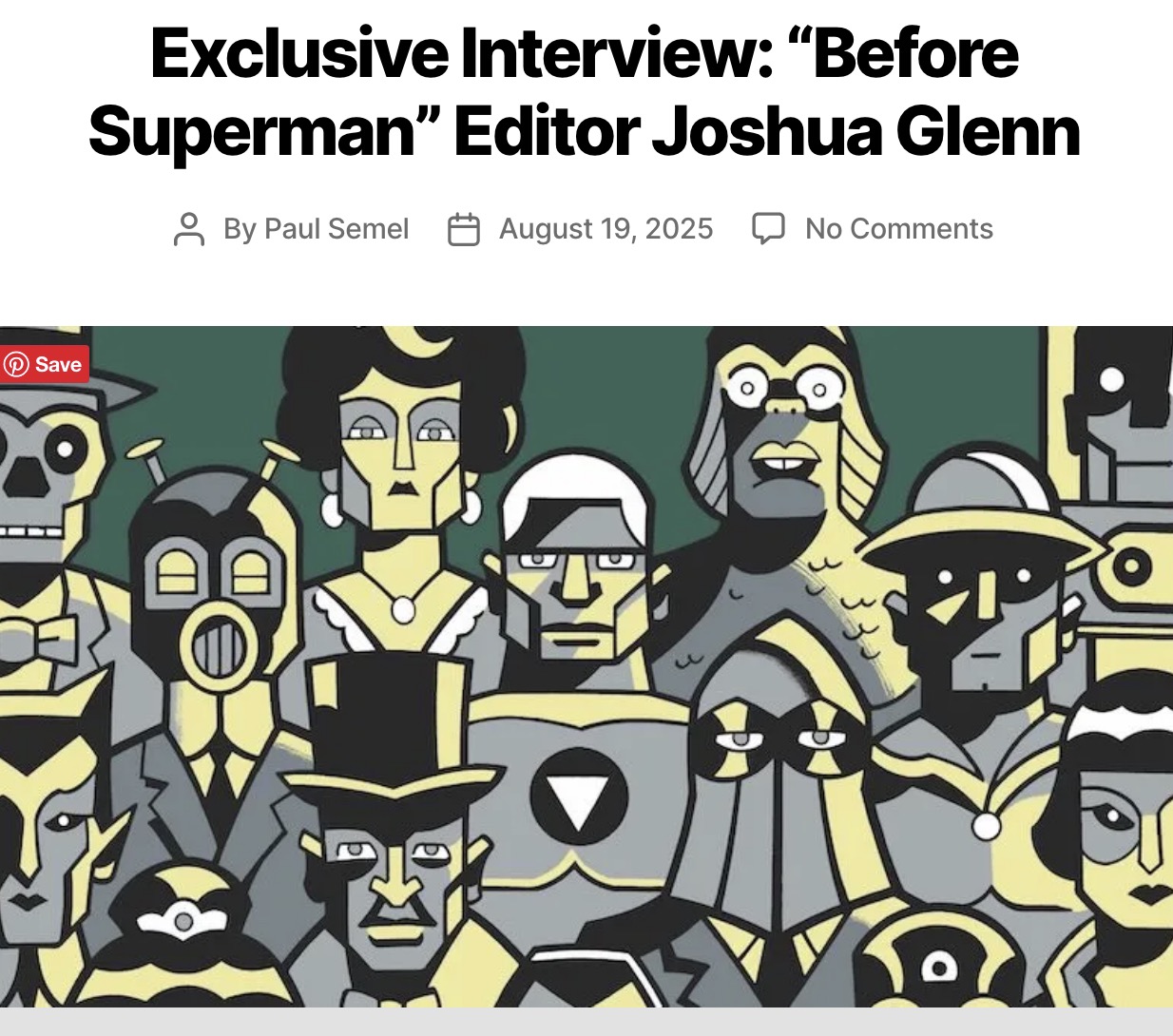
- I was interviewed by Paul Semel about Before Superman — the Q&A was posted on publication day, August 19th. Excerpt:
PAUL SEMEL: Do you think any of the stories in Before Superman could work as a comic book? Or a movie?
JOSH GLENN: These superhuman stories and others would make terrific comic books or movies. Perhaps only now is the world ready for Jarry’s André Marcueil, a Bruce Wayne-like gentleman scientist who trains his body to be superior to ordinary mortals… and who develops a super-sexual capacity.
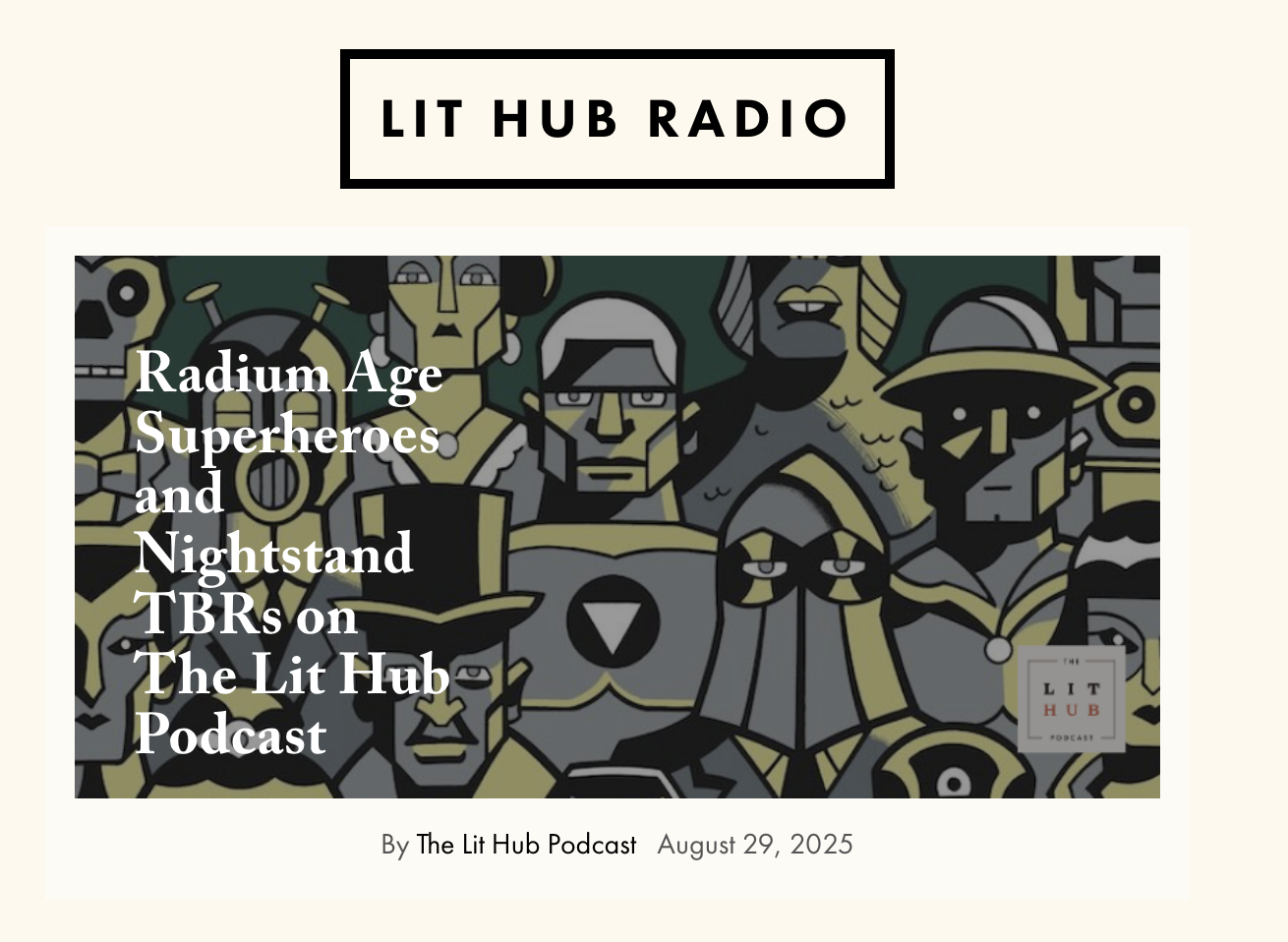
- For the August 29 episode of the Lit Hub Podcast, I was interviewed about the Before Superman anthology, and the Radium Age series in general, by host Drew Broussard.
- “Provides essential background on the rise to dominance of superhumans in our own pop culture.” — From a Toronto Star review of Before Superman.
- In October, Nat Harrington reviewed Jill Roese’s translation of Marietta S. Shaginyan’s Yankees in Petrograd for the Ancillary Review of Books. Excerpt:
Yankees in Petrograd shows us both the promises and the failures of the Soviet project: the dream of a liberated future and the enduring force of racism, sexism, and other systems of oppression even under socialism. If the novel fails to live up to its promise, it is, nonetheless, an engaging and, I think, productive failure, part of an attempt to create a new kind of popular culture, suitable to what its creators saw as a new historical era fighting to take shape—a popular culture oriented not only towards mass entertainment but also towards collective liberation.
- In October, writing in Leonardo Reviews, a peer-reviewed publication of the international arts, sciences, and technology society Leonardo, the Belgian poet and cultural studies professor Jan Baetens reviewed Before Superman. Excerpts:
The originality of the [Radium Age] series is the result of a smart editorial policy, open to a wide range of styles, themes and voices, yet also focusing, as in the case of the present volume, on the anthological presentation of key characters, here that of the superhuman.
About Before Superman:
A smart selection of various types of authors (well-know, lesser known, sometimes almost forgotten, some also translated from the French or the German) as well as a cunning mix of independent short stories and fragments of larger novels.
And:
Before Superman is a joyful as well as thought-provoking volume of an excellent series, insightfully presented by Joshua Glenn. The book is of great interest for all SF lovers but also to all literary and cultural historians, who can only feel encouraged to rethink some of their labels and periodization tools.
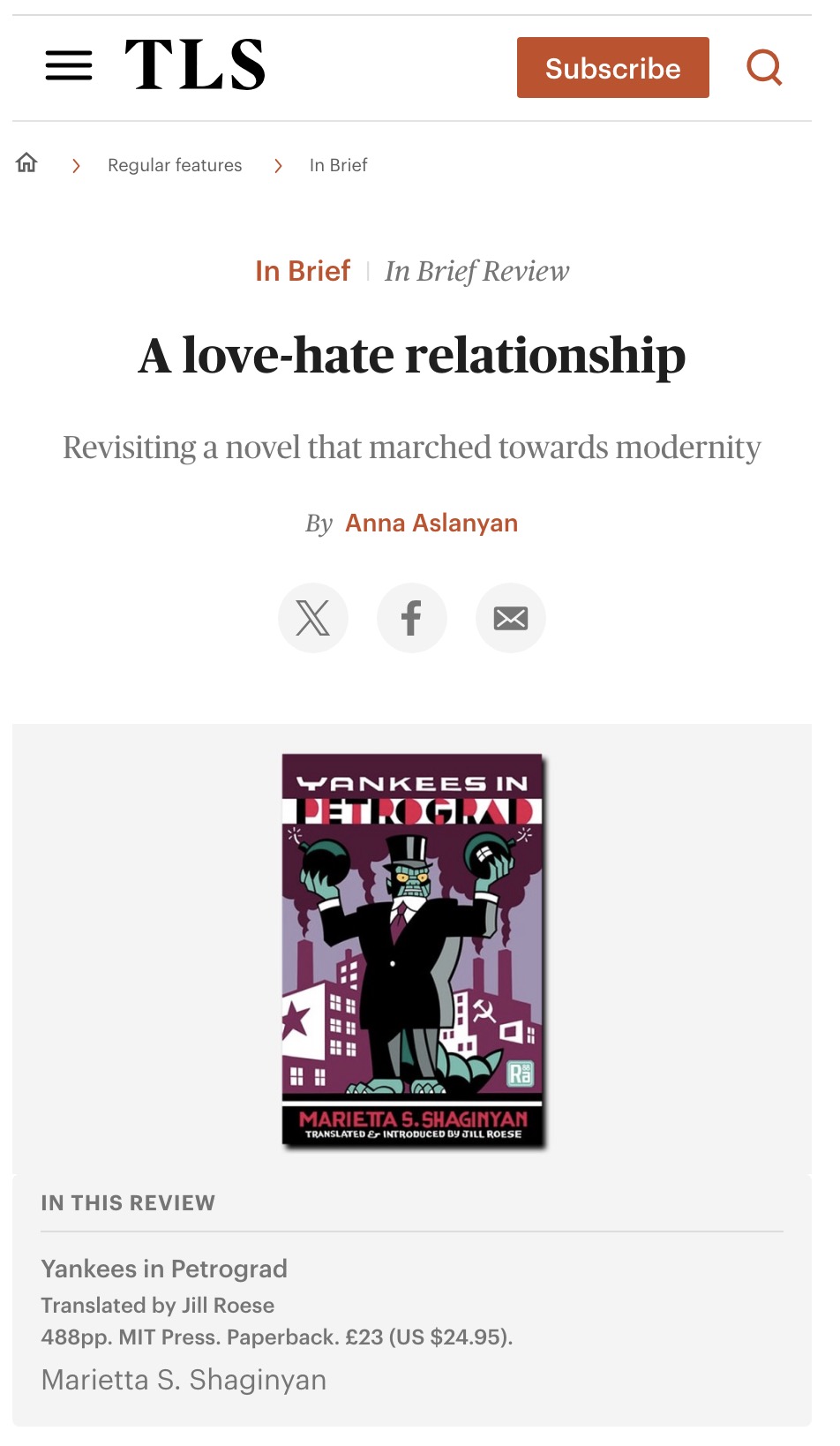
- Anna Aslanyan reviewed Jill Roese’s translation of Marietta S. Shaginyan’s Yankees in Petrograd for the November 14th edition of the Times Literary Supplement. Excerpt:
What to put in a novel to make it a page-turner that would last a century? Here are some possible ingredients: a fast-rising body count; flashy sci-fi devices; “a hidden bomb of infernal contents” planted inside a clock (part of a fascist plot to destroy communism); narrative darting around from America to Russia and back again, propelled by technology; “all manner of cheerful objects… streaming into the world”. Militant masses marching to modernity.
Also:
The fight between cartoonish commies and vaudeville villains makes for good satire. Laughing, you try to imagine the reactions of the novel’s first readers. Theirs must have been the laughter of the victors. The Soviet experiment may eventually have failed, yet it started on a wave of joyous enthusiasm.
- In November, writing for the Financial Times, British sf author James Lovegrove named Before Superman: Superhumans of the Radium Age one of the Five Best SF Books of 2025. Excerpt:
Part of the Radium Age series — reissues and anthologies of early-20th-century science fiction in nattily designed paperback editions — Before Superman assembles stories about superhumans from an era before they achieved comic-book ubiquity. Authors represented include Arthur Conan Doyle, Edgar Rice Burroughs, Karel Čapek, even George Bernard Shaw. Sheer retro bliss, no spandex.
- In December, Before Superman: Superhumans of the Radium Age was reviewed in the Times Literary Supplement by Schrödinger’s Wife author Pippa Goldschmidt. Excerpt: “As in so much speculative fiction set in imagined futures, these superhumans shed a light on the age in which they were conceived. Rather than strengths, they reveal its anxieties and preoccupations.”
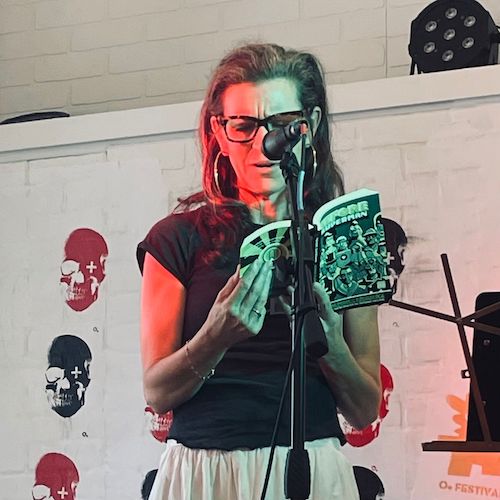
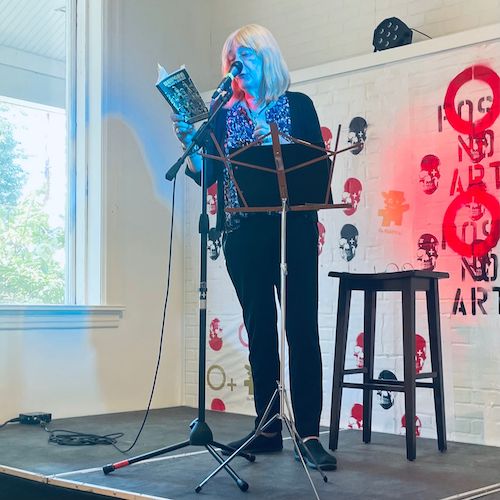
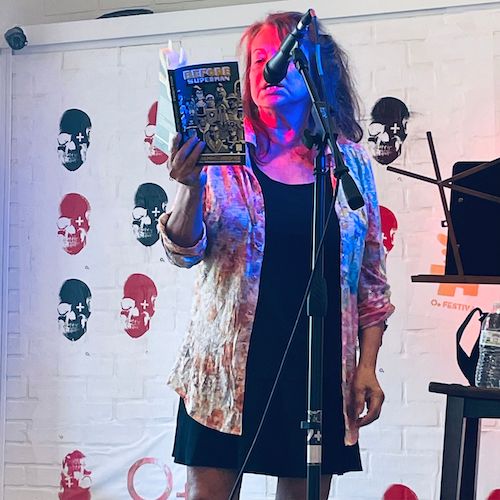
Emma Tourtelot, Lucy Sante, Annie Nocenti reading selections from Before Superman. Many thanks to the very talented readers (who also included Drew Broussard), audience, and Lindsey Wolkowicz for hosting the book’s launch event in the O+ Festival‘s lovely, brand-new venue in Kingston (NY). Thanks also to Rough Draft Books for organizing sales of the book.
On to 2026…
MORE RADIUM AGE SCI FI ON HILOBROW: RADIUM AGE SERIES from THE MIT PRESS: In-depth info on each book in the series; a sneak peek at what’s coming in the months ahead; the secret identity of the series’ advisory panel; and more. | RADIUM AGE: TIMELINE: Notes on proto-sf publications and related events from 1900–1935. | RADIUM AGE POETRY: Proto-sf and science-related poetry from 1900–1935. | RADIUM AGE ART: Proto-sf and science-related fine art from 1900–1935. | RADIUM AGE 100: A list (now somewhat outdated) of Josh’s 100 favorite proto-sf novels from the genre’s emergent Radium Age | SISTERS OF THE RADIUM AGE: A resource compiled by Lisa Yaszek.