
BROKEN KNOWLEDGE (19)
By:
December 22, 2025
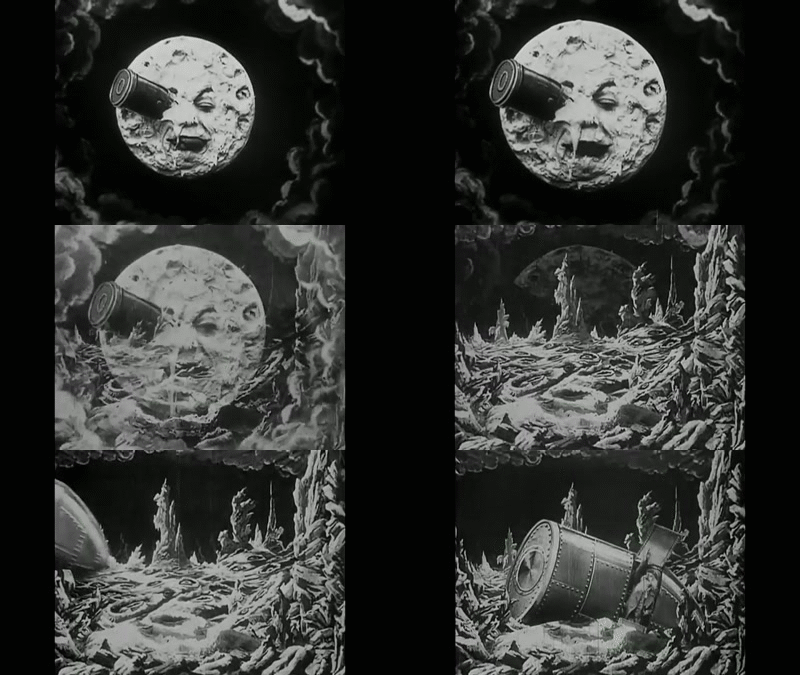
University of Toronto philosopher Mark Kingwell and HILOBROW‘s Josh Glenn are coauthors of The Idler’s Glossary (2008), The Wage Slave’s Glossary (2011), and The Adventurer’s Glossary (2021). In 2022, they engaged in an epistolary exchange about science fiction. Via the series BROKEN KNOWLEDGE, the title of which references Francis Bacon’s philosophy, HILOBROW is pleased to share a lightly edited version of their exchange with our readers. Also see Josh and Mark’s previous exchange 49th PARALLEL.
BROKEN KNOWLEDGE: FIRST CONTACT | WHAT IF? | A HYBRID GENRE | COUNTERFACTUALS | A HOT DILUTE SOUP | I’M A CYBORG | APOPHENIC-CURIOUS | AN AESTHETICS OF DIRT | PAGING DR. KRISTEVA | POLICING THE GENRE | FAMILIAR STRANGENESS | GAME OVER | THE WORLD VIEWED | DEFAMILIARIZATION | SINGULAR CREATURES | ALIEN ARCHAEOLOGIST | THE PHENOMENOLOGY OF SCREEN-TIME | HOMO SUPERIOR | EVERYTHING IS US.
21st November 2022
TORONTO
I’ve been thinking about the “coming home” part of adventure, and of course that is a rich topic — warriors return to unfamiliarity, displacement, even disgrace. One is never unchanged, and sometimes only a scar and a dog’s familiar greeting can vouchsafe who you are. I think in the case of my medical adventures, each return home has been a kind of return to the womb: my family, my cats, my art and books, my own bed. The bed is key. Modern hospital beds are marvels of technology, but they make me think of being in a business-class airplane seat, going nowhere. Plus, they wake you up at 6am every day to draw blood and it’s always cold. Hospitals make you sick, as many have noted — iatrogenic illness — but even just the sleep deprivation is a big net loss in human comfort.
Anyway, I’ve been home for ten days this time and my idea of a big adventure right now is going out to get my hair cut. (Side note: What are the significant haircuts in fiction and movies? Don DeLillo’s Cosmopolis comes to mind. Full Metal Jacket and G I Jane. Audrey Hepburn in Roman Holiday. Empire Records. Natural Born Killers. Most of them are shaved-head brutalisms or pixie-cut rebellions.)
One final thought about simulacral interior design. I’ve come to think of that future-nostalgia style as almost identical to Bond Villain Secret Lair Chic or Thunderbirds Are Go Hipster Pad. It’s a 1960s adolescent’s version of jet-set cool digs. Surely that’s why it’s so inescapable in airport lounges.
Last semi-random thought. I’m fascinated by the division between images of the superman as a kind of perfected athlete, maybe using tools from his utility belt or stored in his gyrocopter, and the big-headed superbrain alien. I think of those controlling zookeepers in the Star Trek pilot “The Menagerie,” later repurposed in the trial of Captain Christopher Pike. Back in the day we called those aliens, with their vein-twitching enlarged craniums, “butt-heads.” They could communicate via telepathy, project convincing illusions, and study captive humans like lab rats. Awesome! This episode with a different ST crew (Spock is the only overlapping officer) also illustrates a key feature of sf franchises like Star Trek: Captain Pike, who was barely present in the OS episodes, returns and recombines as played by, among others, Anson Mount and Bruce Greenwood. There are multiple timelines in play, not entirely resolved, despite such desperate efforts as having Captains Kirk and Picard appear in the same time-travel plot.
The supermen, meanwhile, are most uncanny when they evolve from us — you get that point fixed nicely in the proto- and early-sf books.Thus transhumanism is indeed the danger to watch (per philosopher Nick Bostrom and others) while posthumanism is, for me, the way forward. In fact it has always been the way: we invoke humanness, like naturalness, for specific ideological reasons. When and why we do this is itself an important political study. Nothing is natural until we make it so. Nothing is human except when we feel threatened in some way. Often the threat comes from within. We are our own alien butt-heads running a zoo of human specimens!
That’s why sf is so enduring and vivid a form, I think. Jameson has it right: there is a utopian element present in the self-estrangement of sf. But there is also, by the same token, a nightmare vision. There are no really alien aliens; everything is us. I recall writing about 1950s sf which was often interpreted as placing invading aliens in the place of invading Communists. But this interpretation is too simplistic. The invading Others are within us; they are identical, not antithetical. That’s why The Manchurian Candidate, say, is so excellent. The “brainwashing” looks external, but the internal brainwashing of McCarthysim, in the form of the Angela Lansbury and James Gregory characters — and their unexplained yet constant Abraham Lincoln motif — is the genuine threat to democracy. As we used to say when I wrote for Adbusters, nobody is more fooled than someone who pulls the wool over their own eyes.
So let’s say that sf, at its best, pulls that wool away again, at least partially and for a time. That’s why I return to it, I think. No other fictional form seems so dedicated to political reflection and revelation, except perhaps really savage social satire.
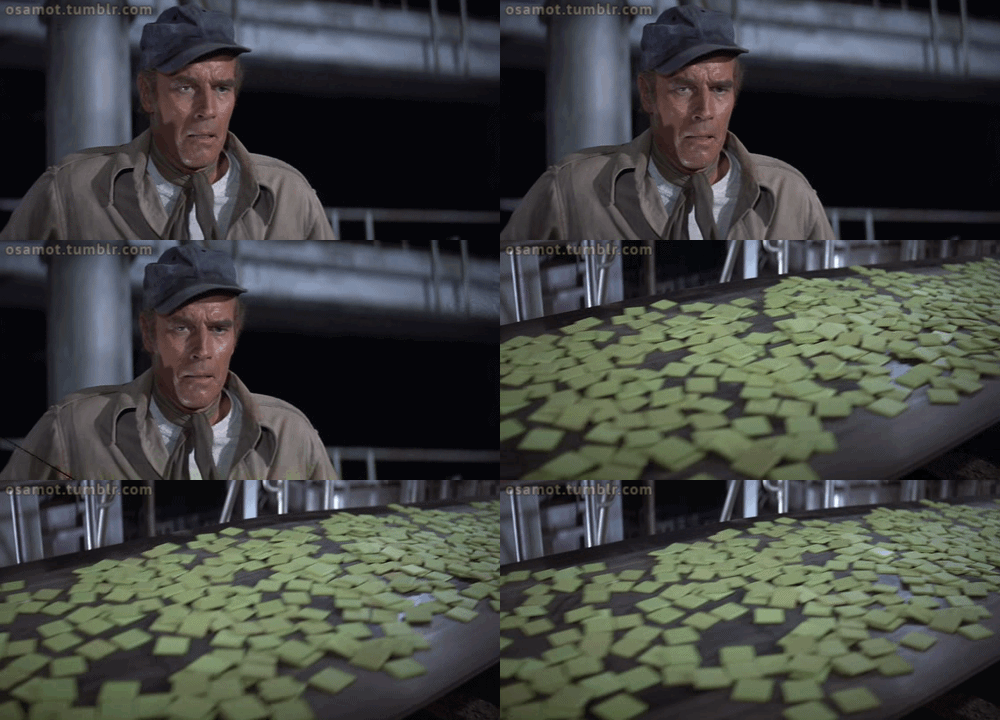
Oh yeah, I can’t ignore your final point. Yes, the cruel-to-be-kind super-dictator lurks everywhere here. I think these figures are most effective when they’re most plausible, especially in a sly way. Swift’s “modest proposal” is an excellent version. Look, there’s a famine problem and an overpopulation problem. Solution obvious, friends — let’s eat babies! I mean, it’s hard to argue with that logic without leaning pretty hard on a pretty flimsy notion of human value. That’s not sf by most people’s reckoning, maybe, but it’s no big jump to Soylent Green, which surely is.
I think what this shows, finally, is how precarious the liberal “humanist” norms really are. They require constant revision and defence. People refer to “democracy” all the time, to the point where it has become something like what Jennifer Egan called, in A Visit from the Goon Squad, a “word casing.” That’s happening now, hollowing out a much-invoked word, and it must be resisted if possible. But even more insidious might be what I argued is happening to humans, namely that we are becoming “person casings” because of, among other things, comprehensive immersion in media and technology. Is this self-alienation just a necessary evolutionary stage, or is it the end of something valuable we’ve been working on for several millennia? Maybe it’s both. My own sense is that philosophy of the correct (speculative) kind, and forms of writing like sf, are more likely to ask the right questions in the right way here than any other extant discourse. Whether they can offer useful answers is another matter!
Mark
ALSO SEE: Josh’s BEST 250 ADVENTURES of the 20th CENTURY list | Mark on BATTLESTAR GALACTICA and THE HONG KONG CAVALIERS | Mark and Josh’s exchange 49th PARALLEL.