
BROKEN KNOWLEDGE (16)
By:
December 9, 2025
University of Toronto philosopher Mark Kingwell and HILOBROW‘s Josh Glenn are coauthors of The Idler’s Glossary (2008), The Wage Slave’s Glossary (2011), and The Adventurer’s Glossary (2021). In 2022, they engaged in an epistolary exchange about science fiction. Via the series BROKEN KNOWLEDGE, the title of which references Francis Bacon’s philosophy, HILOBROW is pleased to share a lightly edited version of their exchange with our readers. Also see Josh and Mark’s previous exchange 49th PARALLEL.
BROKEN KNOWLEDGE: FIRST CONTACT | WHAT IF? | A HYBRID GENRE | COUNTERFACTUALS | A HOT DILUTE SOUP | I’M A CYBORG | APOPHENIC-CURIOUS | AN AESTHETICS OF DIRT | PAGING DR. KRISTEVA | POLICING THE GENRE | FAMILIAR STRANGENESS | GAME OVER | THE WORLD VIEWED | DEFAMILIARIZATION | SINGULAR CREATURES | ALIEN ARCHAEOLOGIST | THE PHENOMENOLOGY OF SCREEN-TIME | HOMO SUPERIOR | EVERYTHING IS US.
14th November, 2022
BOSTON
Rounding off our discussion of the uncanny in general (at least for now), with specific reference to robots and androids, I was first introduced to the topic by Baudrillard’s Simulacra and Simulation — the 1983 English translation from Semiotext(e), which I stumbled upon c. 1988. I recall being struck by Baudrillard’s deployment, in this treatise, of notions of “charm” and “magic/poetry.” The real is charming, he writes, and a concept of the real is magical — precisely because of the “sovereign” [unimpeachable, eternal] difference between the real and the concept. Likewise the territory is charming, while a map of the territory is poetic — again, because we can perceive that one is simulacrum, an abstraction and imitation, of the other. So the uncanny, “hyperreal” simulacrum that’s too similar to what it abstracts/imitates isn’t magical or poetic; we’re confronted with a charmless replacement of reality — one that is generated, perfect, unnatural, creepy. To me that seemed very French, the idea that our daily life absolutely must be in some way charming, and that our simulations should be magical/poetic — alluring, in one way or another. We efficiency-driven Americans have never internalized this lovely ideal. Have Canadians?
And I appreciate your point (maybe it’s Freud’s point? I forget) about why we abhor the uncanny — because we can’t face up to the slippage between what is objectively real vs. what is a cultural construct or a psychological complex in our own selves and lives. We paper over any such fissures, accept the resulting handiwork as natural, inevitable, eternal — just the way things are — and fiercely resist any efforts to question it.
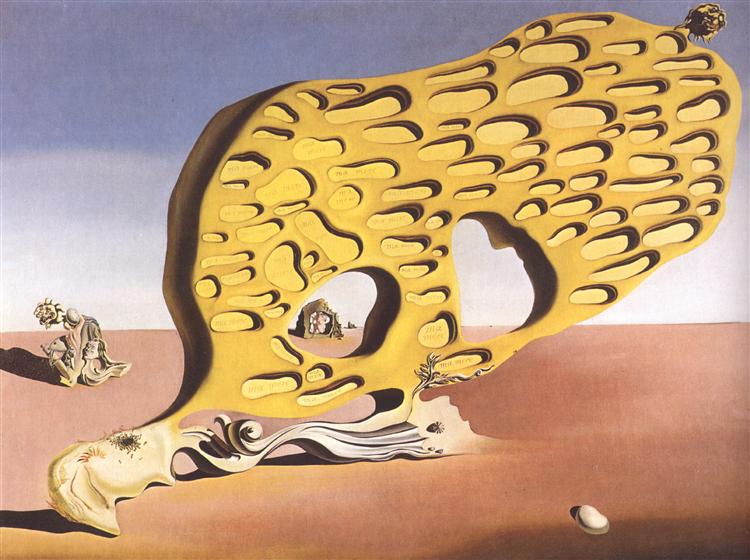
You’re right that we shouldn’t rush to judgment — on the aesthetic front — against AI image/art-generating programs. I mean, obviously I’m enjoying Midjourney. According to today’s /info query, since I started using it on July 24 (“elevated train winter Boston smoking” was my first prompt), I’ve generated 1687 images. However, I was expressing a creeped-out feeling that arose from my perception at just how truly alien an AI “consciousness” is. I suppose, though, that this is what the Surrealists were exploring too — shaking off inherited taboos about how we’re supposed to depict reality, releasing the unbridled imagination of the subconscious. Speaking of the Surrealists, a lot of uncanny Surrealist artwork produced in the 1920s and ’30s evokes Radium Age proto-sf, for me. The Futurists, too, of course.
Also appreciate your point about the flunky working in an artist’s studio — whether during the Renaissance or today. Who’s to say the resulting artwork isn’t “authentic”? But there’s an uncanny valley at work there, too — the more assembly-line the art gets, the less magical/poetical. One thinks of the works of art marketed under Robert Indiana’s name — when the artist was fully senile — by his caretaker, say. It’s perhaps better to deploy Baudrillard’s “charming/uncharming” rather than getting into vexed questions of “authenticity” (a topic we could discuss for another 20k words).
Thank you for the Cavell stuff — I have not read him, not even his Pursuits of Happiness, though that book discusses some of my favorite movies. When you say that the question for Heidegger and Cavell alike is “what do these figures tell us about the world beyond themselves, the world that created them and which they, in our spectation, they create?” I’m reminded of what I enjoy about Sarte, Husserl, and Barthes — all of whom have influenced my semiotics practice. In the great anecdote about the origins of existentialism, Sartre goes pale when Aron — who’d been studying Husserl and Heidegger in Berlin — suggests that a phenomenologist can “make philosophy” out of an apricot cocktail. (I may have read this story in your cocktail book.) Yes, the prospect of being an alien/future archaeologist, extrapolating about a “semiosphere” based on various pop-culture fragments, makes me go pale with excitement as well!
Thanks also for talking a little bit about watching yourself watch movies. It’s a topic that fascinates me — I used to pester my film critic friends Chris Fujiwara and Scott Hamrah, and more recently Ty Burr and Wesley Morris, about it. You make the point that — like anything, if you do it (movie-watching, in this case) diligently and for many, many hours — you’ll become expert at it. You’ll master the basics and then explore the nuances. OK, but if I can keep pushing here — what is this like, phenomenologically? Are you “in it” — immersed in the story — but periodically, if even just for micro-moments, bumped “out of it” when you notice, say, a camera angle? Is your movie-watching experience radically different in a cinema than at home on the couch? Or watching with others vs. watching alone? I want to hear more — however, I’m pushing us too far afield from science fiction.
“So much of [what makes us human] is irreproducible because it lies at the level of texture, odor, nagging feelings, shards of memory, tiny anxieties, and the like.” I’m opportunistically paraphrasing something you wrote — in relation to robots and androids — in your note because it offers a way into a Radium Age proto-sf trope that I’m eager for us to discuss: the superman. Who may be physically human (even if altered in utero, or in a laboratory), but who perceives the world around him- or herself as though from on high. Not for them the nagging feelings, shards of memory, tiny anxieties, etc. — and in the case of superhumans, they don’t even feel the same pain we do. The superman was introduced to sf during the Radium Age, and I have lots to say about it — but maybe let’s start with the superman in philosophy, since I think most if not all proto-sf writers interested in the superman were responding in way or another to Nietzsche, and perhaps also to Bergson. Over to you….
Josh
PS: Note to future readers, if I seem harsh in not discussing Mark’s health or hospital stay, it’s because we’d already discussed all this via Zoom.
ALSO SEE: Josh’s BEST 250 ADVENTURES of the 20th CENTURY list | Mark on BATTLESTAR GALACTICA and THE HONG KONG CAVALIERS | Mark and Josh’s exchange 49th PARALLEL.