
THE FALL OF MERCURY (10)
By:
December 6, 2025
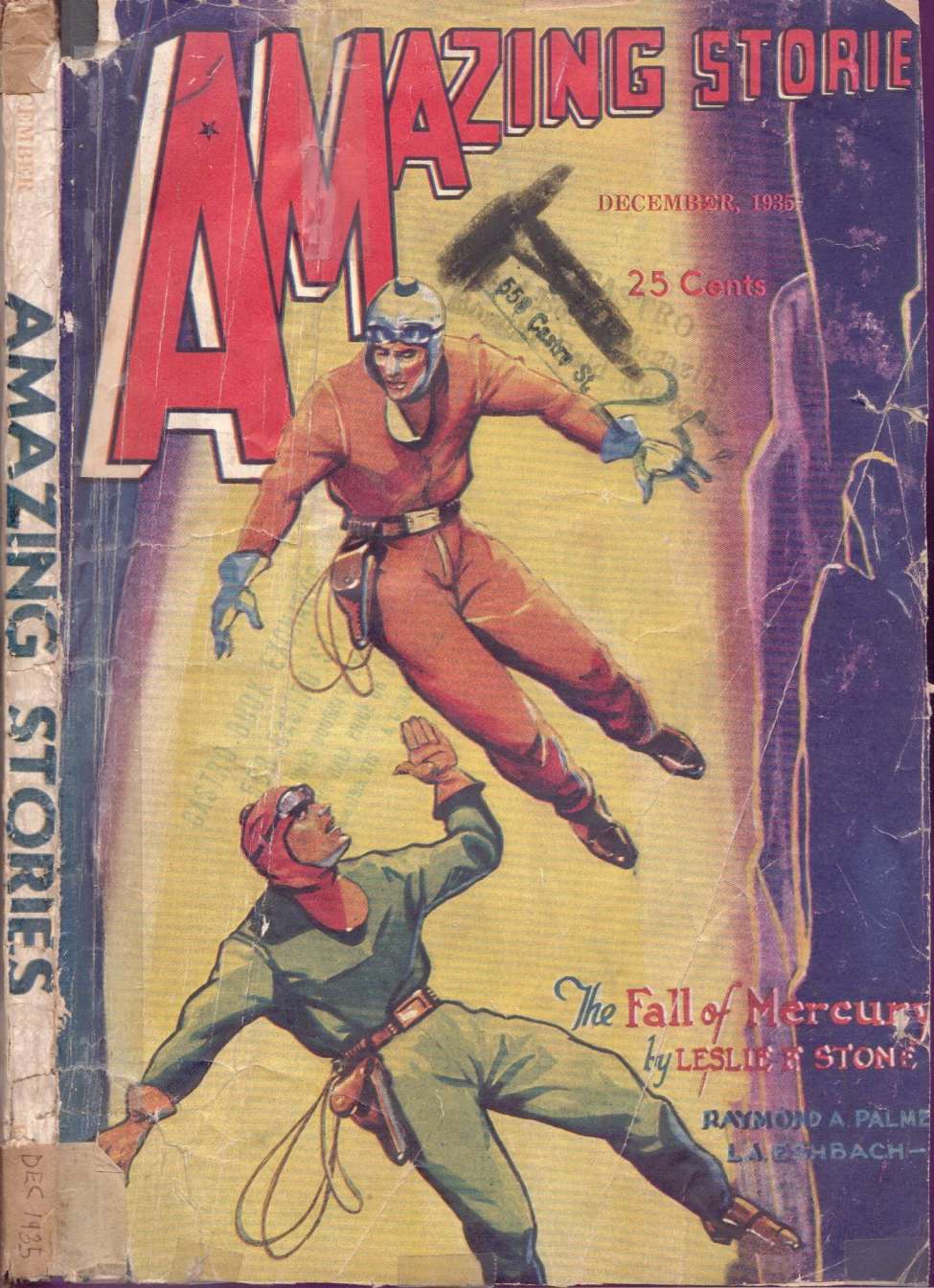
Leslie F. Stone was one of the first women science fiction pulp writers; her stories — including “The Fall of Mercury” (Amazing Stories, Dec. 1935), in which a Black hero uses super-science to destroy a white race bent on conquering the solar system — often featured female or Black protagonists. We are pleased to serialize this story for HILOBROW’s readers.
ALL INSTALLMENTS: 1 | 2 | 3 | 4 | 5 | 6 | 7 | 8 | 9 | 10 | 11 | 12.
CHAPTER X
War!
Hands quivering on the controls of our ship, Forrest, nevertheless, was prepared to obey, and slowly he drove the Victory straight for that dull black wall before us, feeling his way, ready to put on brakes at the least warning of danger. Chen-Chak had disappeared from our sight within the shell, and now we were touching it. I was correct in my conjecture concerning its tenuousity, for the walls were no more than a mist falling away from us as we pushed forward, swirling behind us as we came on. Our lights refused to pierce the gloom, the darkness seemed physical, touchable. It was but a few seconds we were in the darkness; it seemed ages. Forrest was manipulating the flyer’s progress practically by touch as his eyes sought to see through the opaque mist. Then it was over. Light came, light so dazzling, it blinded us.
Forrest, perforce, had halted the Victory, not daring to budge until his eyes adjusted themselves to the sudden change. We found we were within the sphere, our ship resting on a surface that had a slight curvature. This surface had the appearance of solidity, in color it was black, smooth and highly polished; yet it was apparent to us that we had come through the outer shell at this very point!
Stupefied by the passage of these strange events neither of us thought to move. We simply sat where we were, staring in incredulous wonder. The sphere, as I already mentioned, was approximately a thousand feet in diameter, and we had traversed about ten feet on entering it. The curved walls stretched away from us in all directions, the farther sides barely discernible because of the brilliant light, but overhead was something more tangible and unique.
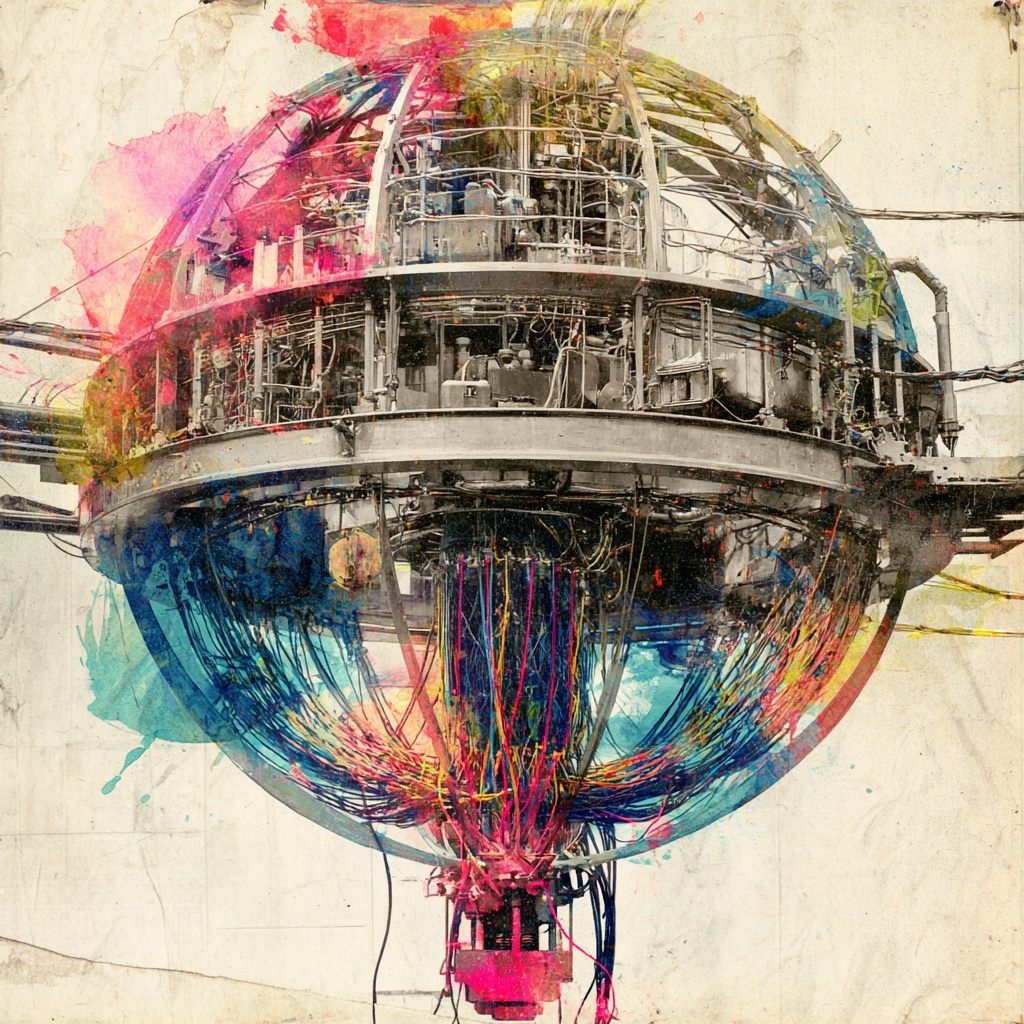
It was a round ball about forty feet in diameter hanging in the exact center of the sphere, yet having no visible means of suspension. Spaced at intervals all over its surface were queer masses of metal and glittering glass, with intricate arrangements of wheels, wires, glowing tubes, levers and dials, and other shapes I can not give name to. And facing us, head down, standing upon the lower curve of the ball was none other than our strange host, Chen-Chak. He was motioning. He wanted us to join him.
“He wants us to come up,” I said without reason to Forrest, wondering at the same time how it was to be done. He nodded, automatically closing the visor of his helmet. (Neither of us had taken off our space-suits, but had simply opened the visors on re-entering the Victory.)
“Hadn’t we better renew our air-cartridges?” I timidly suggested. “There’s evidently no air, out there.”
“Sure thing.”
Wordless we removed the expended air cartridges from each other’s shoulders, and refilled them. In the airlock, after all the air had been withdrawn, we found it necessary to adjust our valves to outside air-pressure, then gingerly stepped upon the inner shell of Chen-Chak’s unusual ship. Still I did not see how we were to ascend to that round ball hanging unsupported overhead. I glanced about, half-expecting a ladder to appear from nowhere for our convenience. Then it happened.
As suddenly, as if struck by a mighty hand, everything went black around me, a vertigo seized me. Never before had I been so sick in so short a space of time. Horrible pains shot through my body, tore at my muscles and beat at my skull. I remember wondering that the human body could stand such pain. Then, as quickly as the seizure came, it was gone.
Swaying slightly I remained where I stood, enjoying the surcease from pain, training my senses upon my body to make sure that all of me was right again, There was a lightness in my head, a new feeling of unlimited strength in my body. I felt I could lick ten of my equals at once.
“Well, ostrich, how long are you going to keep your eyes shut?”
It was Forrest having his fun at my expense, and I realized my eyes were tight shut, the muscles ached from a tight compression.
“Say, I guess you’d close your eyes if you were suddenly seized by a severe pain like…” I did not finish my thought as I wondered if he had not suffered as I. Then I saw Chen-Chak.
Instead of being on the ball far over our heads upside-down he was beside us, holding a queer weapon in his hand, that looked somewhat like an old-fashioned sawed-off shot-gun. But what magic was this? My eyes were on the level with his single green orb; he was no longer a giant, but a man the size of myself. He was smiling. He spoke.
“Sorry, I made you suffer so, but it was necessary to increase your size, so the extra-gravitational force here on the control ball would not be felt so strongly. This way, it is more evenly distributed, your muscles can coordinate themselves more easily…”
Increase our size! Extra-gravitational force. Control ball, evenly distributed. What was the man talking about? Wide mouthed I listened to him, half turning to see what Forrest thought of this. Thus it was I caught a glimpse, from the corner of my eye, of what lay over my head. And instead of seeing the forty foot ball I was puzzled to find myself staring upward at the curved surface of the inner shell of this strange space-ship. And there, like a fly on the ceiling, hung the Victory!
Now I grasped what had happened. Somehow the Saturnian had lifted us beside him to the control ball of the ship; and in doing it he had enlarged our size to cqual his. The ball itself had its own gravity field sO that what ordinarily should have been “down” was “up” and vice-versa. Later Forrest tried to explain how Chen-Chak increased our size by causing the molecules that made up our systems to expand, thus swelling us to more than double our own height and girth. That accounted for the sudden sickness. I was tongue-tied now with surprise.
“You see, my friend,” said Chen-Chak kindly. “Time does not grow heavy on one’s hand as long as there are so many miraculous secrets to be plucked from Nature’s breast. These miracles I seem to perform are merely the results of long ages of study and research. And still there are many grander secrets unknown to the Raxtau. Who should want to die, when the future promises so great a fulfilment?”
I nodded. “I guess that was a faux pas on my part, but what could you expect from a savage like me.”
“You are far from being a savage. Let us call you a child instead. To a child old age is death. But forget all that. You admire my ship?”
I looked at him blankly. I wasn’t going to let myself be tripped again. I shook my head dubiously. “It’s the queerest ship I ever saw.”
Chen-Chak threw back his head and laughed. “Ay, I would not doubt it, but in the future your ancestors will use such ships. Long ago my ancestors deprived our world of all its minerals, excepting those too close to the core of the planet to be attainable. But Nature does not stop with the physical. The void is even a greater storehouse of energy and raw material. Each day our scientists discover new forces heretofore unknown to us. You call these forces “rays,” a term as ambiguous as our term “forces.” We do know them as energy in various forms, pure unadulterated energy.”
Here Forrest who had been silent spoke up. “You mean to say that the solids of your ship are not solids after all?”
“Ay. Not solids as you know solids. There is no metal in all your worlds comparable to the metal of this ship. You noticed, when you came through the outer wall, that it appeared to have no substance, but was a mist, vapor? Yet, now you perceive that that surface on which your ship rests is as solid as this sphere on which we stand. However, before you entered here, this sphere was even as the outer wall — immaterial.
“See!” As he spoke Chen-Chak suddenly depressed a small lever on a machine near which we stood. At his touch the white glare of light around us faded sharply, the floor seemed to fall from under our feet. I felt mists swirl around us once again. Unconsciously Forrest and I clung to each other, still we did not fall. A moment and the light returned, and with it solidity.
“Rays, forces,” said the giant, “held in subjugation by the power of light. To explain how it is done would involve a degree of higher mathematics that is beyond your present comprehension. Light is the only thing known to subjugate these rays completely. Once the rays are solidified, they are as malleable as any metallic ore, and more enduring. You comprehend?” As he spoke I thought I saw a flicker of a smile cross his face, but it was gone as quickly as it came.
Neither Forrester nor I were willing to admit anything. I think had Chen-Chak said to me “You are dead,” I would have straightway dropped lifeless at his feet. But let him play with his rays and forces, I was interested simply in the material world. “How,” I wanted to know, “did you gain access to your ship in the first place? I know it was impossible for you to come up that shaft. How did you come?”
Forrest answered before Chen-Chak had a chance. “You materialized yourself within the wall of the ship, didn’t you, Chen-Chak?”
He nodded. “I was longer in coming than I expected, for it was difficult to work with the Raxgeu forces, but I had to calculate exactly the ship’s position, else I might have materialized in your little flyer, or not at all, since the atmosphere here is too tenuous a medium to rely upon.”
“Is nothing impossible to you?” Forrest demanded sharply.
The miracle man laughed as if at a joke. “I hope that it shall not be impossible to convert the men of Mercury to my way of thinking! Come, we talk, and meanwhile our diminutive friends organize their forces anew. And I must have word with the Heig Rau’ first!”
As he spoke he was leading us around the sphere to its opposite side. Here a strange machine filled almost the entire side of the sphere. It looked to me for all the world like one of those mammoth pipe-organs of Tellus. There was a great bank of keys (I counted no less than forty rows), and in a great circle were the “stops,” round, white buttons marked with queer hieroglyphic-like figures. Above, standing on end like the pipes of the organ, were hundreds of glass-like tubes ranging from pencil-thinness to a size double a man’s girth. Only the tubes had no mouths such as those of organ pipes. Set above the banks of keys were a series of round mirrors of hightly polished metal. The central mirror was about three feet across, and those on either side were proportionately smaller, until the last ones were no more than four inches across.
Chen-Chak took his place immediately upon a round stool, facing the keyboard, placing his feet on two round bars that dropped from the framework before him. Pressing one of these bars brought the “organ” to life. Color began to glow in the tubes above him; in a faint whisper of golden light. It wavered a moment then burst into bright glory that communicated itself to one then to another of the tubes, row after row. So intense grew the golden light it began to hurt our eyes, but then Chen-Chak touched several “‘stops” of his keyboard and the gold faded into blue, a restful blue, that soothed and caressed. For a moment his twenty fingers raced over the machine, and so absorbed were Forrest and I in that play of colors that we noticed nothing else, until the Saturnian suddenly spoke.
“You will find chairs behind you, gentlemen.” He knew that we were tired. His voice startled us, and looking around we were surprised to find that on a yellow slab next to the machine, there were two black metal, three-legged arm-chairs, where no chairs had been before. Glancing at each other we picked up the chairs and placed them just behind Chen-Chak, sitting down self-consciously. We were unaccustomed to chairs appearing from nowhere. Next we looked at our host to express our thanks, only he had forgotten us as he worked diligently over his controls.
We realized that the central mirror over his head was glowing with silvery light; behind it colors flicked in the hundreds of tubes, a very mosaic of polychromatic flame. But the mirror held our attention as it turned blue, then green and back to silver. Now a form was taking shape on its surface, and a massive head looked out of the mirror, a smooth black head, single-eyed and strangely handsome. The face was gentle, kindly.
“Ge Hurta, Heig-Rau, dictator of Saxta,” whispered Chen-Chak, then was silent, and a strange voice spoke somewhere in the depths of the machine. The language was new to our ears, liquid in tone. Chen-Chak answered in kind, and for several moments the two carried on a dialogue of which we could not understand a word. Chen-Chak played again on his organ, and one of the smaller mirrors beside the central mirror showed another head. It was the livid white, ugly face of a midget Mercurian, expressionless except for an ugly twist to the thin lips. Chen-Chak addressed this second apparition in the same tongue he had used to Ge Hurta, and again we listened to unintelligible speech, to which now and then the Heig-Rau of Saxta added a word.
There was a sweep of emotion across the midget’s face, and though we could not understand what was passing between the three we saw that the Mercurian was defiant, contemptuous and at the same time challenging his enemies to do their worst. In his mouth the liquid language sounded harsh, guttural, menacing. Ge Hurta spoke one sharp, terse word at which Chen-Chak switched the control that blotted out the face of the Mercurian leader.
Instantly another vision flashed on the screen, and we found ourselves peering into the laboratory we had lately quitted. The four tubes that had been left alive by Chen-Chak flanked with color, pulsating with vivid purple fire, and an admixture of rose and violet. It was evident the little men of the inner world were busily repairing the other tubes that had been tampered with. Even as we stared into the mirror, another four tubes sprang to life; faint dim colors glowed in their depths to slowly swell in intensity.
The mirror on the other side of the central screen in which the face of Ge Hurta still showed glowed with another scene. It was a second laboratory within the planet. Here again was strange activity we could not understand. One after another Chen-Chak filled all the vision screens before him with life, showing us unwonted activity within the planet under us.
A deep sigh seemed drawn from the very depths of his being as he declared “It is war!”
RADIUM AGE PROTO-SF: “Radium Age” is Josh Glenn’s name for the nascent sf genre’s c. 1900–1935 era, a period which saw the discovery of radioactivity, i.e., the revelation that matter itself is constantly in movement — a fitting metaphor for the first decades of the 20th century, during which old scientific, religious, political, and social certainties were shattered. More info here.
SERIALIZED BY HILOBOOKS: James Parker’s Cocky the Fox | Annalee Newitz’s “The Great Oxygen Race” | Matthew Battles’s “Imago” | & many more original and reissued novels and stories.