
SKANK YOUR ENTHUSIASM (19)
By:
December 4, 2025
One in a series of enthusiastic posts, contributed by 25 HILOBROW friends and regulars, analyzing and celebrating our favorite… ska records! PLAYLIST HERE. Series edited by Josh Glenn.
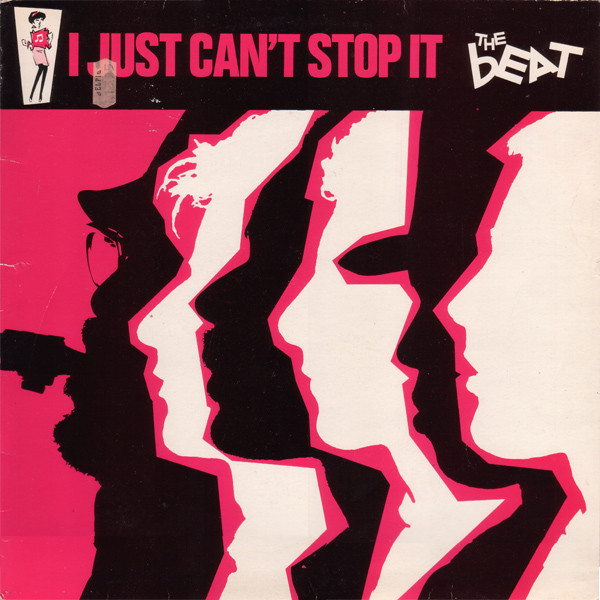
Album for album, the (English) Beat have the deepest, hookiest catalog of the 2 Tone ska revivalists. So it’s unsurprising this series is top heavy with their songs. For me, it’s hard to pick a favorite. But their single “Whine & Grind/Stand Down Margaret,” from the unstoppably slapping 1980 LP I Just Can’t Stop It, feels like a song for this moment. It’s actually two songs — a jacked-up cover version of the 1960 single by Prince Buster, a dirty-mind dancehall banger built for twerking/humping/hoochie-coochie-ing that, midway through, hard-pivots into a clear-eyed protest song, sans metaphor, calling for then-Prime Minister Maggie Thatcher to step down as PM and clear out of Downing Street.
When I first heard the record at my college radio station in the United States, the mix of explicit political critique and breakneck dance music was fairly new to me. I knew about political folk music via Dylan, pump-your-fist-in-the-air rock’n’roll protest songs from being a ’60s kid, and was playing catch-up on the black power jams that evolved from Motown and James Brown’s funk lab. But dancing in the late ’70s – early ’80s still meant disco, which seemed by definition to be de-politicized escapist fare. This was just before Grandmaster Flash and the Furious Five dropped “The Message,” advancing a notion of activist hip-hop, and probably before I’d encountered Emma Goldman’s famous quote about not wanting to be part of a revolution unless she could dance at it. It was also before I fully understood the radical queer rootstock of so much disco and nightclub culture, or the integral identity politics — a term that’s become unfairly pejorative when it should be merely descriptive — of salsa and other Latin dance music, politics that certain artists (the great Rúben Blades, for one) made explicit.
There were also politics coded into early American punk. But British punks made politics more explicit — it doesn’t get much more plainspoken than “God save the queen/ the fascist regime.” And mixing politics and club grooves was common in pre- and post-colonial Caribbean music, calypso early on and later reggae, massive in the UK thanks in part to the post-war Windrush generation of Caribbean immigrants.
The ’70s & ’80s were golden-era peaks for both punk and reggae, styles that defined the era’s British music. Band names — The Clash, The Police, The Beat — telegraphed politics as did the sound, which reflected the culture of struggling black Britons even if the bands in question (The Clash, the Police) weren’t black.
The Beat, however, in the namesake 2 Tone tradition, were an interracial band. In Walls Come Tumbling Down: The 2 Tone Records Story by Daniel Rachel, Beat frontman Dave Wakeling unpacks the lyrics to “Stand Down Margaret,” which is full of references that anyone paying attention to the UK news in 1980 would get, from the title’s reprise, to the phrase “short sharp lesson,” a variation on “short sharp shock,” a stock coinage used by British rulers to denote harsh punishment as a supposed criminal deterrent. (The phrase has a pop music pedigree — see The Mikado and Pink Floyd’s “Us and Them.”) Wakeling explains the reference to “Third World War,” a nod to the popular 1978 British dystopian sci fi novel by Sir John Hackett, and unpacks the wordplay of “you tell me how can it work in this all white law,” a line he credits to the band’s guitarist Andy Cox. It alludes to Margaret Thatcher’s Cabinet ministers Geoffrey Howe and William Whitelaw, major architects and boosters of her policies. Wakeling calls the line “one of the best satirical lyrics in literature.”
Overstatement perhaps, but it’s pretty good. And the tasty dub version of “Stand Down Margaret” adds a some pointed Jamaican toasting — a style that was a major part of rap’s DNA — via “Ranking” Roger Charlery, who died in 2019. Wakeling has kept a version of the Beat alive. It deserves to be. The first three albums are classics, pushing ska to the breaking point formally while showing how durable it is. Along with assorted 12”s, they remain in regular rotation in my record crates whenever I’m DJing, and I expect they always will.
SKANK YOUR ENTHUSIASM: INTRODUCTION by Josh Glenn | Lucy Sante on Margarita’s WOMAN COME | Douglas Wolk on Millie’s MAYFAIR | Lynn Peril on Prince Buster’s TEN COMMANDMENTS | Mark Kingwell on The [English] Beat’s TEARS OF A CLOWN | Annie Nocenti on Jimmy Cliff’s MISS JAMAICA | Mariane Cara on The Selecter’s ON MY RADIO | Adam McGovern on The Specials’ GHOST TOWN | Josh Glenn on The Ethiopians’ TRAIN TO SKAVILLE | Susannah Breslin on The [English] Beat’s MIRROR IN THE BATHROOM | Carl Wilson on Prince Buster / Madness’s ONE STEP BEYOND | Carlo Rotella on The Mighty Mighty Bosstones’ THE IMPRESSION THAT I GET | Rani Som on The Bodysnatchers’ EASY LIFE | David Cantwell on Desmond Dekker’s 007 (SHANTY TOWN) | Francesca Royster on Joya Landis’ ANGEL OF THE MORNING | Mimi Lipson on Folkes Brothers’ OH CAROLINA | Alix Lambert on The Specials’ TOO MUCH TOO YOUNG | Marc Weidenbaum on Dandy Livingstone’s RUDY, A MESSAGE TO YOU | Heather Quinlan on Fishbone’s MA & PA | Will Hermes on The [English] Beat’s WHINE & GRINE / STAND DOWN MARGARET | Peter Doyle on The Skatalites’ GUNS OF NAVARONE | James Parker on The [English] Beat’s SAVE IT FOR LATER | Brian Berger on The Upsetters’ RETURN OF DJANGO | Annie Zaleski on The Mighty Mighty Bosstones’ SOME DAY I SUPPOSE | Deborah Wassertzug on The Bodysnatchers’ TOO EXPERIENCED | Dan Reines on The Untouchables’ I SPY FOR THE FBI | PLUS: AL Deakin on SKANKING FOR YOUR LIFE.
JACK KIRBY PANELS | CAPTAIN KIRK SCENES | OLD-SCHOOL HIP HOP | TYPEFACES | NEW WAVE | SQUADS | PUNK | NEO-NOIR MOVIES | COMICS | SCI-FI MOVIES | SIDEKICKS | CARTOONS | TV DEATHS | COUNTRY | PROTO-PUNK | METAL | & more enthusiasms!