
THE DICTATOR (4)
By:
October 25, 2026
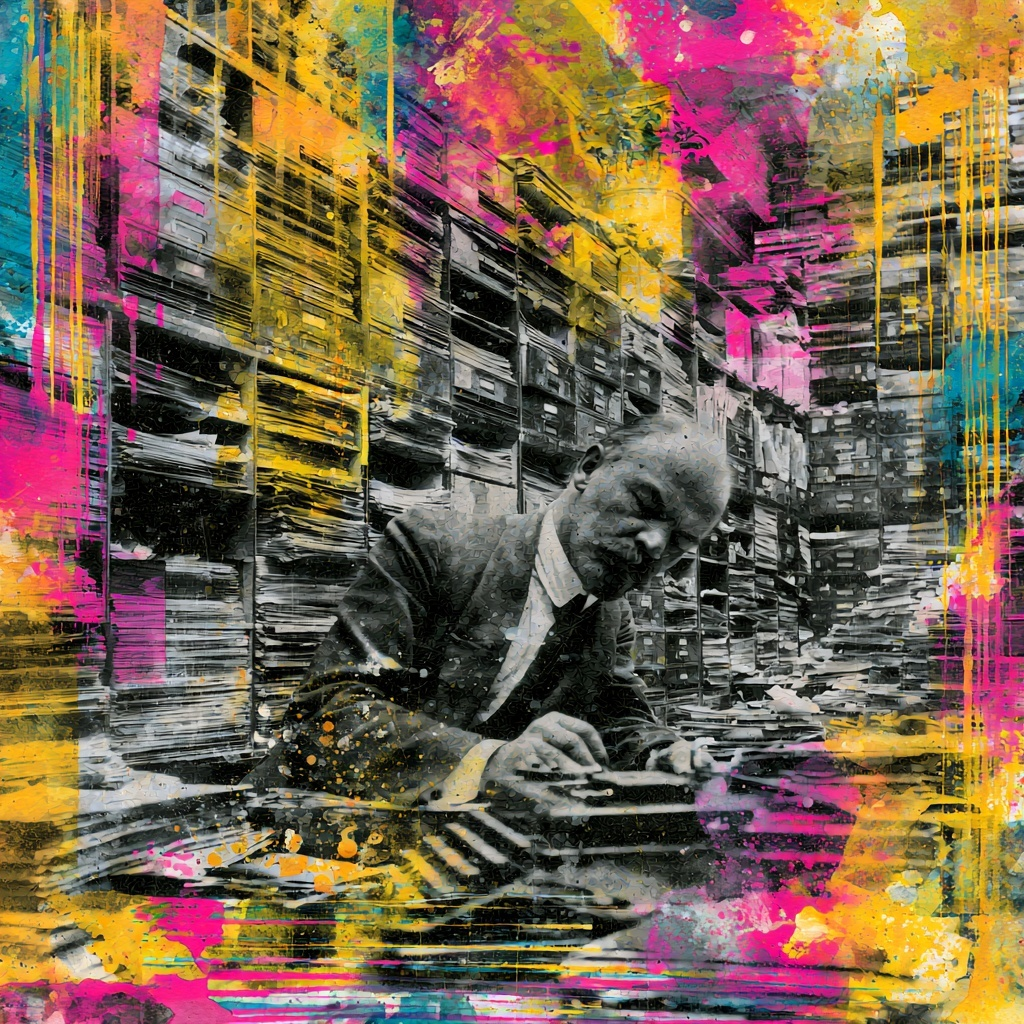
Yefim Zozulya’s “The Dictator: The Story of Ak and Humanity” is a darkly humorous parody of Bolshevik utopian eugenics. This thinly veiled critique of the Soviet regime, which was first published in the only issue of magazine Zori (Зори, spring 1919), Kyiv, would inspire and influence Yevgeny Zamyatin’s much better-known anti-utopia We. Translated into English by the Russian-American anarchist and author Alexander Berkman. HiLoBooks is pleased to serialize this story for HILOBROW’s readers.
ALL INSTALLMENTS: 1 | 2 | 3 | 4 | 5.
7. Ak’s doubts.
One time, members of the Board of Supreme Determination arrived at the headquarters, intending to make another report to Ak.
Ak wasn’t at his usual place. They looked for him but couldn’t find him. They sent for him, called on the phone and still couldn’t find him.
Two hours later they accidentally found him inside the Gray Cabinet. Ak sat in the Cabinet atop a pile of grave profiles of those killed, and thought with an unprecedented — even for him — intensity.
“What are you doing here?” they asked Ak.
“Can’t you see I’m thinking?” Ak replied wearily.
“But why in the Cabinet?”
“This is the most suitable place. I am thinking about people, and one can only think fruitfully about people while perched directly atop the acts of their destruction. Only while sitting on the documents of a person’s destruction can one study their extremely strange life.”
Someone laughed, a flat and empty sound.
“Don’t you laugh,” Ak warned. He brandished someone’s profile. “Don’t laugh. The Board of Supreme Determination seems to be in crisis. Studying those who have perished has led me to search for new paths toward progress. You have all learned to concisely and venomously prove the uselessness of a person’s existence. Even the least talented among you can convincingly prove it in a few sentences. And so I sit here and think whether we’re on the right path.”
Ak pondered this, sighed bitterly, and spoke quietly.
“What to do? What’s the solution? When you study living people, you come to the conclusion that three-quarters of them should be culled. But when you study the slaughtered, you don’t know: perhaps they should’ve been loved and pitied instead. This, in my opinion, is the dead end of the human question, the tragic dead end of human history.”
Ak mournfully fell silent and buried himself in the mountain of profiles of the perished, painfully reading their eerily standardized laconic entries.
The Board members withdrew. No one objected. First, because it was useless to object to Ak. Second, because no one dared object to him. Everyone felt that a new solution was brewing, and almost everyone was dissatisfied. There was an established process, clear and definitive, that would probably have to be replaced with something else. But with what?
What else would this madman, who had such unprecedented control over the city, think of?
8. Crisis.
Ak disappeared.
He always disappeared when he needed to think. They searched for him everywhere but couldn’t find him. Someone said that Ak sat in a tree outside the city and cried. Someone else said that Ak ran on all fours in his garden and gnawed at the ground.
The productivity of the Board of Supreme Determination had weakened. With Ak gone, something went awry with their work. Residents put up iron bolts on their doors and refused to let commission inspectors in. In some neighborhoods the Board members’ questions about the right to life were answered with laughter. In some instances, the unnecessary people grabbed the members of the Board of Supreme Determination and checked their own right to life, mockingly writing profile-protocols that weren’t much different from the ones stored in the Gray Cabinet.
Chaos descended upon the city. Unnecessary, insignificant people who hadn’t yet been culled grew so impudent as to appear freely in the streets, began to visit each other, have fun, engage in all sorts of entertainment, and even get married. They congratulated each other in the streets:
“It’s over! It’s over! Hurray!”
“The verification of the right to life has ended.”
“Don’t you find, fellow citizen, that life has become more pleasant? There’s less human rubbish. It’s become easier to breathe.”
“Shame on you, citizen! Do you think only those who had no right to life have died? Oh! I know those who have no right to live for even an hour and yet they live on and will live for years, while on the other hand so many worthy individuals have died. If only you knew!”
“This means nothing. Mistakes are inevitable. Tell me, do you know where Ak is?”
“I don’t know.”
“Ak sits in a tree outside the city and cries.”
“Ak runs on all fours and gnaws at the ground.”
“Let him cry!”
“Let him gnaw!”
“You rejoice too soon, citizens. Too soon. Ak is coming back tonight, and the Board of Supreme Determination will resume its work.”
“How do you know?”
“I know! There’s too much human rubbish remaining. We must cleanse and cleanse and cleanse!”
“You’re very cruel, citizen.”
“I don’t care.”
“Citizens! Citizens! Look! Look!”
“They’re putting up new posters.”
“Look!”
“Citizens! What happiness! What joy!”
“Read, citizens!”
“Read!”
“Read! Read!”
“Read!!!”
RADIUM AGE PROTO-SF: “Radium Age” is Josh Glenn’s name for the nascent sf genre’s c. 1900–1935 era, a period which saw the discovery of radioactivity, i.e., the revelation that matter itself is constantly in movement — a fitting metaphor for the first decades of the 20th century, during which old scientific, religious, political, and social certainties were shattered. More info here.
SERIALIZED BY HILOBOOKS: James Parker’s Cocky the Fox | Annalee Newitz’s “The Great Oxygen Race” | Matthew Battles’s “Imago” | & many more original and reissued novels and stories.