
OMAC YOUR ENTHUSIASM (6)
By:
April 21, 2026
One in a series of enthusiastic posts, contributed by 25 HILOBROW friends and regulars, analyzing and celebrating our favorite… Seventies (1974–83) sci-fi novels and comics! Series edited by Josh Glenn.
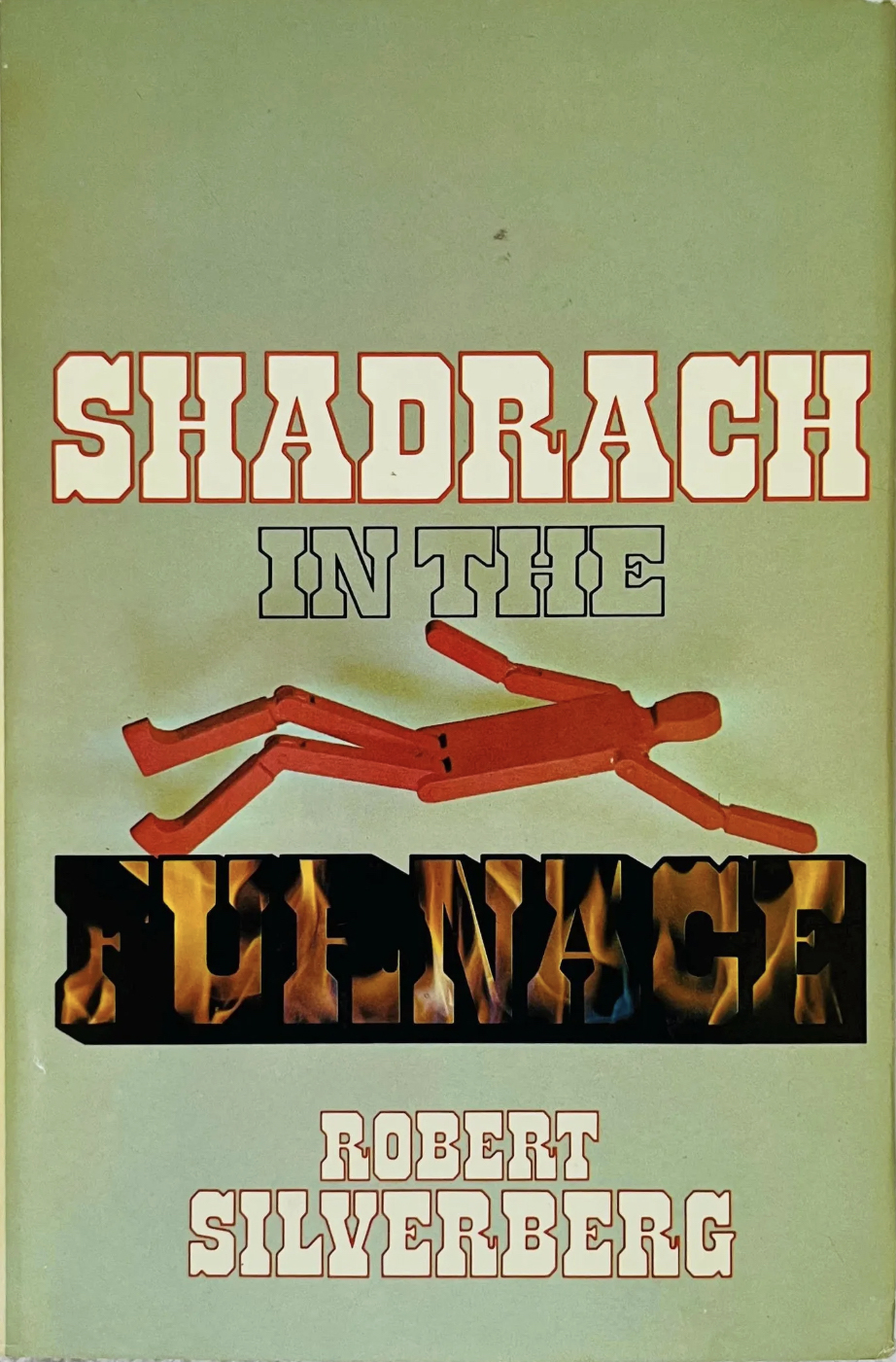
SHADRACH IN THE FURNACE | ROBERT SILVERBERG | 1976
Even as the most perceptive character of his own story, Shadrach Mordecai can’t see what’s coming. But we’ve already seen a lot of his future arrive: Weaponized pandemic, survival as a political favor, tight bubbles of privilege with suffering masses surrounding them. In the faroff year of 2012, young and charismatic Shadrach is the personal physician to a global dictator whose vital signs are transmitted to diagnostic implants in Shadrach’s body, a weirdly intimate tyranny. Worldwide biological warfare in the late 20th century has left Earth’s human population at 2 billion and falling, as most people succumb to a residual “organ rot” disease; the dictator’s staff and denizens of his imperial capital have access to the scarce and temporary antidote, another creepy compact of coercion. Their master is something like a century old, kept alive by a cuisine of drugs and array of replacement anatomy. But he’s preparing to succeed himself, with three moonshot-style programs to either replicate his psyche in a mechanical simulacrum (Project Talos), regenerate him at the cellular level (Project Phoenix), or transfer his brainwaves to a willing-or-not human subject (Project Avatar). And who might that unknowing subject be?
Shadrach in the Furnace is screaming to be a movie; told in present-tense, all of the narrative feels like stage directions, inviting you to complete the scenario in your head and inducing the characters’ experience into your own senses. This also conveys a suspenseful immediacy as old as the science-fiction form’s pulp origins; we’re being given a window into humanity’s future but not even the next minute is guaranteed.
Also carried over from the pulp era is a tendency toward exoticizing tropes and some outright slurs; the dictator in question is Genghis II Mao IV Khan, a character that has its traces of yellow-peril stereotype, though not, for the most part, a characterization; the Khan is fully and empathetically drawn as is everyone in a mostly-POC cast (Shadrach is African-American, the Project heads are Indigenous, Persian and Swedish women, and the capital Ulaanbaatar is a salad-bowl of what peoples are left on earth) though there’s a classic-Trek-like tension (even among the white characters) between ethnic cliches and the multicultural moment the author knew was at hand. Each character is seen wrestling with the inconceivable future and the roles the past wrote for them, and I guess so was he.
Tensions of exterior and interior define the whole narrative. Silverberg’s style starts out hyper-particular, mapping every character’s appearance upon their introduction — their measurements, facial structure, skin-tone, carriage — like the morphological scans of their society’s ubiquitous computer eyes; with this layer in place Silverberg creates a space for what remains out of reach — the characters’ memories, motivations, reactions in the moment, and secret assessments of each other. Flashbacks to Shadrach’s youth in a lost world; the reveries of two new religions which use hallucinogens to simulate either the afterlife (“dream death”) or grand and tragic events of history (“transtemporalism”); an autobiography of the Khan that Shadrach intermittently imagines (or perhaps seeps into his consciousness?); and portraits of twilight humanity in Nairobi, Israel/Palestine, Istanbul and San Francisco on a brief tour he undertakes of what’s left of the world are as lyrical as public life among the elite is constricted.
The surface familiarities can be uncanny for a book published in 1976 — characters use recognizable smartphones, and we’re told there was an early 21st century Pope named Benedict — but everyone’s adaptation to being perpetually observed, and the ease with which societies relinquish democratic structures, are what’s most eerily recognizable here. We know from the way the omniscient narrative nevertheless focuses on Shadrach’s POV that he is special, perhaps as an agent of change or maybe just a sacrifice. Can he escape his fate, and we escape his future? We’re both still in the present tense…
OMAC YOUR ENTHUSIASM: INTRODUCTION by Josh Glenn | Mark Kingwell on RIDDLEY WALKER | Carlo Rotella on THE FACE | Sara Ryan on DREAMSNAKE | Matthew Battles on THE WORD FOR WORLD IS FOREST | Ramona Lyons on HIGH-RISE | Adam McGovern on SHADRACH IN THE FURNACE | Deb Chachra on THE HITCHHIKER’S GUIDE TO THE GALAXY | Tom Nealon on DHALGREN | Michael Grasso on FLOW MY TEARS, THE POLICEMAN SAID | Stephanie Burt on BRIGHTNESS FALLS FROM THE AIR | Nikhil Singh on SABRE | Gordon Dahlquist on VALIS | Miranda Mellis on THE DISPOSSESSED | Marc Weidenbaum on SOFTWARE | Peggy Nelson on THE TRANSMIGRATION OF TIMOTHY ARCHER | Josh Glenn on ENGINE SUMMER | Mimi Lipson on A SCANNER DARKLY | Douglas Wolk on THRILLER | David Hirmes on ARZACH | Anthony Miller on THE SHOCKWAVE RIDER | Annie Nocenti on JIMBO | Seth on MR. MACHINE | Alex Brook Lynn on JUDGE DREDD | Joe Alterio on THE INCAL | Jason Grote on JOSIE AND THE ELEVATOR.
JACK KIRBY PANELS | CAPTAIN KIRK SCENES | OLD-SCHOOL HIP HOP | TYPEFACES | NEW WAVE | SQUADS | PUNK | NEO-NOIR MOVIES | COMICS | SCI-FI MOVIES | SIDEKICKS | CARTOONS | TV DEATHS | COUNTRY | PROTO-PUNK | METAL | & more enthusiasms!