
VOYAGE TO FAREMIDO (2)
By:
April 11, 2026
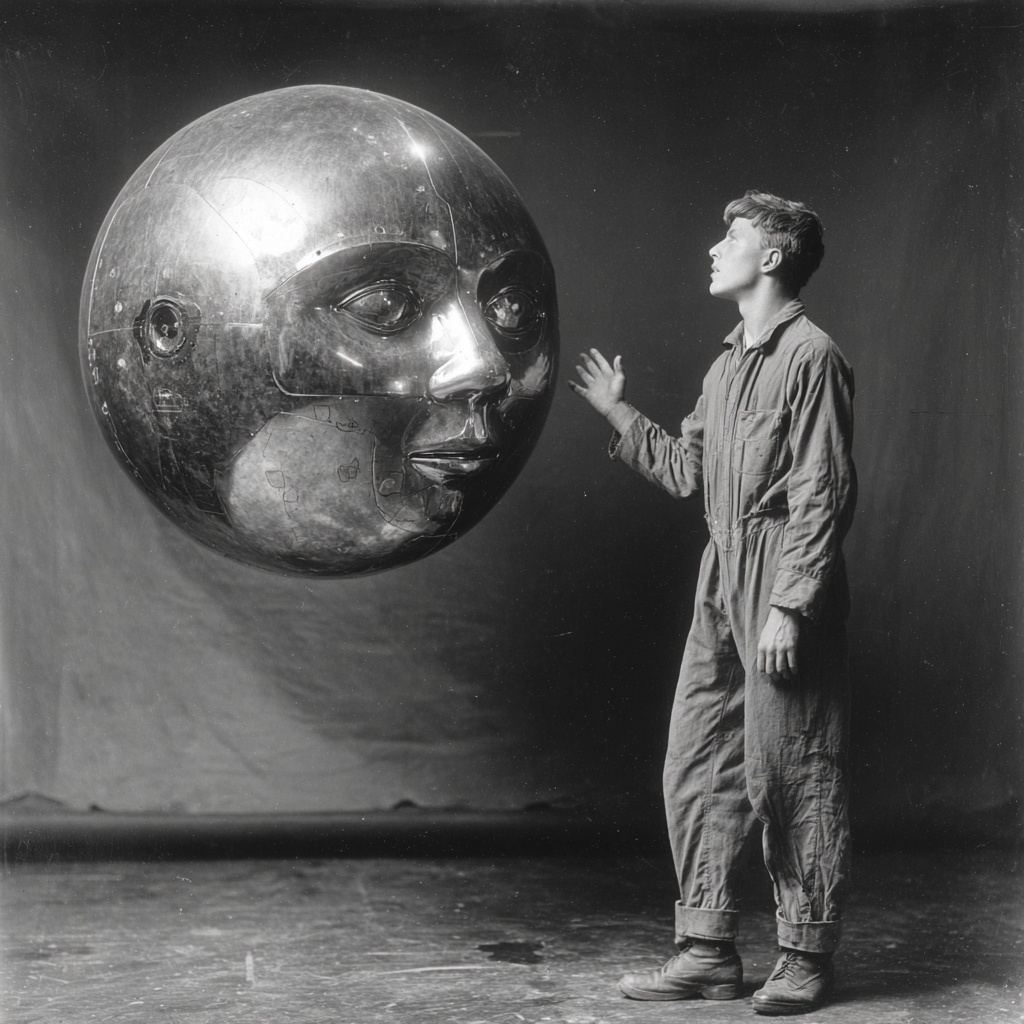
Frigyes Karinthy’s Voyage to Faremido: Gulliver’s Fifth Voyage was published in 1916, in Hungarian. Jonathan Swift’s Lemuel Gulliver signs on as a surgeon on a British ship, only to be torpedoed, then picked up by a UFO and transported to Faremido, a planet ruled by intelligent, utterly benevolent machine-folk. In this excerpt, Gulliver accepts an injection of their own brain-matter — quicksilver and minerals — into his head. HiLoBooks is pleased to serialize the story for HILOBROW’s readers.
ALL INSTALLMENTS: 1 | 2 | 3 | 4 | 5.
CHAPTER FIVE
The author learns the language of the solasis — A short digression on outward and inward attitudes — Epistemology-Sick solasis — A few words about the ‘music of the spheres’
It would take me too long to detail chronologically the history of the few months that passed between my arrival in Faremido and the day when I could claim that I was able to express myself in the solasi language (however clumsily and brokenly) and could understand, more or less, their speech. It is possible that this course of study took longer than I thought at the time. The innumerable new impressions crowded with such feverish speed upon my brain that I did not even think of measuring time — which is, in any case, measured in different units in Faremido. (A day there lasts twice or three times twenty-four hours.) On the other hand, these impressions demanded my attention almost exclusively — so that whatever happened to me personally in this first period of my sojourn remained sketchy and dim. I only retain in my memory all the lessons I gathered; everything concerning my physical life faded away. In a way I came to realize (and actually experienced in my own case) that the intellect — which we believe to be destined for the cognizance of things — can attain the highest and most intensive grade of its function only when it completely forgets itself in order to gather and classify the phenomena of the outside world. Later I talked a good deal about this with Midore, my master. This was at the time when I tried with all my mental power to explain to him what we meant by the expression ‘human brain.’ He was quite incapable of understanding this idea. “It is impossible,” he said, “that an instrument manufactured of the decomposed and corrupt materials similar to your body,” this is how he termed flesh and blood, for the solasis had no words to express these concepts, “can carry out the true functions of the brain: the understanding of the relations of things.” When in order to correct his error I tried to enlighten him and said that our own thinkers were well aware of the human mind’s aim being the understanding of the world, Midore shook his head sceptically and asked how our alleged thinkers functioned.
I was only too pleased to be given this opportunity to establish in such a far distant land the glory of the great philosophers of our human race and especially those of my beloved country. I mentioned at random the works of four or five great philosophers, sketching briefly their thought. I related the heartening development of epistemology which occupied itself with the laws of the human mind and established the sequence and basis of the birth of thought. I spoke of the great biologists who explored the functions of our organs and sought to establish the way phenomena affect our brains. I mentioned those who considered the labour of the human mind a purely organic function and those who assumed that the workings of the spirit must be ascribed to some force that could not be measured by matter. I quoted the views of some great logicians who deduced the birth of emotion and thought on a purely mathematical basis and others who used metaphysical symbols. I summed up concisely the present-day status of philosophy and at the end remarked triumphantly that we were very close to the time when we would know what one ought to mean by the functioning of the intellect.
Midore heard me out politely and then remarked that I had answered all sorts of questions — except the one he had posed. (I can no longer refer to him by ‘it,’ for he had become very much of a person to me.) From the point of view of the final goal, he pointed out, the instrument or tool, by which we achieve such a goal, is quite indifferent. Anybody who examines an instrument does not do so in order to discover its purpose — this was a priori and self-evident, for if one did not know the purpose, an instrument was of no interest. One examined an instrument in order to establish whether it had any faults or whether it was perfect and usable — and then start to use it. His question was, he continued, whether we were able to employ our minds for the purpose they served; upon which I had given him a long and enthusiastic answer, declaring that we knew the instrument and were able to take it to pieces. From my words, he said, he saw that for centuries we had done nothing but kept on dismantling and reconstituting our intellects; I had called those who performed the lowest and least important work the greatest thinkers — and yet they seemed to fill the sort of job which was done by turners in Faremido. He, Midore, had asked to what purpose we employed our minds, what we were thinking about — and my answer showed that we did nothing but constantly pose the same question, pondering what we should ponder. For if he understood me correctly, this was what I meant by my talk about epistemology. All this was understandable. Such a disease occurred in Faremido, too, and a special repair workshop had been established in the solasi factory to deal with such cases. For it sometimes happened that the clear and correctly compounded liquid of the skull, the solasi‘s brain (as we would call it) would go bad. Even on this clean planet, as I could see for myself, there was a superfluity of that corrupt and decomposing material which I, Gulliver, called an organic compound. This poisonous, tainted substance somehow invaded the solasis‘ skull and infected the organ of thought. On such occasions a thick mucilagous scum was deposited on the golden interior of the skull, fogging the clarity of the eye-lenses; the outside rays did not penetrate the brain but were refracted by the dark scum, changed the true image of things and created false conceptions. Such a sick solasi could be recognized by the inward turn of his eyes. His confused and feverish words proved that he was seeing his own mind instead of the world, and he spoke of his brain, this simple and insignificant instrument whose value was solely in its functions, as if it were the world itself. He indulged in all kinds of foolish and ridiculous utterances — for instance, he said that the sky was covered with green spots, or that life was a liquid; he argued that space was really time, and that matter contained energy but there was no energy in matter; he considered it as an important and pertinent question whether Man’s will was his own or nature’s; whether free will was possible, or whether volition could influence will; whether I knew what I thought or thought what I knew; whether I brought consciousness into the world, or whether consciousness brought me into being — and had it existed when 1 had not; whether there existed a force without matter, and whether a higher, immaterial intelligence was conceivable; whether we thought in images or imagined our thoughts, etc. It was interesting that this disease affected the vocal chords, too; instead of the pure and pleasant singing tones, the solasi‘s throat produced unpleasant, discordant sounds — sounds which incidentally resembled closely what I, Gulliver, called speech, and which offended the ears considerably. He, Midore, had once studied the case of such a sick solasi. He had made notes of such an inarticulate cacophony; and he had discovered that if lead and soapstone were rubbed together in a certain way, they produced the same sort of sound. At this stage Midore began to try and imitate this pathological expletive and — to my greatest surprise — pronounced fairly clearly two words that were familiar to me: the words ‘historical materialism’…
Then he told me that the cause of this disease had been known for a long time, and that it was very easy to cure — the brains of the patient were drained in the solasi factory, were mixed with a certain reagent and filtered through a specific compound. This separated the decomposing elements, and the eyes regained their original clarity. If the liquid was no longer capable of being purified, it was simply discarded and a fresh mixture introduced.
“All this,” concluded Midore, “I have told you only to prove how completely I have understood your description. Similar mental disorders can and do occur. What surprises me is that you term the greatest thinkers of mankind exactly those diseased intellects that have become deranged within themselves. I admit that the human mind, manufactured and delivered by some unknown mechanic in an imperfect and primitive condition, has to wait — if I have understood you rightly — for many years until it develops at least to the stage that it can be used at all. It is precisely due to this peculiar quality that the mind must unavoidably pass through periods of evolution when (being still imperfect in itself) whatever it invents and produces must be imperfect. In this case, if we assume that you have spoken the truth when you maintain that you, too, strive for an understanding of the exterior world, I must consider the human mind as a lump of unpolished glass from which you want to manufacture a magnifying lens. In order to achieve this, the liquid vitreous material must be filtered and purified until it becomes completely transparent so that the magnified object can be observed through it. But you do not follow this course — on the contrary, you mix all kinds of opaque and crude elements with the liquid — such as consciousness, self-knowledge and the conception of the ego — in order to make it darker and more solid. Because you are afraid that the completely transparent mind itself, letting the rays pass through, disappears — because, unlike glass, it is not visible. Yet this fear is quite groundless, for, after all, the presence and perfection of a magnifying glass are appreciable exactly by the fact that it makes the outside world clearly and purely visible for me.”
Before we could talk further on these matters, Midore digressed to ask me how I, as an organic earthling, was able to learn their language. I told him that we, too, were familiar with music — but we never dreamt of the possibility of expressing concrete thoughts by musical sounds. When he enquired as to the use we made of music, I explained that we expressed our feelings through it, and I spoke at length about the difference between emotion and thought in our world.
This amazed him because for the solasis these were synonymous. He could not understand how we failed to notice that emotion expressed thought, that in turn created the emotion — and vice versa. I told him that we sometimes combined these two, expressing our thoughts through emotions, and I spoke of songs which were the framework of this process, the spoken word being combined with a musical accompaniment or set to a melody. This made him even more surprised; how could the clear and perfectly expressive musical tones, he said, be made intelligible by accompanying them with inarticulate noises? Manifestly, this could only hinder understanding. I remarked that we, too, had people who believed that music was a self-contained method of expression. This gave Midore the idea that these humans might have sensed something of the existence of the solasis — or that, perhaps, a few tones spoken by someone in Faremido had reached their ears. I was about to protest against this impossible theory — when I suddenly remembered the often-refuted and often-derided ‘music of the spheres’ of which some medieval mystics and astronomers had spoken — and I fell silent.
RADIUM AGE PROTO-SF: “Radium Age” is Josh Glenn’s name for the nascent sf genre’s c. 1900–1935 era, a period which saw the discovery of radioactivity, i.e., the revelation that matter itself is constantly in movement — a fitting metaphor for the first decades of the 20th century, during which old scientific, religious, political, and social certainties were shattered. More info here.
SERIALIZED BY HILOBOOKS: James Parker’s Cocky the Fox | Annalee Newitz’s “The Great Oxygen Race” | Matthew Battles’s “Imago” | & many more original and reissued novels and stories.