
VOYAGE TO FAREMIDO (1)
By:
April 3, 2026
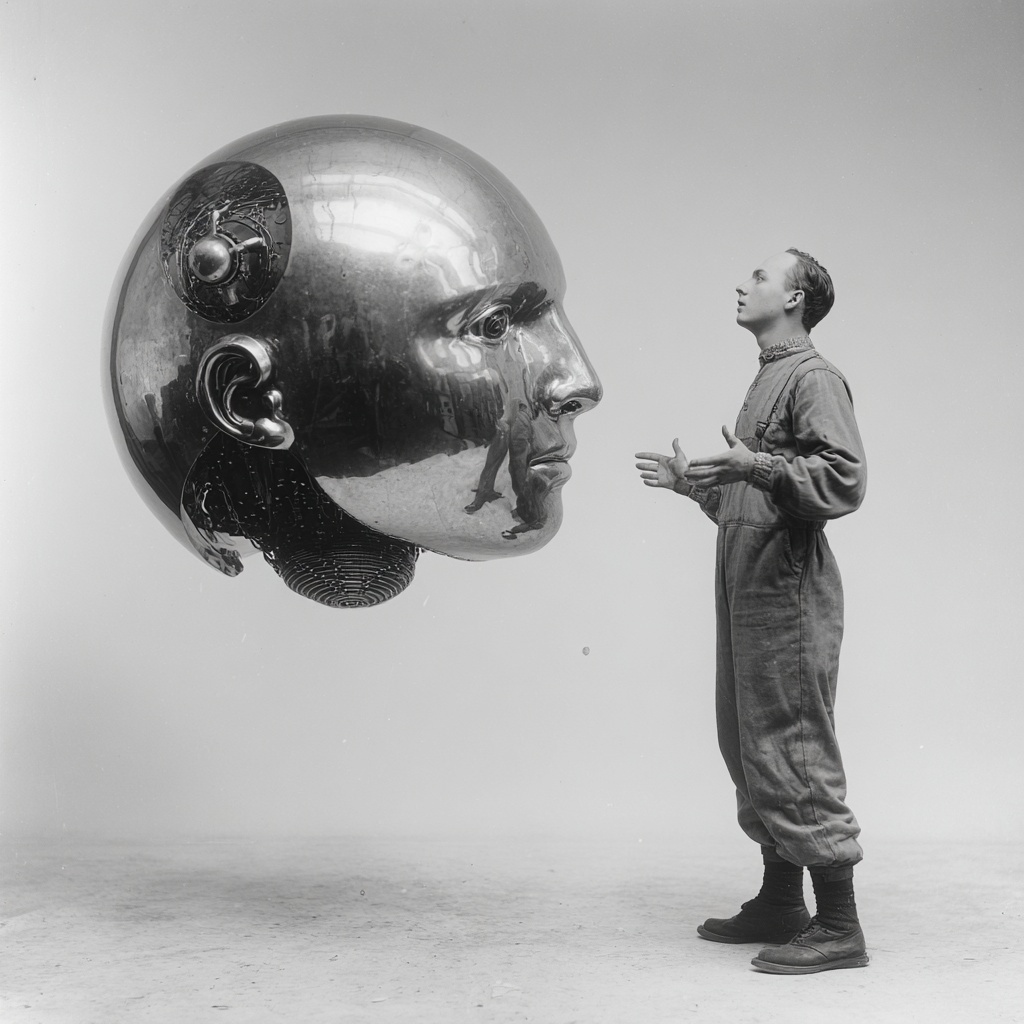
Frigyes Karinthy’s Voyage to Faremido: Gulliver’s Fifth Voyage was published in 1916, in Hungarian. Jonathan Swift’s Lemuel Gulliver signs on as a surgeon on a British ship, only to be torpedoed, then picked up by a UFO and transported to Faremido, a planet ruled by intelligent, utterly benevolent machine-folk. In this excerpt, Gulliver accepts an injection of their own brain-matter — quicksilver and minerals — into his head. HiLoBooks is pleased to serialize the story for HILOBROW’s readers.
ALL INSTALLMENTS: 1 | 2 | 3 | 4 | 5.
CHAPTER FOUR
World conceptions — The author begins to guess what sort of creatures he has encountered — The solasis — A few words about the solasi factory
All I have tried to explain to the reader took me many days and weeks to understand fully. It is certain, however, that when I stood there under the man-shaped tree and suddenly became aware that this miraculous mechanism, one of Faremido’s citizens, was comparing me with the tree — even then I began, with a shiver, to sense possibilities of which I had never dreamt. My amazing adventures which had often baffled my intellect during my earlier voyages had accustomed me — while preserving my conception of the world evolved and prescribed by eminent philosophers and logicians and, above all, by the natural scientists of my beloved country — to endeavour to accept facts and realities which could in no way be fitted into such a conception. I knew that a serious natural scientist could not be influenced in the construction of his theories by such trifles, as, for instance, a fact or phenomenon that was in direct contradiction to such theories.
Maintaining thus my ideological position, I still had to acknowledge the fact that my misfortune had cast me on to a country or continent or maybe a planet where the inhabitants, the lords of creation, were not only dissimilar to human beings but in the sense of our globe could not even be considered living creatures. Though they moved by their own volition, acted purposefully and formed certain social organisms collectively, not even the tiniest fragment of their body consisted of that certain matter which, according to our conception, was the only possible carrier and condition of life, and which was called, in common parlance, organic matter. These creatures, the solasis (as they called themselves in their music-language) consisted of inorganic elements: iron, gold and many different metals and minerals — among them several unknown to our inorganic chemistry. That these lifeless organisms moved and acted could be perhaps explained by pointing out that we have ourselves experienced such movements in inorganic matter; only not in such an obvious and harmonious manner. Consider the expansion of bodies caused by heat; or the whole field of magnetic attraction; all these provoke movement in lifeless matter. I conjectured at the time (and later became convinced of it) that the lives of the solasis were directed by such simple and primitive forces as light, heat, electricity and magnetic energy. The magnificent, secret and complex force which we call, in deep awe, life force, vitality, the force that decomposes and multiplies the nuclei of organic matter — this force was not known to the solasis; or rather, they knew but, amazingly, had no need of it. On the contrary, as I later realized, they considered it as an inferior and, from a certain viewpoint, pathological and unnatural form of existence; a form which was not suited to make the soul — which is the material concentration of the forces of nature, destined for the understanding and perhaps improvement of nature, and which we call human soul or human intellect — to make this soul and intellect happy, harmonious and intelligible.
The organ of the solasi intellect, their brain, consists of inorganic matter; it is the judicious mixture of a mercurial, liquid metal and some mineral. Within this brain it is not the mysterious life force but some known and controllable forces, heat and electricity, that provoke the dynamic processes we call thought and emotion. Whether these emotions and thoughts are inferior to ours, I cannot determine with my mortal senses. I was able to establish later that essentially they do not differ from the products of our organic intellect but are simply immeasurably intensified and heightened. There is, of course, nothing surprising in this. After all, we have a similar experience in our world. Machines made of inorganic matter produce per unit of time more and better than human or animal effort. The solasis‘ association of ideas is considerably faster and more precise than ours. As for the force of their emotions and passions, it is characteristic that they use, even for the expression of their simplest thoughts, the means which we employ only for the expression of our most complex and heightened feelings — the medium of music. It is also possible that with them thought and emotion are not as strictly delimited as in our intellects.
The reader must find it natural that when I began to suspect all this, my first question was how these creatures came into being; for the method of procreation used by humanity could not be pertinent to their inorganic lives. This question was answered very quickly. The solasi which placed me side by side with the humanoid tree, listening in surprise to my imitation of its musical phrases, beckoned to me with one of its arms (let me call it an arm for the time being) to follow it. So I set out with alacrity. I realized that it was trying hard to adjust its pace to my pitifully slow progress — slow, at least, compared to its motion. It was as if on Earth an automobile were leading a man. Before long we reached the entrance to the magnificent building which had already dazzled my eyes. I noticed some golden signs or letters above the portals. Later I learned that in their alphabet these stood for so-la-si-mi-re — meaning, in a rough translation, solasi factory or solasi workshop.
Stepping across the elliptic threshold, I heard a strange humming and clattering. As we walked along the marble corridor, the sounds became louder. A door made of flexible glass opened in front of us, disclosing a huge hall bathed in white light. It would take very long to describe the indescribable (or, at the most, only circumscribable) complexity that filled the hall — perhaps I could approach it better in a drawing or painting. Long stone tables stretched in parallel lines, covered with a myriad of assorted and fantastic implements — alembics, retorts, taps, metals, screws, welding apparatuses, cranes, vessels, scales, thermal installations, liquids, pipes, dynamos, wires, axles, wheels, transmissions, forceps, scalpels, drills and pivots. Some of these were in rhythmic movement, driven by an invisible current; there were turn-tables, silent but rotating at dizzy speed which flashed in the light and spun with a soft hiss from above and from below; transmission belts and wires and steel bands which quivered and anglejoints which slid along the edge of the tables. Here and there red, violet and blue flames and lights, naked or covered, flickered and thick or clear fluids splashed and poured into huge tanks.
At first I barely noticed that there were solasis at work in this seeming chaos; for the structure of these beings was the same as those of the machines and tools I saw. When gradually my eyes became used to the light, I realized that smaller and larger solasis stood, working diligently, at the tables, spaced at equal distances from one another. Their oval golden heads identified them and the two gleaming glass lenses set under their foreheads. Arms and levers reached from their bodies towards the tables, arranging and combining the different parts, welding chains above flames — as if they were all precision instrument makers. The solasi who was my guide now stepped to the nearest worker. For a moment the latter stopped his toil, and they began to make music to one another. All this while both turned their faces towards me, and I felt that I was the subject of their discussion. I turned away, embarrassed. With a feeling of shame that puzzled me I began to examine the various objects on the table.
There were many concave and convex lenses and a bottle containing some transparent adhesive material. At the far end of the table there was a mechanism already assembled. When I examined it more closely now, I was surprised to discover that, at least in its essentials, it was by no means utterly unfamiliar. It resembled closely a tiny, immensely precise and delicate photo camera; except that the whole thing was spherical with steel wires hanging from both sides of the back. There was in front a shining concave lens and behind this a dark spherical chamber. It was clear that its purpose was the same as a camera. Yet the whole thing appeared to be like a prodigious eyeball. It immediately flashed through my mind that this was perfectly in order. We know that cameras are basically nothing but reconstructed human eyes which function in the same way, the only difference being that the human eye cannot be perfected — while the camera can be developed in such a way that it produces a hundred times quicker and more sharply the phenomena of light. Think of all the sensitive motion pictures which record a thousand times more of the details of motion than our eyes!
A glance at the face of the solasi convinced me that it was manufacturing this same product which it needed — eyes. Now it became evident how these amazing creatures or mechanisms came into being: they themselves manufactured their equals from metals and minerals, and they themselves activated the finished solasi through the sources of energy (electric accumulators, steam, gases, etc.) placed within their bodies.
At first glance this method of procreation appeared to be more complex and difficult than the one employed on our globe — and some witty person might add that it was far less enjoyable — but it must be admitted that as far as the end product was concerned, the solasis‘ system was more reliable and thorough. The solasi who created or assembled its companion — I must call it a companion because I can hardly call it son or child, in view of the fact that each solasi is the creation not of two but of six or seven individuals, and these are all of the same se — such a solasi had the opportunity of examining every part thoroughly from the point of view of its practicability and of assembling it without the slightest blemish or functional fault. It could replace materials which disturbed the coordinated functions, and it could create perfect harmony between the motive system and the different mechanical parts. That was why you could find no cripple, maimed or imperfect individual among the solasis — a fact that can also be explained by the circumstance (which I am going to explain later) that the components of a finished solasi can be exchanged and replaced at any time in case of deterioration or wear and tear — without any damage or change in the harmony and individuality of the whole. Of this I must speak at more length in connection with the great difference between the creatures of Faremido and ourselves with respect to birth, life and death.
It would be premature to tell you about the different organs whose manufacture I observed while passing between the long tables. The purpose and even the mechanism of most of these were completely baffling and unintelligible at that stage of my knowledge. I can only note that beyond the last table, on a dais, I saw a completely finished and assembled solasi standing motionless, with workers busily occupied around it. They must have been just installing the apparatus which in our world we call the engine. They were pouring liquid through an opening and turning some valve at the lower end. As I passed by, I heard a humming from inside the solasi; and, looking back, I saw it lifting its head slowly and gazing around.
RADIUM AGE PROTO-SF: “Radium Age” is Josh Glenn’s name for the nascent sf genre’s c. 1900–1935 era, a period which saw the discovery of radioactivity, i.e., the revelation that matter itself is constantly in movement — a fitting metaphor for the first decades of the 20th century, during which old scientific, religious, political, and social certainties were shattered. More info here.
SERIALIZED BY HILOBOOKS: James Parker’s Cocky the Fox | Annalee Newitz’s “The Great Oxygen Race” | Matthew Battles’s “Imago” | & many more original and reissued novels and stories.