
MEDIA DIET
By:
February 24, 2026
A weekly series exploring the media “input” of a group of people — HILOBROW’s friends and contributors — whose “output” we admire.
Adam has been a valued HILOBROW contributor since 2011. His first post was on the topic of FULL FATHOM FIVE. His most recent contributions to this publication include: GHOST TOWN | HEART OF GLASS (MAD JENNY) | FAD DIETY. Since 2019, he’s contributed the HILOBROW column OFF-TOPIC.
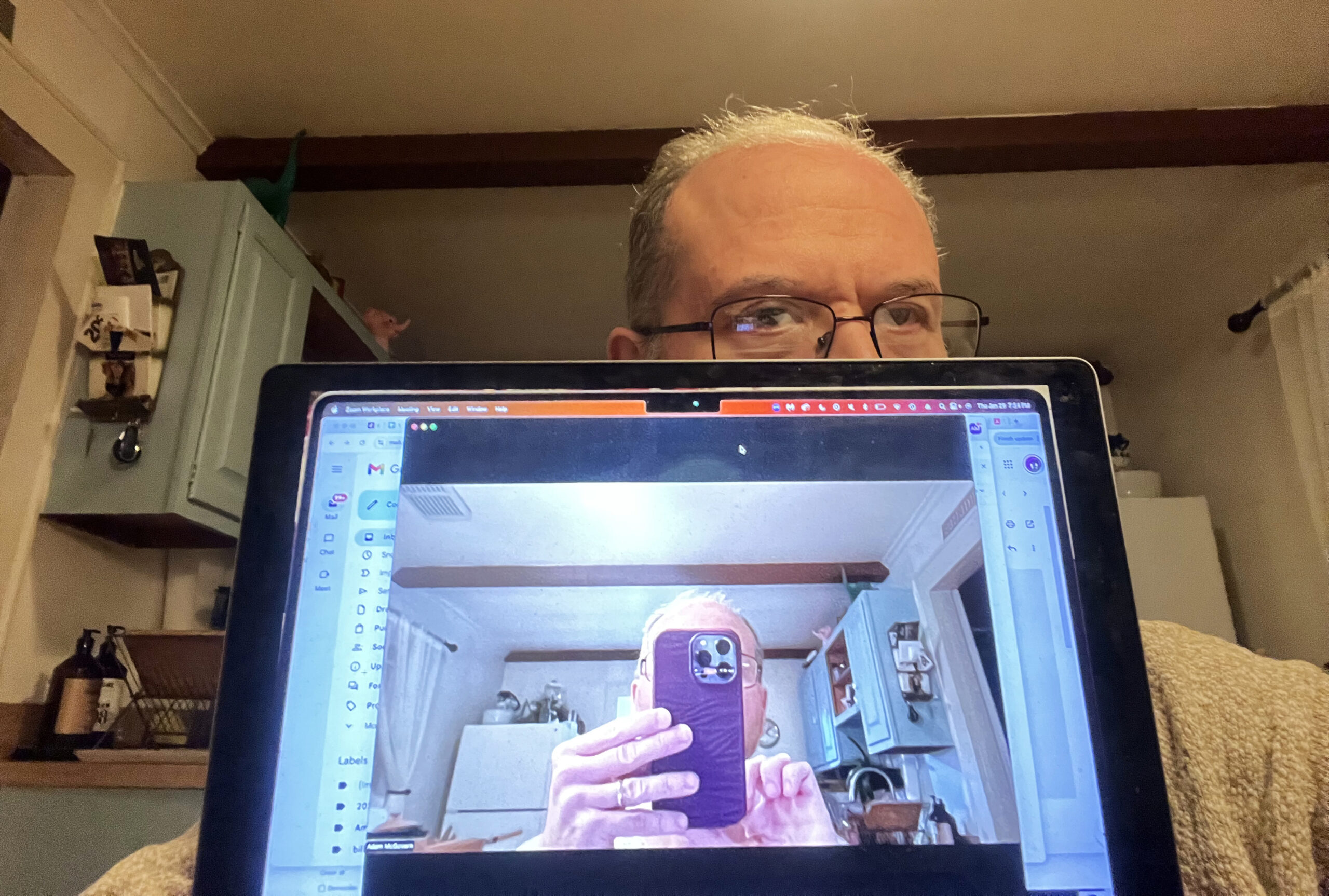
Mount Tabor, NJ…
HILOBROW: What music — genres, particular artists and songs — do you listen to during a typical day?
ADAM McGOVERN: Listening has become breathing. Brian Eno had it slightly wrong, he envisioned music that would be like wallpaper, a permanent background, and he saw this as in some way liberating sound from the artificial prison of being limited to a turntable or a tape deck and being listened to only at assigned times (in the same way guerrilla performance and street-sculpture sought to free art from the captivity of the white-walled gallery and bring it into people’s daily awareness, to emulate how an African mask is not just the mask, but the ritual that accompanies it when worn, and the pottery we see in museums was once someone’s lunch bowl). However, music is not recessive now, it permeates; not background, but literal atmosphere. It drifts over our coffee-break or grocery-run like breezes and we collect it out of the air like dew. These days I do all my listening by coincidence, in cafes and stores or during shows or in the car; my favorite songs are from soundtracks and ambient playlists captured by Shazam. The score to Hazbin Hotel gave me my song-of-the-decade so far (“Whatever It Takes,” season 1, ep. 3); random Starbucks and supermarket selections sent me down rabbit holes and into wonderlands of post-trip-hop chanteuses and neo-torch singers like Rachel Chinouriri, Lola Young and girl in red. The algorithmic associations of my in-car music service reminded me of First Nations sound sculptor Tanya Tagaq after I typed in artificial-native Buffy Sainte-Marie, and I didn’t turn back. At its best (and as good as it gets), this is the century of what you almost just missed.
HILOBROW: What music did you love as a teenager? Do you still listen to it today?
ADAM McGOVERN: I find there is no “still,” just “again” — enthusiasms move in orbits. Music listened to in youth (or infancy) is treasure buried in your psyche to be mined for future understanding of what it means to you. I remember Ben Katchor remarking to me around 2010 that his students were all listening “to Louis Armstrong on Pandora” rather than anyone new, and culture loops that way for me too; I listen to the musics that exist for me at the farthest poles from each other; more that just came out or that I was played in my cradle than from teen years or young adulthood. 21st-century music abets this by, itself, reaching back to eras far behind its makers’ lifetimes, with techniques and aesthetics inconceivable outside the sci-fi soundtracks of those periods (if then). As rock was reigning, my mom was raising us on symphonies and show tunes; it was good training for displacement in time. Were these sounds instilling taste in me, or tapping pathways I’d live my truest life traveling? Probably the latter, since I did select favorites. Mom said she once left me in my highchair briefly, to come back right after Stravinsky’s The Firebird had finished and find me clapping; its tale reminded me of the mythic mashup in “Melisande” from 110 in the Shade, where “King Hamlet” travels south of Mexico to obtain an ogre’s golden fleece. This was the kind of fruitfully misremembered story Mom herself would improvise for us, and prepped me for the recombinant myth of my own poems and comics, and the mixed centuries of music in this millennium.
HILOBROW: Share a media “input” of yours that wasn’t listed above.
ADAM McGOVERN: Pollock composed his paintings by cropping them from the chaos on canvas; Microsoft knew what it was saying when it accentuated “windows” above what was seen through them; and Frames are the new Art. I write comics, and the template of white borders is what defines the rhythm and temperature of everything that narratively happens. When the pandemic hit, we all became collected in little cubes of imagery, a stack of tableaux frozen in glass, the thumbprint of our stylistic identity and personal habitat; Zoom was the museum of all our dispersed self-framings in avatars and profile pix, now stacked like those storage bays that outnumber housing units and memorialize our stuff like pharaohs in advance. Containers and components are everywhere in our consciousness, the shipping pods in multicolors that pile up on docks and look like giant pixels of an image we are tiny to, city-sized warehouses that swallow up humans one way or another. I remember a lobbying trip to DC, in the last year before it was under occupation, eating ice cream across from a glass-module apartment block, each wall-sized window a diorama, with smaller screens playing within them, a living comic or zoom-grid. Concentricity is the medium of our consciousness now, a nesting of interiors. Are we living or dead inside the box?
MEDIA DIET series: MATTHEW BATTLES | DEB CHACHRA | ADRIENNE CREW | HOLLY INTERLANDI | CAROLYN KELLOGG | MARK KINGWELL | ADAM McGOVERN | CHARLIE MITCHELL | TOM NEALON | PEGGY NELSON | ANNIE NOCENTI | GARY PANTER | LYNN PERIL | JONATHAN PINCHERA | HEATHER QUINLAN | NICHOLAS ROMBES | CARLO ROTELLA | LUCY SANTE | SETH | MIKE WATT | JUDITH ZISSMAN | & more to come! Visit the SERIES INDEX.