
BROKEN KNOWLEDGE (13)
By:
November 26, 2025
University of Toronto philosopher Mark Kingwell and HILOBROW‘s Josh Glenn are coauthors of The Idler’s Glossary (2008), The Wage Slave’s Glossary (2011), and The Adventurer’s Glossary (2021). In 2022, they engaged in an epistolary exchange about science fiction. Via the series BROKEN KNOWLEDGE, the title of which references Francis Bacon’s philosophy, HILOBROW is pleased to share a lightly edited version of their exchange with our readers. Also see Josh and Mark’s previous exchange 49th PARALLEL.
BROKEN KNOWLEDGE: FIRST CONTACT | WHAT IF? | A HYBRID GENRE | COUNTERFACTUALS | A HOT DILUTE SOUP | I’M A CYBORG | APOPHENIC-CURIOUS | AN AESTHETICS OF DIRT | PAGING DR. KRISTEVA | POLICING THE GENRE | FAMILIAR STRANGENESS | GAME OVER | THE WORLD VIEWED | DEFAMILIARIZATION | SINGULAR CREATURES | ALIEN ARCHAEOLOGIST | THE PHENOMENOLOGY OF SCREEN-TIME | HOMO SUPERIOR | EVERYTHING IS US.
31st October, 2022
TORONTO GENERAL HOSPITAL
Hi Josh. Yes, I’m still in the hospital! I was going to wait to respond to your last until I got home and could be comfortably behind my usual desk, but they keep finding things wrong with me. Every little problem seems to require two or three days of reaction: test, bad result, order new test, try treatment, new test, procedure, test, etc. I consider myself a man of science so this is all perfectly rational from an objective point of view but I’m starting to feel a bit like a lab rat. On top of it all, after two years of extreme caution and care, I got covid last week! I guess the only good thing about getting covid from being in the hospital (probably some careless visitor) is that you’re already in the hospital and can be treated for covid. My symptoms so far are mild and I’m not too worried about it.
As usual, I have lots, probably too much, to say about your last post. Here are a few reactions. Your summary of the robot theme is excellent and basically mirrors the early discussion of “robot” in my new book, Singular Creatures. I didn’t know about the early story by the Čapeks, though – must hunt that down. I was and am particularly exercised by the political questions here, which range from the factory-exploitation version of the robot to the can-we-live-together of more recent depictions of non-human entities. The violent takeover scenario forms a kind of middle term between outright slavery of automated entities and equality of some sort. I won’t rehearse the whole argument of the book here, but this continues to fascinate me as time goes on, not least because AI – if not androids – are more present in daily life by the week.
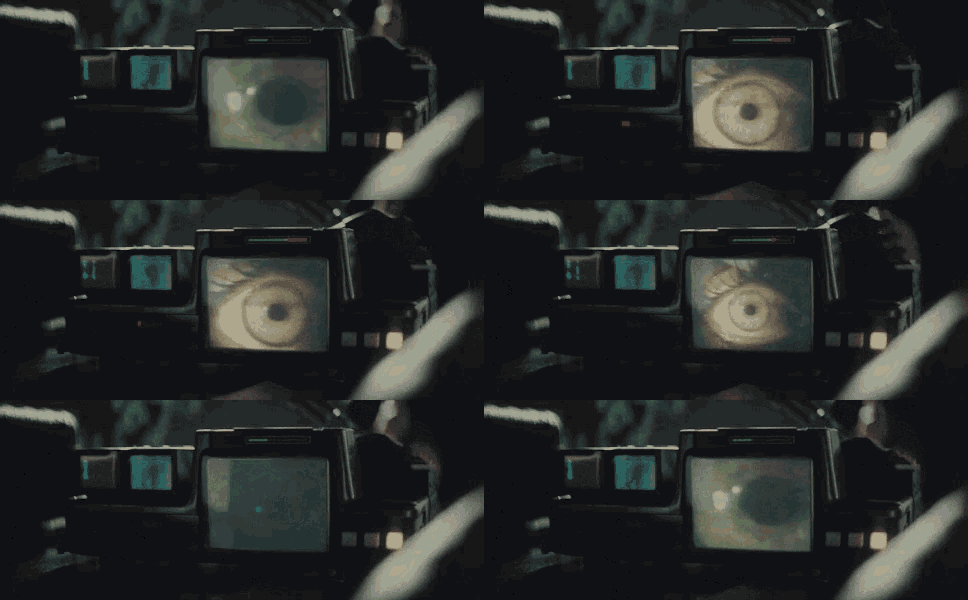
I love the Wilde quote and what it implies for film, since it clarifies my argument. The uncanniness of film is its use of the world to depict the world. But the very presence of the camera, blocking, shifting angles, cuts, lighting, soundtrack, and so on create an aesthetic universe that is neither this world nor a faithful representation of it. We are its temporal and cultural prisoners. Among other things, this is a universe of cliches so familiar that their very repetition can seem at once comforting and strange, where narrative enslavement to time can be noticed but not really obliterated, where human physiognomy is celebrated and tortured. The uncanny feeling is normalized by the situation: we submit to the apparatus of the camera. But that’s the thing – uncanniness only works when the familiar and strange are both present in a kind of epistemological slippage. That’s what the Voight-Kampff test is about, attempting to overcome the uncanniness of what Cavell called “the world viewed.” It’s supposed to distinguish the real from the artificial. But push too hard and – well, we all know what happened to the Blade Runner who preceded Deckard. Think of the movie camera as the inverse of the V-K machine, making what is obviously artificial seem to be real – a bargain we make with ourselves and the medium.
Someone might object that, by this reasoning, all aesthetic mediums are uncanny and, in a way, that’s true. The play of mimesis over the centuries, the trompe l’oeil goal of tricking the eye into mistaking appearance for reality, is ever-renewing and paradoxical. Perfect representation is a disappointing endgame (the birds can’t eat the grapes painted by Zeuxis) and so modes of representation become playgrounds of the potentially strange. More on all this in my book, if and when I get to it! I want it to be a short, cine-centric, thematic eccentric primer on aesthetics. Because technology is so central to film as a medium, it might even form the third volume in a notional trilogy consisting of Wish I Were Here (my book on boredom and technology), Singular Creatures, and this projected meditation on film. Overarching theme: the questions concerning technology in three encounters (the interface, artificial intelligence, film). Maybe!
Anyway, a few more things before I rest my eyes a bit. Too much screen time in this isolation-ward life (though thank god for it). A Janeite is of course a devotee of the works of Miss Austen, sometimes to the exclusion of all else, like a Swifty or a Belieber. Austen’s books have had so much cinematic attention in recent years that I sense that old-fashioned Janeites have gone underground. I used the ‘sort of’ because a lot of times undergraduates are Janeites in all but formal acknowledgment: fiction just is naturalism about romance, money, family, marriages, and sometimes the weather.
The last thing is a deferral. Yes, my biggest concern in all my work is the future of democracy (not so much ‘humanness’ — as a colleague of mine says, we have always been posthuman) under current techno-capital conditions. Climate change may ‘solve’ the problem for us. But I’ll take a break and offer some sketchy thoughts in another post.
Mark
ALSO SEE: Josh’s BEST 250 ADVENTURES of the 20th CENTURY list | Mark on BATTLESTAR GALACTICA and THE HONG KONG CAVALIERS | Mark and Josh’s exchange 49th PARALLEL.