
THE “V” FORCE (3)
By:
August 29, 2026
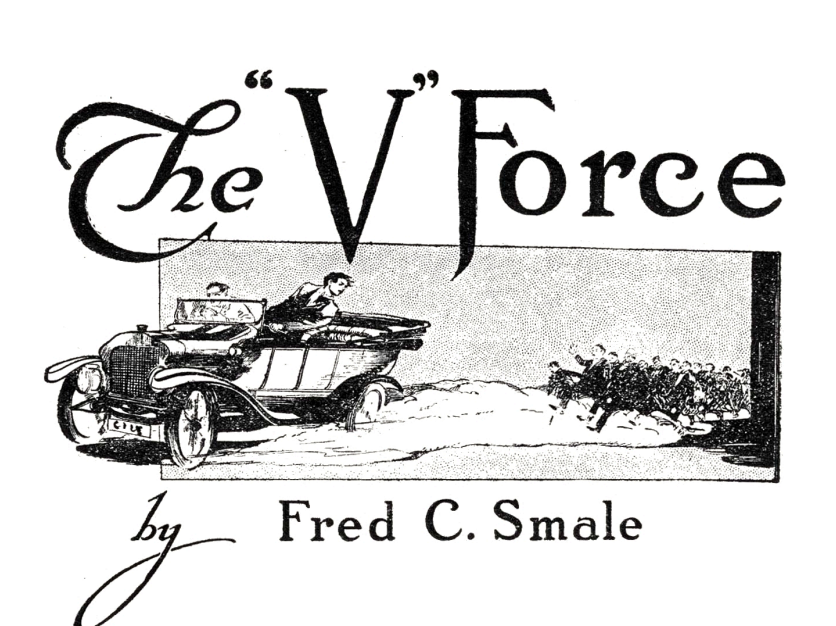
Fred C. Smale’s “The ‘V’ Force” was first published in All Story Magazine, December 1913. Surtees has returned from Tibet with an engraved metal bar that glows in the dark… and has mysterious effects on living things. (As you read, please note that Tolkien didn’t conceive of his malign ring of power until c. 1937.) HiLoBooks is pleased to serialize the story for HILOBROW’s readers.
“The back!” cried Surtees.
We dashed from the room, holding the bar between us. Our strength seemed irresistible. We moved as one individual, and even our unspoken thoughts seemed in unison.
We burst through the flimsy door leading to the back premises, carrying it clear off its hinges; and I afterward found that the jagged iron of one of these had caused a nasty gash in my shoulder.
I felt nothing then.
On we raced, through a yard and into a narrow lane. Then, without a word passing between us, we burst off like some quaint quadruped. For a few minutes we saw no one, then suddenly we found ourselves in a main thoroughfare — the Edgeware Road, I think, but am not sure.
It was now nearly one in the morning and very few people were about; but we were dimly conscious of curious swervings on the part of those we did pass, and presently we heard the pattering of footsteps behind us. We kept to the center of the road, which at that hour presented few obstacles. We could not have dropped the bar now even had we desired to do so.
Our pursuers seemed to be growing in numbers. They were horribly silent. There were no shouts — no cries to those ahead to stop us — only that fearsome patter of many feet behind.
We dived down a side street which took us into an open space — Norfolk Crescent, we found it to be afterward. It might have been the top of the monument for all we knew then. Apparently our pursuers had received a check, but, even as we paused a second, the head of the procession poured into the crescent.
At the curb in front of one of the houses stood a motor-car — a long, low, gray machine.
“Quick!” panted Surtees hoarsely, speaking for the first time during our flight.
We literally flew to the car. The chauffeur was dozing in furs. As we came up he lurched sidewise and fell almost at our feet. We scrambled over him into the car, and, while Surtees seized the steering-wheel with his free hand, I jerked back the starting-lever.
Luckily, we both understood motors. The vision of a wild-eyed man, clutching vainly at the back of the car, danced momentarily across my vision. I reached back to fling him off, and a sea of fierce, gibbering faces seemed to glide smoothly away.
I looked round dazedly. We. were on a broad road which appeared to stretch away into infinity.
Surtees sat beside me, his jaw set like iron, and his eyes glowing like live coals under his knit brows.
“Cannot we drop this infernal thing? It is like being handcuffed,” said I.
I had no need to raise my voice. The car was almost noiseless.
“Try,” said Surtees grimly.
But my hand felt paralyzed. I realized that I had no power over it. But I was desperate. It seemed ridiculous that I should not be able to conquer this mere piece of metal.
Lowering the bar, of course with Surtees’s hand as well, I placed my foot upon it and we wrenched our bodies back suddenly.
I groaned with pain. Half the flesh seemed torn from my hand — but we were free and our tyrant lay at the bottom of the car.
“Shall I kick it out?” said I.
“No — no!” replied Surtees: “The sea!”
I understood. He meant to give this thing effectual burial.
I leaned back and laughed a little. I was just beginning to realize what we had done and were doing.
“Where are we?” I asked.
“Great Bath Road,” he answered.
“But the sea!” I exclaimed. “Why not the Norfolk or Sussex coast?”
“I didn’t stop to think it out,” re-turned Surtees dryly.
“Then we must go on —”
“Until dawn.”
“And then——”
“Relief and freedom,” said Surtees, his eyes fixed on the road before him.
The houses were thinning now and there were no lights. Fortunately those of the car were powerful.
“Well, we are free now,” said I, “if it comes to that.”
I seized the side of the car and strove to raise myself from the seat. It was impossible and I sank back in renewed dismay. It was as though we were bound down by iron bands.
“Sunlight the only antidote.” My friend’s words flashed through my brain. Truly, we must go on — until the dawn.
“Is there petrol enough?” I asked.
Surtees shrugged his shoulders.
“I hope so.”
“Where are we going?”
“Devon or Cornwall. What is the time?”
My watch had stopped, but just then we heard a bell somewhere give a solitary stroke.
“One,” said Surtee. “Sunrise half past six or thereabouts — over five hours.”
The effects of our violent exercise were passing off, and after binding up Surtees’s wounded hand as well as my own I busied myself with hunting out the rugs which had been considerately left in the car. I found no goggles or vizors, and as the roads were in perfect condition, neither muddy nor dusty, we had no need of such.
We had met very few vehicles. A belated four-wheeler or two and one other motor were all, and we were going at too great a speed for the bar to have any effect on those.
When we overtook anything, however, it was different. This only happened once — between Slough and Maidenhead. On a long stretch of road we rapidly overhauled the red light of another car, and as we came within thirty yards or so it suddenly slackened speed so that we almost dashed into it.
We swerved aside and dashed by. The other car seemed to leap at us and the occupants to tumble together of a heap. I set my teeth and held tight, but we just managed to clear them. Only our great speed saved them and us from what would no doubt have been a particularly complicated smash.
It must have been a very mystified party of motorists that we left behind, but we never learned that any one of them was hurt. Fortunately, throughout the whole of our journey the experience was not repeated.
I need not detail the entire course of that trying journey. We got no chance of bite or sup.
Luckily the car held out, and the gray light of dawn overtook us on the north coast of Cornwall, where we drew up at last somewhere between Padstow and Newquay, near the edge of high cliffs directly overlooking the sea.
Our red-rimmed eyes looked out from pallid, dust-begrimed faces over a slate-colored expanse of waters. We were cold and faint with hunger.
With an effort I managed to drag myself from the car, but was for some minutes unable to stand. Natural stiffness seemed all we had to contend with now. True, our limbs seemed leaden and we lurched drunkenly against the side of the car; but presently we realized that the dread power of the bar was almost if not quite vanquished.
What would not we have given for a flask of brandy or even hot coffee — tea — anything to ease our parched throats and warm our chilled blood!
Presently the ruddy rim of sun shot over the horizon to our right, and Surtees, staggering to the car, rolled back the rugs and seized the bar recklessly. He held it to the ruddy beams of the rising monarch which were struggling through the wintry morning mist.
He gave a crazy, chuckling laugh. Then his face changed and a furious expression came over it.
“Curse it!” he cried, and, turning seaward, he drew back his arm and flung the bar with all his strength far out over the dull-gray waters.
We could not discern the tiny splash where it fell some twenty or thirty yards from the shore and in, as we afterward ascertained, about twenty-eight fathoms of water.
We stood gazing dumbly for a moment. Then we realized that we were at last rid of our ghastly incubus and we danced on the grassy sward like lunatics.
“Sorry for the fish,” said I.
“Whatever the infernal thing can do,” said Surtees, “it can’t rise from the sea.”
We turned to the car and our eyes met. Surtees laughed rather grimly.
“We are in for trouble,” said he.
“On the contrary, we are just rid of it,” I returned lightly. “We have only to explain —”
I paused, and Surtees laughed again.
I paused, and Surtees laughed again.
“Who will believe?” said he. “No — we must clear out. The machine is useless to us now. There is no petrol. We must leave it here.”
I stood doubtfully and was about to make some suggestion, I know not what, when a glance seaward drove the blood from my face afresh.
At the spot where the bar had sunk was a huge mound of water like a gigantic wave. The surface of it was was white with foam, and though it was as yet in the shadow of the cliff I thought I could discern something writhing and leaping therefrom.
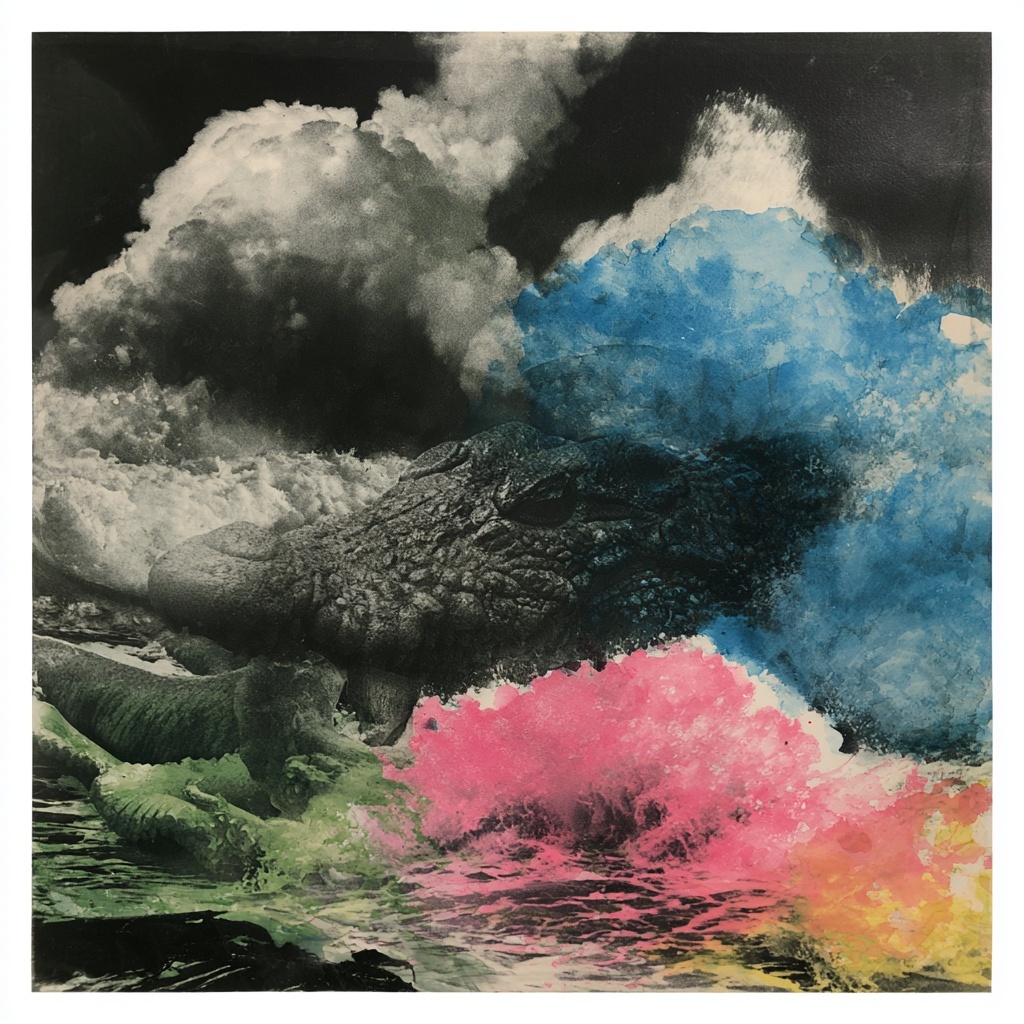
Walter Surtees and I gazed spellbound. A sea-fog was rolling in rapidly, growing denser every moment, and ere it blotted the great tossing wave from our view, I fancied I saw a terrible, scaly head arise from the turmoil — a hideous monster with wildly whirling tentacles and ghastly, wide-open eyes.
Then the fog hid all. We lingered no longer, but turned and ran wildly, whither we knew not — anywhere away from that awful nightmare.
We escaped all awkward inquiries more by luck than anything else. We found ourselves possessed of a few pounds in cash, enough to take us safely to Falmouth and thence to Jersey and France, where we lay perdu for a while, easily reenforcing our funds by means of letters to our bankers.
The English newspapers were particularly interesting to us during the next few days.
We read how the Hon. Stockwood Ridgeway’s motor-car had been found deserted on the Cornish cliffs; of the mysterious happenings in the neighborhood of Pelham Street, W., and of the no less inexplicable slaughter of fish near the coast where the car was found, some hundreds of tons being cast up on the neighboring sands every tide for some weeks following; but a convenient theory of submarines accounted for the last named, and, curiously enough, the “riot,” as it was termed, in Pelham Street, of which, after all, a few broken limbs were the worst results, was never connected in any way by the press with the “hiring” of the car.
I suppose our exit by the back door and dash down the lane broke the link which might have somewhat enlightened the public. Yet what more would they have learned?
What do even Walter Surtees and I know, after all? Where is the accursed bar now?
Walter Surtees suggests that some ill-advised saurian has swallowed it and borne it off to spread calamity in other climes when its periodic power shall return.
I have sometimes wondered whether this story may not contain a clue to the fatal and unaccountable deviations of ships from their correct courses when near the Cornish coasts.
However, here my story ends, as far as I know it.
I hope it may never have a sequel.
RADIUM AGE PROTO-SF: “Radium Age” is Josh Glenn’s name for the nascent sf genre’s c. 1900–1935 era, a period which saw the discovery of radioactivity, i.e., the revelation that matter itself is constantly in movement — a fitting metaphor for the first decades of the 20th century, during which old scientific, religious, political, and social certainties were shattered. More info here.
SERIALIZED BY HILOBOOKS: James Parker’s Cocky the Fox | Annalee Newitz’s “The Great Oxygen Race” | Matthew Battles’s “Imago” | & many more original and reissued novels and stories.