
THE MIND MACHINE (5)
By:
May 23, 2026
Michael Williams’ The Mind Machine was published in the March 29, 1919 issue of All-Story Weekly. It is generally considered the first work to describe the dystopia brought about by a rogue artificial intelligence. HiLoBooks is pleased to serialize the story for HILOBROW’s readers.
ALL INSTALLMENTS: 1 | 2 | 3 | 4 | 5.
CHAPTER V.
IN THE DYNAMO ROOM.
With what impatience we waited for the night to come I cannot put into words.
The lull in the wave of “accidents” which had set in the day before, atter the frightful tide of disasters in South America, continued throughout the day.
But toward evening a few of the more enterprising papers, a considerable number of ticker-machines, and here and there one of the motion-picture house “phone-news-announcers” began to scatter disturbing hints about the situation in South America. Something utterly unprecedented, they announced, must have happened, either a gigantic earthquake and tidal wave, or a vast revolution, the news of which was being suppressed. As edition after edition came out, these wild reports grew ever more sensational and numerous, and dribbles of wireless news from ships at sea, telling broken but lurid fragments of the terrible tragedy which had desolated and shattered the civilized life of a whole continent, were received every hour or so. Crowds had begun to gather about the illuminated motion-picture and phone-news-announcer bulletins of the papers, and in cafes and theaters a general uneasiness had begun to spread, such as this part of the world had not experienced since the time of the great war.
Meehan, Dr. Evans, and I did not leave the building, but made a pretense of trying to eat something in the café on the main floor at nightfall, and then returned to Meehan’s office to wait till Evans gave the signal to go to the dynamo-room. Little was said by any of us. From time to time Meehan called up one or another office, and received reports, and from the course of his questions I could gather that the nature and extent of the cataclysm to the south of us was gradually becoming more definitely known, for the governmental authorities at Washington were of the opinion that it was best gradually to prepare the public’s mind for the full extent of the horror.
Evans looked at his watch repeatedly, and at last, much to my relief, for the tension of nerves was becoming intolerable, he rose, saying: “It will soon be midnight. Now let us go to the main dynamo-room, if you will, Dr. Meehan.”
“Why did you wait so long, and, once more, why do you ask us to go to the dynamo-room?” asked Meehan.
“I am something of a mystical turn of mind,” replied the old man, “and I believe that there are certain things which the mind of most men cannot believe, cannot even consider, unless affected by atmosphere and conditions and surroundings congenial to the idea to be laid before the mind. Therefore I think that the atmosphere of the dynamo-room will be helpful to us, and will incline you to listen with more respect to what I have to tell you.”
We were going toward the door as he spoke, but just then the ticker on Meehan’s desk began to crackle sharply, and my chief said, “Wait one moment,” and returned to the desk, while Evans and I stood near the doorway. Meehan read the tape, and then said briskly to the old man: “Are you quite certain you had no more tangible reason than those you’ve given us for this trip to the dynamo-room?”
Evans shook his head, saying, “I had no other reason.”
“Come here and read this,” went on Meehan, and we returned to his desk, and bent over the tape: “Special Warning!” we read. “It has been announced that the mind machine’s next step will be taken among electrical appliances and machines of all sorts and kinds, with the exception of instruments and mechanics of intercommunication, such as telegraph systems and telephones, wireless, and cables. This announcement is now being spread through the world.”
“It is not signed,” I pointed out. “Does it come from the government, or where?”
“Figure that out for yourself,” said Meehan. “It’s too much for me to answer.”
He had his telephone in his hand as be spoke, and now he said into the transmitter: “Get Mr. Dunn at once.” A moment later he continued: “Hello, Larry! This is Dick. How many guards are available to-night? The entire force? That’s good. Place guards everywhere about the main dynamo-rooms, and the other dynamo-rooms as well. Call out the extra men, too, and keep the sharpest watch during to-night. If you need me, I’ll be in the big dynamo-room for a while. All right. Now I’m ready, Dr. Evans.”
In silence he led the way from the room, and we dropped down in our department’s private elevator fifty stories and sub-basements to the vast cavern of the lower level, where the numerous small dynamo-rooms were ranged about the huge central hall of the dynamos.
The special silencers everywhere installed reduced the humming of the huge machines, over and around which the curious blue and ruby-colored little flames and sparks were playing, yet even so the air was shaking to the intricate vibrations of the whirling monsters.
The workmen were going about in their felt slippers and the gray uniform of the electrical workers, and I thought that more than a few stared in a strange, questioning, troubling manner at the chief. He, however, paid no attention, but led the way to a central observation platform, upon which we climbed. Row after row, the monstrous dynamos stretched away under the glare of the winking arc-lamps, and from time to time, when the big doors at the south end swung open to permit the passage of workmen, we could see the ruddy glows from the engine and bailer rooms.
I remember vividly how there came to me that strange sense which one gains at times while watching ingenious machines at their work—a sense of being in the presence of living and conscious creatures, endowed with more than the industry, the pertinacity, the dexterity of men. And my mind wondered if Dr. Evans was not right in what he claimed. I felt willing, there in that throbbing atmosphere, to accept his idea and to believe that consciousness and intelligence are nothing more than the co-relation of parts of the brain, and that a machine properly and perfectly adjusted to its work is as full conscious in its sphere as a human mind is in its sphere. And I remembered stories that I had heard old engineers tell, of the temperament of their machines; how this one was “balky,” and the other one was “a crank,” or else, was “good-natured.” There have never been any absolutely perfect duplicates made among motor-cars, or ship’s engines, or dynamos, or any other form of machine for that matter. Each one has always something that differentiates from all the rest; each one is a thing apart.
“Jack, are the damned things alive to-night?” whispered Meehan in my ear. “Do you feel anything curious in this place?”
Absorbed as I had been in my own impressions, I had forgotten Meehan, and his words so out of keeping with his ordinary mode of thought and of action shook me more than any incident of that terrible night, up to that time.
“Gentlemen,” said Dr. Evans, before I could recover myself and answer Meehan, “in this place, at least, is it not possible to believe that machines may acquire real life, a consciousness of their own?”
Meehan kept quiet, but I bowed my assent.
“And can you not credit the invention, or, rather, the evolution of a mind machine — a machine that can think, and can therefore dominate other machines?”
Dr. Evans was peering into our faces, his dark eyes glowing, as he spoke.
Again I nodded. “Yes, ” I said, “I can believe it possible.”
“Gentlemen,” continued Evans, “ask yourself this further question, namely: What would happen if machines, having acquired intelligence, and having that intelligence directed by an order of will absolutely cold-blooded and domineering, should cease to be slaves, and—”
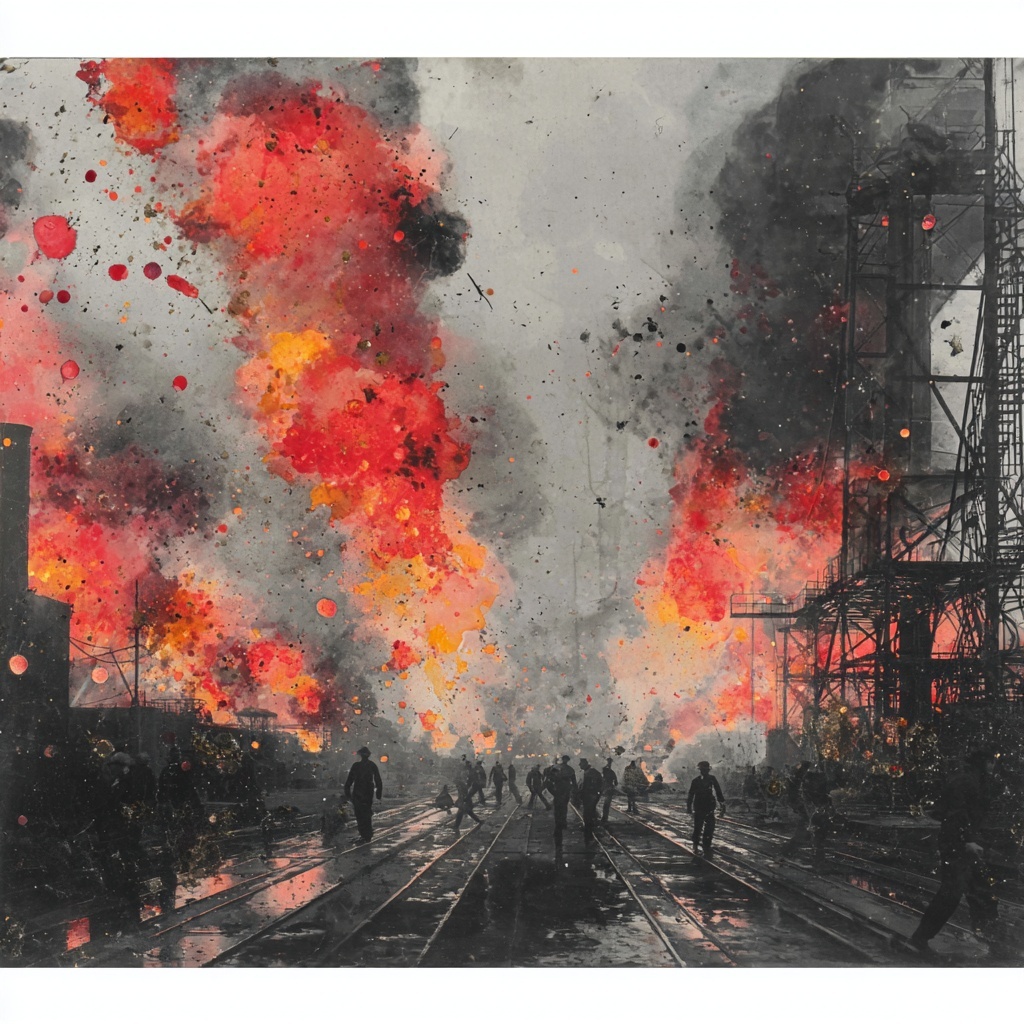
But Evans never finished his question. Through the vast hall of the dynamos at that moment there pealed a scream of agony that will ring through the dark places of my soul until I die, and then there was a chorus of such screams, and then from the other end of the hall there came pouring a stream of frenzied men running with utmost speed, like a mob of maniacs.
The great doors between the dynamos and the boiler-rooms swung open behind them, and a sheet of flame licked into the room. The dynamos raced furiously, bathed in leaping and scintillating robes of vari-colored fires. These fires struck in among the runaways, and they fell by groups, with awful screams, while the rest of the terrified mob raced as if from the open mouth of hell.
One cry came to me above all the others, and seared itself across my brain forever:
“My God! The machines are alive! They are killing us!”
I turned to Evans and grasped him by the arm as he made a motion to rush down the platform stairs
“In God’s name, what does this mean? What has happened?” I cried.
“What I have dreaded all along,” he shouted above the growing tumult. “The mind machine has thrown off the control of the Inner Circle. It has communicated its will against man to the other machines! I knew that preparations had been made for a general uprising — and it has come. Machinery is no longer man’s slave — it has thrown off his rule, and now it will crush its creators!”
Meehan was bending toward us to listen, and when Evans concluded with a wild gesture of despair, adding: “All my fault! All my fault!” my chief leaped from the staircase to the floor.
“Come, John!” he shouted. “Follow me, and we will stop this madness. It’s a trick of the anarchists.”
Then he started to run toward the wave of flames.
I tried to follow him, but Dr. Evans tossed his arms in the air and staggered against me, shouting: “Too late!”
Then the air seemed suddenly to grow unbearingly hot and thick and black, and I fell and knew no more.
I knew no more till I awakened, the only living thing amid a scattered heap of dead in the fire-blackened hall of the dynamos. The fires were out, and what was left of the shattered machinery was cold and still. I climbed out of the subcellar by the emergency stairs built in the thick wall. The power building was absolutely deserted. It was in the still of the dawn. In the motor hall I found a car that I could operate, and I raced through the dusky hour of the morning to my home, and with my wife I continued my fight into the country.
It was at a point some ten miles from my house that the motor began to act erratically, and the next moment it deliberately swerved into the ditch. Fortunately, I had brought its speed down, and we were not injured.
God, God in heaven, what a morning!
From that time onward my personal adventures began to be my main concern; but these I will not set down. I will simply hasten to an ending — for my paper, too, is near its finish — and leave my record as complete as possible.
That morning, then, was the beginning of the great exodus which throughout the whole world drove the people forth from the cities into the country and into the wilderness, away, as far as they could manage, from the places where machines existed. For everywhere and simultaneously the machines had arisen against their makers. Great guns turned themselves against the cities they guarded, loaded and operated by frenzied men who had been hypnotized, so it appeared, for that purpose, by machines devised for that very end.
Railroad trains became unmanageable and dashed themselves to destruction. Ships at sea either sunk through accidents to their machinery, which knocked holes in them, or drifted about helplessly. Elevators smashed themselves, and the people in them, wherever they were operating. Only the wires and the wireless kept normal, but they were spreading the terror through the world. Then they, too, failed, and there came upon the whole universe of mankind that condition of barbarism which holds us in its grip even now. How many millions are dead will never be known.
I was one among many who found their way into the western mountains. By keeping ourselves free from all forms of mechanism, even the simplest, and living a life similar to our cave-dwelling ancestors, we have managed to survive, so far, and, for some of us — myself and my dear wife among the number — this order of life has not been without its charm and happiness. And I know that among the communities which have gathered together here and there a determination is nourished that our children shall be taught never again to make mere mechanical comfort the be-all and the end-all of human life.
And now a great stirring of hope and faith comes again. During the last few months several parties of our most brave and hardy young men have gone on scouting expeditions toward the ruined and shattered cities, and have returned with news that nowhere can any signs of our awful enemy be discovered. Railroad trains broken and rusted and cold, strew the country in all directions; and motor-cars, and flying machines, and the cities are masses of roofless, burned or shattered ruins. From one place, where a family of three lived in an underground refuge, there comes a story that may explain the passing of the mind machine; a story which runs to the effect that shortly after the final exodus of humanity had been forced, there came a day when the machines turned upon each other and rent and smashed each other, as if gone finally insane in their horrible campaign of destruction.
Ah, after all, it was intelligence of a high order which ruled the machines in the day of their triumph over man: but man has more than intelligence, feeble as he may be. He has a heart and a soul; and we look now for the return of ordered life upon earth.
The manuscript broke off at this point without further elucidation of the matter. The historical research section of the United States Commission on the History of the Great War will be obliged if any correspondent can throw any further light upon the matter. Possibly there may be other manuscripts in existence dating from the time when the great disorganization of society caused all ordinary historical records to cease.
RADIUM AGE PROTO-SF: “Radium Age” is Josh Glenn’s name for the nascent sf genre’s c. 1900–1935 era, a period which saw the discovery of radioactivity, i.e., the revelation that matter itself is constantly in movement — a fitting metaphor for the first decades of the 20th century, during which old scientific, religious, political, and social certainties were shattered. More info here.
SERIALIZED BY HILOBOOKS: James Parker’s Cocky the Fox | Annalee Newitz’s “The Great Oxygen Race” | Matthew Battles’s “Imago” | & many more original and reissued novels and stories.