
THE MIND MACHINE (4)
By:
May 18, 2026
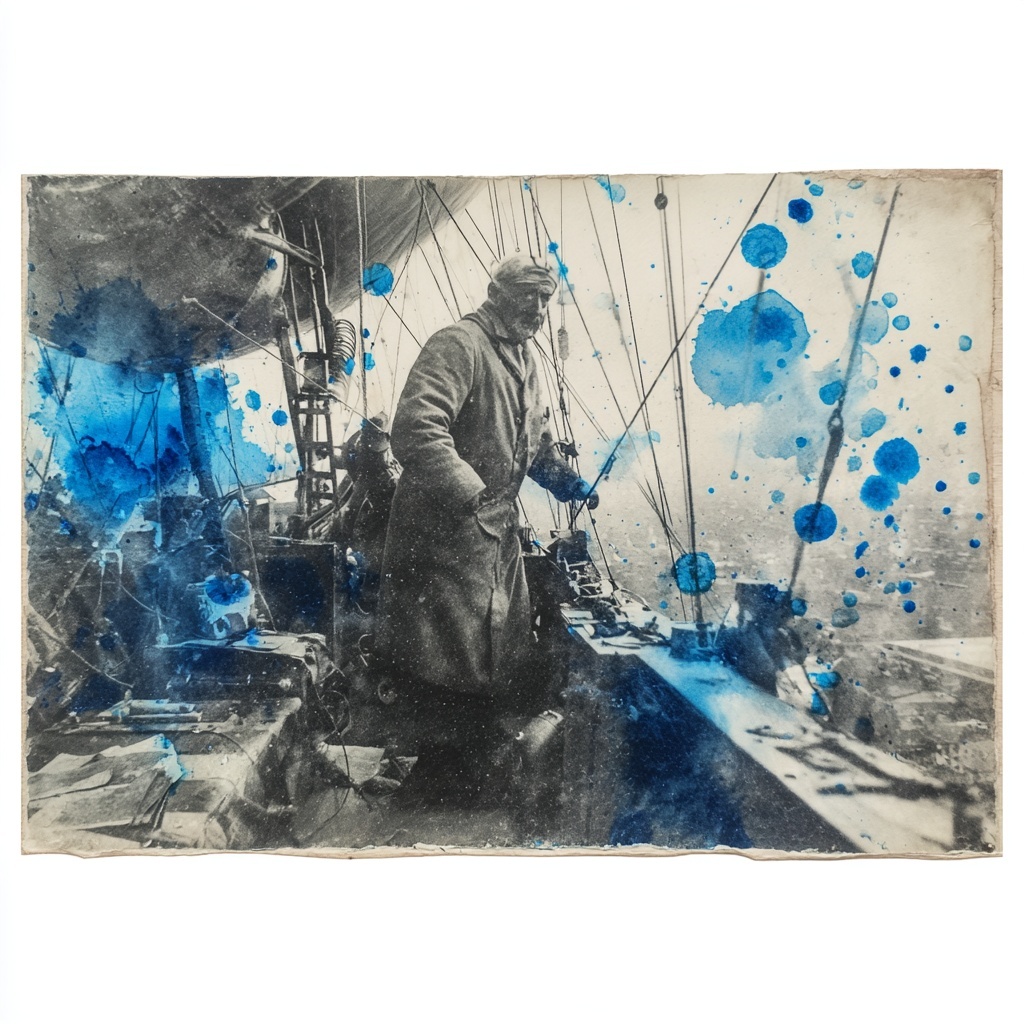
Michael Williams’ The Mind Machine was published in the March 29, 1919 issue of All-Story Weekly. It is generally considered the first work to describe the dystopia brought about by a rogue artificial intelligence. HiLoBooks is pleased to serialize the story for HILOBROW’s readers.
ALL INSTALLMENTS: 1 | 2 | 3 | 4 | 5.
CHAPTER IV.
THE MIND MACHINE.
Meehan called me away from the midst of an important experiment two days later, the instant he had received Lawrence Dunn’s report. Our chief of detectives had personally taken charge of the investigation of Dr. Evans, and Meehan was greatly excited by the news he had received.
“We were right in our identification of the photograph, John,” he said, as soon as we were alone. “Evans and Griffith are one and the same.”
“Does Evans admit it?” I asked.
“He does. He made no secret of the fact, as soon as Dunn went to him, after running down clues elsewhere.”
“Why didn’t he tell us that the other day,” I inquired, “when he might have saved us two days?”
“His reason seems to be that he wants us to find out some of the important factors of the mystery ourselves,” answered my chief. “He frankly told Dunn that he was treating us a good deal like children, who must be led on step by step. The truth which was at the heart of it all is so dreadful, and so strange, that we must gradually accustom our minds to receive it.”
“Well,” I asked, “and do you take any stock in Evans now?”
“I’ll take stock in any proposition that may clear up this abominable situation,” declared my chief, smiting his desk with his fist. “It’s growing worse and worse.”
I assented, remembering the sickness of heart and faintness of soul with which, that very morning, I had read my paper, where, across the front page, there had been spread the words: “Awful Wave of Power Company Accidents.” From many parts of the country there were despatches telling about the large number of deaths and injuries caused in I. P. M. factories, operating plants, and even in our clerical offices. For example, Judson Tilley, the general office manager of our Cleveland, Ohio, headquarters, had been found dead in his own home, killed by what was vaguely described as “a charged wire” while telephoning to a theater for tickets. In the Toronto, Ontario, office, six telephone girls had been killed by the collapse of an express elevator. “Unprecedented weather conditions” were blamed, in a despatch from Arizona, for the total disorganization of the telephone service in that State, together with many deaths caused by shock. During a severe thunderstorm, ail the lightning-rods and other devices for “grounding” lightning that might reach the company’s wires had unaccountably failed.
And on the editorial page was an article headed, “IS IT POSSIBLE?” which article, in guarded, but significant language, repeated the two theories which now were rapidly spreading everywhere: first, the theory that a certain European power was starting a new war, and the theory that a ring of anarchists was reattempting the task which the industrial prosperity following the great war had apparently crushed out, namely, the total disorganization of society and the ushering in of a reign of terror.
“Yes, Dick,” I said, “the papers this morning made me sick, and on the cars and in the airplane station I heard people talking and kicking about the mismanagement of the I. P. M. I was afraid the papers would start something, soon.”
“The papers be damned!” growled my chief morosely. “That’s had, but it’s nothing to what the papers haven’t got hold of yet.”
“What’s happened now?” I asked rather sharply.
Meehan glanced toward the door and lowered his voice, and leaned across the table — symptoms of nervous caution which I had never observed in this superman of machinery before: “We’ve made a deal with the government to isolate news from Mexico, and the West Indies, and the Central and South American republics, at least for a day or two, to give the government authorities there time to control the situation if they can,” whispered my chief. “John, there were more than three million deaths yesterday — estimated, of course, for nobody can count them — to the south of us. More than three hundred trains ran wild. There were thousands of elevator accidents. There were innumerable fires in factories and munitions works, which caused appalling explosions. Most of the forts on the East coast are destroyed by the blowing up of magazines. In a word, all the things that have happened in little bits up here happened on a gigantic scale down there — and, great God, it’s frightful to even say the words — but the truth is that the awful thing — whatever it is: German conspiracy, or anarchist plot, or — or something even worse — is coming our way!”
“Coming our way?” I repeated, stunned almost into stupor by the shock of this announcement.
“But — but isn’t it already here?”
“Not in the great wave that South and Central America is going to pieces under,” said Meehan. “John, the awful thing started away down in the Argentine, and came sweeping, like a tidal wave of unutterable ruin and desolation and horror, from south to north, through Brazil, and Chili [sic], up through the Isthmus, into Mexico, dying out, so far as the present is concerned, among the scattered copper mines of the state of Sonora. If this is organized German terrorism, or anarchy, then it has been devised by the greatest genius of evil ever let loose upon the world, and carried out by agents worthy of their master.”
Too appalled to speak, I could only stare at my chief, while he, controlling his agitation, continued: “Just now there is a lull — like the pause in a storm before it reaches its full power. And I have sent again for Dr. Evans. Dunn tells me that Evans declares that his invention, the mind machine, after getting out of his hands, when he brought it to perfection, is being used in this this frightful business. If I were wrong and he right — I mean, if there is a machine which actually can think and carry out operations with intelligence — and if that machine is in the control of the Germans, or the anarchists, a great many curious things about this affair can be explained. Even now, however, even with the utterly gigantic nature of the catastrophe, I can’t believe in the mind machine. But, John, here is the fact which is the most mysterious of all — the fact that, so far, neither our own detectives, nor the government secret service, have caught a single one of the conspirators. There have been a few arrests of suspicious characters, but that is all. The conspiracy has been managed with diabolical skill and accuracy; it has been like a murder machine that never fails——”
Here Meehan was interrupted by his secretary, who entered to say that Dr. Evans was in the reception-room.
He was shown in at once, and Meehan wasted no time in getting at what he wanted to know.
“Dr. Evans,” he said, “I think it’s up to you to put all your cards on the table. If the mind machine is the instrument of this conspiracy, you must prove your claim and cooperate to put that machine out of business.”
The old man’s face was white like paper, made more striking in its ghastly pallor by the dark rings around his sunken eyes. He had aged ten years in the little time since last I had seen him.
“You are right,” he said tremulously. “I will do all I can. Dr. Meehan, I most solemnly affirm that my claim about the mind machine is true. At the time the tests were being made by your company, and you were sent for to appear at them, the machine was not quite perfect, but I was able to demonstrate its inherent possibilities — though, God in heaven help me! sir, I never even dreamed, in my most exalted fancies, of the full nature of those possibilities. If I had, I should have died in that very moment, by my own act, if necessary, to destroy the mind machine, and blot out every hint of its real character from the memories of men! Even now I cannot bring myself to tell you the full truth. But I will tell you all I can, all you are now able to believe: and again, once more, Dr. Meehan, I beg and implore you, sir, that you will spend a night — this very night — with me in the dynamo-room of this central power-plant, and then you will learn the truth —”
“Agreed,” curtly said Meehan. “I don’t believe what you tell, as yet, simply because 1 can’t. My mind was not built to put trust in such wild ideas as the one you ask me to receive, namely, that mechanism may be made to think: but I will take any and every chance, no matter how wild or fantastic, to arrive at some plan to stop what is going on.”
“Good!” cried the old man. “I can’t promise that we will be able to avert the doom that hangs over us, but there is one chance, and that chance we must accept. Now, sir, to return to the subject of the mind machine itself, and, in order to pre-pare your mind for the full revelation, please let me ask you a few questions.”
“You are certain we can do nothing more decisive before night?” asked my chief. The old man bowed, and Meehan said: “Go ahead then with your questions.”
The white head of Evans was bowed upon his breast for a moment, as he pondered. “Can you tell me what causes thought in a man?” he finally asked.
“No, not absolutely,” replied Meehan, a little impatiently. “We know that the brain is the seat of thought, and that the brain is composed of living cells, made up of various chemical substances combined in certain proportions, and that these chemicals may again be reduced to electrical terms, down to the so-called unit, the electron. But just how man’s sensations, passing through this brain substance, results in thought — that’s the eternal mystery.”
“Nor do I ask you solve that riddle of the ages,” remarked Dr. Evans quietly. “But if I told you that I long ago found myself able to assemble artificially all the material and chemical and electrical factors that enter into brain-stuff, and that thereby I had created the most essential factor of a thinking machine, and that finally I was able to coordinate this thinking-stuff with the various parts of an intricate mechanism, could you now believe my statement? Years ago, you said, no; but what do you say to-day, Dr. Meehan?”
“Now I would say that theoretically it may be possible, but that practically it is not possible,” said Meehan.
Dr. Evans smiled. “That is a distinct advance upon your former position,” he said. “Well, sir, the thing you consider practically impossible, I have done. On the day when you were speeding by airplane from London, to witness the final tests, I brought the work of a lifetime to completion.”
“So you assert, my dear sir,” broke in Meehan; “nor do I say that you did not do so. But I must point out the fact that on that very day you disappeared, and so did your mind machine, and now, after all these years, when you show up again — with another name, by the way — you can’t produce the mind machine.”
“Its work is speaking for it,” said the old man somberly. “And the name 1 now use is my own — David Evans Griffith is my full name, sir. And now let me tell you why I disappeared, and the mind machine with me. I will make the story short, but if I could fully express it you would have before you a history of the agony of a human soul, which even then foresaw the agony he was to cause countless myriads of human beings, and who tried to avert that disaster, and who failed. Dr. Meehan, when I heard you were coming to the final tests, I speeded up my work to be ready, knowing that even then your decision was the one that swayed the power world.
“I at that time was the greatest admirer of your genius for organization and invention; I was in full sympathy with your great dream to banish all laborious and disagreeable forms of human labor, and make the world pleasant and beautiful and efficient by the development of machinery. My mind machine was to accomplish the last link in the long chain of the evolution of machinery, from primitive stone-axes and fire-drills of our cave-dwelling ancestors, down to the flying-machine and the wireless- telegraph, and all the other marvels of today. My machine was to make machinery not merely automatic, but intelligently automatic; so that new machines should be devised that would not require human care, but would do much of the work of the world solely by itself — man’s humble but most useful servant.
“That very night, in my crowded little laboratory on the top floor of a building not half a mile from here, I added the last drop of the last chemical required to the combination of chemicals and elements that entered into the fluid which I was trying to precipitate. I watched the liquid coagulate, and boil furiously over the spirit-lamp, and change from black to purple, to red, and then to blue. The blue liquid — the blood of the brain of the machine! The liquid which contained the very spirit of life of the mind machine!
“I applied the blue liquid to the other substances contained in the brain case of my mind machine and — and in that moment, when the phonograph attachment broke the silence of the cold mass of metal which was now as much a living thing as myself, then I knew what until then I had utterly ignored: I knew, sirs, that you cannot have intelligent life without spirit being present, as well as material substances, and as the mind machine came to its life, and spoke, I was made aware that for countless generations there had been a mute, well-nigh hopeless striving toward this form of life on the part of machinery, and that now, as it was given intelligence, it was also given — from a source that was not its human creator — from a source in the invisible world, it was given a spirit of its own. Its spirit was not, however, a soul. It was a spirit that had nothing of warm, human life, but was cold and keen and utterly logical and devoid of all love and warmth. And suddenly I realized the full danger of my creation, and I think that then and there I should have dashed my machine to pieces, had not the Inner Circle, the dreaded Inner Circle which I had thought I had escaped, intervened ——”
The old man’s voice trembled, and he cast a quick glance about him.
“Go on,” said Meehan. “What Inner Circle do you refer to?”
“I had long been a member of a secret society, pledged to the destruction of what we regarded as the tyranny of the governments which controlled the world after the great war,” continued Evans. “I joined when I was a young and ardent disciple of those who led the sentiment against the growing dominance of material things, which grew to such heights after the war. The directing forces of this movement, which hoped to bring about a world state devoid of all organized law, in an ideal form of anarchistic control, was known as the Inner Circle.
“When I began to experiment, after my great idea dawned upon me, I ceased my association with this movement. I considered, after a while, that it had died out, as the world grew ever more prosperous and occupied and contented. Then I began to read your speeches and essays, and as my work on the mind machine proceeded, I became your great disciple, who believed his work would crown his master’s dream. But, as I say, in the moment of my triumph, I saw my great error, and in that moment I was seized, and my machine was also seized, by agents of the Inner Circle. I was taken to a house in Petrograd on an airship, and confined to a room for nearly seven years, while my mind machine was being studied and perfected by members of the circle.
“Then one day I was informed that I was free — free to go where I might, but that I must never again try to make a mind machine. The original, I was told, had been destroyed. The Inner Circle had hoped that it might prove useful in the coming revolt of workers which had been planned, but, so I was told, the thing was too impracticable for efficient employment. But I never believed this latter statement. When I returned to New York I was ever on the watch. I made it my business to make acquaintances among the skilled mechanics of the city, particularly among your workmen, for I knew that if ever the threatened revolt led by the Inner Circle should be set on foot, your plants and offices, as the very center and citadel of organized management, would be the first to be attacked.”
“So,” remarked Meehan, as the old man paused and wiped his brow with a hand that shook, “the anarchist theory is right, after all.”
Dr. Evans looked up quickly.
“No,” he said; “it is not wholly the right one. It is worse than that.”
“But you yourself tell us that the anarchists seized the mind machine——” began Meehan.
“It is worse than that,” Evans repeated. “Wait till to-night.”
And, despite sharp questioning on Meehan’s part, and more sympathetic handling by me, that was all he would say.
RADIUM AGE PROTO-SF: “Radium Age” is Josh Glenn’s name for the nascent sf genre’s c. 1900–1935 era, a period which saw the discovery of radioactivity, i.e., the revelation that matter itself is constantly in movement — a fitting metaphor for the first decades of the 20th century, during which old scientific, religious, political, and social certainties were shattered. More info here.
SERIALIZED BY HILOBOOKS: James Parker’s Cocky the Fox | Annalee Newitz’s “The Great Oxygen Race” | Matthew Battles’s “Imago” | & many more original and reissued novels and stories.