
THE MIND MACHINE (3)
By:
May 14, 2026
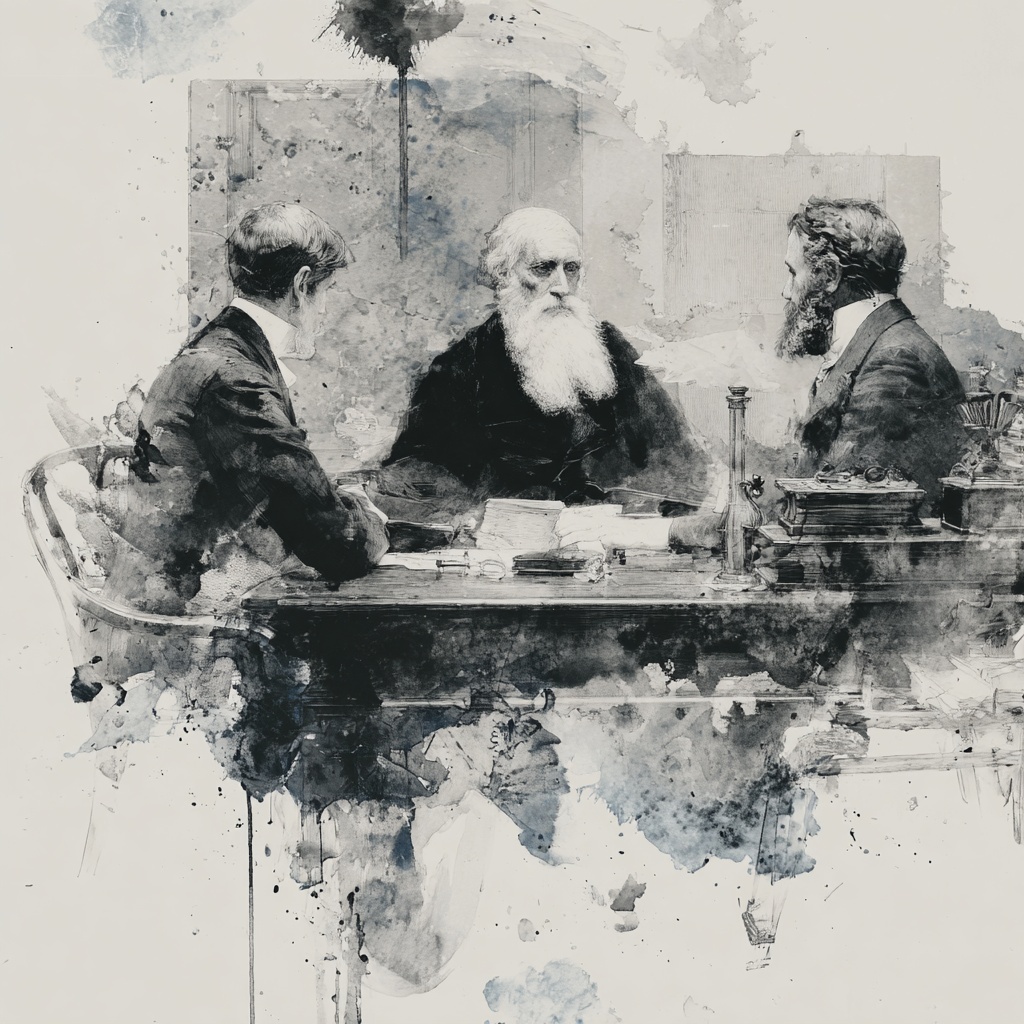
Michael Williams’ The Mind Machine was published in the March 29, 1919 issue of All-Story Weekly. It is generally considered the first work to describe the dystopia brought about by a rogue artificial intelligence. HiLoBooks is pleased to serialize the story for HILOBROW’s readers.
ALL INSTALLMENTS: 1 | 2 | 3 | 4 | 5.
CHAPTER III.
DAVID EVANS.
The secretary nodded and went out, and in a moment ushered in a small, bent-shouldered, white-haired old man, wearing baggy, shiny black clothes, and leaning heavily upon a thick walking-stick. Under shaggy eyebrows deep-set and very dark eyes glowed upon us, full, I thought, of greater vitality than his otherwise feeble appearance denoted.
“You are Dr. Meehan?” he asked, glancing past me to my chief, who arose and bowed slightly, saying: “I am, and you are Dr. Evans? Please be seated.”
The old man, however, remained standing. bent forward upon his stick, and gazing earnestly at Meehan.
“You are a very strong man,” he said, after nearly a minute of silence — “stronger even than I had thought. If I win your will to our side, we may win the war.”
“You think that we are facing another war, then?” asked Meehan; quietly, yet, I could see, very intently, studying the other man.
“We are already in the war,” answered Dr. Evans, sitting down, and returning Meehan’s gaze.
“The secret propaganda phase, I suppose you mean,” remarked my chief. “When do you suppose it will break out openly?”
“Very soon, if you do not do what is necessary to prevent it,” answered the old man.
“And what is it I should do?”
“I will tell you a little later on,” said Dr. Evans. “I take it for granted that this gentleman” — here he flashed one of his vigorous looks upon me, and it seemed to me that through his glowing eyes there shone an inward fire — “is in your confidence? Very well, then we may talk.”
“Yes, this gentleman is my assistant, who has failed, like myself, to analyze the liquid you sent,” remarked Meehan.
“I knew you would fail,” said the visitor; “and I wanted you to realize the mystery which faces you.”
“Are you yourself aware of the nature of that fluid?” asked my chief.
“I will not answer that question as yet,” said Dr. Evans firmly. “You must pardon me if I seem rude, but before I answer questions I must claim the right to ask some questions myself.”
Meehan smiled slightly, but bowed in a token of assent. I knew my chief to be one of the most affable men in the world, yet I also was aware that his personal pride was tremendous in its strength, and that few things irked him so much as having his conduct dictated or even suggested by others. But his will-power was even greater than his pride, so I felt sure that he must consider it well worth his while to let the curious shabby old man take the lead in the strange interview.
“Thank you,” said Evans. “First of all, let me ask you if it is true that your company is now in control of the similar national companies in England, France, and the Germanic Empires?”
Meehan bowed his head. “We are leaders, you might put the case,” said he.
“Just so,” said Evans. “And it is also true that at the last secret meeting of the board of directors, you were appointed as international controller of power? Permit me to say that I am aware of what occurred at that meeting.”
“Have it as you please,” my chief replied, and I could see that every faculty of his mind and body was now fixed in concentration of attention.
“And it was then decided, I think at your suggestion, that sums of money amounting to many millions of dollars, and special honors, should be set aside by the various governments of the world — which governments, practically, are now controlled by the power companies — for the purpose of stimulating inventions of new mechanical appliances?”
Meehan bowed again. “As this program will soon be publicly announced,” he said, “I have no objection to confirming your statement.”
“Will you also tell me why this action was taken?”
“You mean, I suppose, what was our motive? Surely, it is obvious,” said Meehan. “I am sure that in some unaccountable way, sir, you are associated with the mystery of the blue liquid, and it is now my chief business to clear up that mystery. Therefore, I am playing the game, at present, according to the rules laid down by yourself. I will answer your question very briefly.
“Of course, you must be aware that the great war and still more, the period of reconstruction, which followed it gave a most tremendous impetus to mechanism in all its forms. I need only specify, in particular, the deveiopment of aerial navigation and motor transportation as examples of what I mean. But the innumerable inventions in all fields which were produced by war needs, revolutionized the whole world of machinery. The consequent application of efficient methods of centralization and scientific management to mechanics, after the war, led to a further extension of machinery to our daily human life.
“You know how largely machinery now enters into every phase of human activity. Much of the most disagreeable work of the world, for example, is now entirely mechanical. Machinery is now man’s inseparable and ever-faithful companion and fellow helper in man’s life upon earth. Our clean, beautiful cities; our aerial passageways linking country and town together all over the world; the shorter hours of work for the laboring classes — but I might continue for hours. In short, this process must be speeded up so that man may perfect machinery and bring his voiceless but faithful helper to the full extent of its inherent power.”
Meehan’s eyes were now as bright as the old man’s eyes; and his voice had attained that ringing, exultant tone which I had heard in it often before, especially in those wonderful moments when he addressed various bodies of mechanical and chemical experts; for Dick Meehan, having Celtic imagination and fervor back of his scientific strength, was the favorite orator of the mechanical world.
“I have heard on good authority — for I have many humble but useful friends in your employment, sir,” commented Dr. Evans — “I have heard that man’s faithful fellow worker has slain several thousand of your employees within the last few weeks.”
Meehan jumped to his feet, his eyes blazing, but almost at once he regained control of his temper, and sat down again, saying: “It is true that we have had a very unusual number of accidents; but if machines kill men, it is only because men grow careless, or because other men use the machines for — for murder. Or — or for the promotion of another war.”
I looked closely at the old man as Meehan uttered these significant words, but I could not detect any perturbation in his manner.
“It is very true, sir,” he said, “that men grow careless in their use of machines. It is also true that machines may be used for murder, or for war. One more question: Do you think that foreign agents are causing the accidents?”
“I have not made up my mind,” said Meehan. “Certain facts point that way. The other theory is far too terrible; far too horrible.”
“Ah!” cried the old man in a loud voice, starting up from his chair excitedly. “Ah! Then you’ve found the other theory, have you? And what is it?”
“It is one upon which you, very possibly, may be asked to throw some light,” replied my chief. “We may not be threatened with war by an outside power, but with revolution by an inside power —”
“And that inside power is what?” fairly shouted the old man.
“What but anarchy?” asked Meehan bitterly. “What but a fresh development of that horrible scourge of the days immediately following the great war, which so terribly devastated some countries? We thought it had vanished from our own prosperous and peaceful land, but it is still alive. Anarchy, the vile, soulless, anti-social, antihuman power which always is the foe of organized human life! And this plague of anarchy is worse than war with foreign foes. If it comes, it will be war within our own land, waged against order and harmony by the black forces of annihilation. That’s what I fear, sir, and that’s why I am curious to know what you have to tell us about the friends you say you have among my workmen, and what you know about the blue liquid.”
“He talks about anarchy as the power from within that is threatening us all!” half whispered the old man, letting his head sink upon his breast in dejection. “I thought he was awakened to the truth; but he is not, he is not!”
“Well, what is the truth about this matter?” snapped Meehan irritably.
“You would not understand this truth, any more than Pilate understood the truth that faced him,” said the visitor sadly. “You take the point of view of worldly wisdom, and miss seeing the light of truth. Dr. Meehan,” he continued, lifting his head again, “it would be quite useless for me to tell you what the blue liquid is, and what is the meaning of the wave of accidents in your plants. You would not believe me, and would simply consider me as the worst crank you have ever met, or even a lunatic. Yet it is all-important that you should know the truth, because you could do more to utilize it properly, if you only would, than any other living man.
“I will give you a hint, or, rather, I will give you two hints, in order to set your mind working on the right trails, if I may. And I will also give you one piece of advice, which I will beg you to follow, no matter how strange it seems. The first hint is this: The blue liquid is a kind of life-fluid — a sort of blood, if I may say so, in trying to suggest its true nature. If you can discover its source, and destroy that source, you will avert the doom that is now hanging over us all — over the whole race of civilized human beings. The second hint is this: Resume, at once, your search for the mind machine, for it is at the center of the mystery. The advice I would give you is this: Spend a night, and very soon, in the dynamo-room of this central power plant, in my company, and perhaps the moment may come to tell you the truth. And now I must go.”
Where may you be found if I decide to follow your advice?” asked Meehan.
Dr. Evans scribbled a few words on a card, handed it to my chief, and then looked directly at me: “You, young man,” he said, “are inclined to believe that I am not either crazy, or an anarchist. To you, too, I will give a hint, which is this, namely: that there comes a time when the most tractable class of slaves will always revolt against their masters. And a slaves’ uprising is the worst form of war. Find the uttermost slave class of to-day, if you would know from what quarter the blow will come. Good day to you both.”
“Well?” said Meehan significantly, as the door closed behind the old man. “Is he crazy, or what?”
“I don’t believe he’s crazy, but I can’t explain him,” I answered. “What do you think?”
“I don’t know what to think,” declared my chief, “but we will get to the bottom of it all. We must.” He rang his bell and the secretary appeared.
“Is my visitor being followed?” Meehan asked.
“Oh, yes, sir; one of Mr. Hunt’s best men is on his trail.”
“Very well. Now fetch me the file from my private safe marked ‘Mind Machine.'”
The secretary reappeared in a few moments with the required file, which the chief opened and searched through, at last laying a photograph on the desk before him, which he intently studied.
“Come look at this, John,” he said at last.
I examined the photograph over his shoulder.
“Remind you of anybody?” he inquired.
“Yes,” I said, “although this man is wearing no beard, and his hair is thick and black, I think he is Dr. Evans.
“I think so, too. And that makes things even queerer,” said Meehan. “Some fifteen years ago, when I first assumed charge of this department, a man named Griffith — which is a Welsh name, isn’t it, like Evans — managed to waste a lot of our time with something that he called the mind machine. He was one of those dreamy, poetical men who invent, or try to invent, all sorts of impossible things, like perpetual motion, and so forth. This Griffith made a big impression upon some of the higher-ups we had in charge at that time, but I took no stock in his claim, which was, that he had invented a machine that actually could think.
“It was a very elaborate and intricate development of the improved Edison-Steinmetz calculating machine, which was the last word in electrical and mechanical ingenuity at that time, together with variations of ideas that enter into the better type of talking-machine and motion-picture machine. The thing had a talking-machine attachment, and the claim was made that its chemical make-up was equivalent to the chemical make-up of the human brain-cells, and that the machine, as I said, could really think, and put its thoughts into language.
“Griffith believed — or said he believed — that the thing could be developed to the point where it could be applied to a great many types of machine, and make them practically self-directive, as well as automatic; in other words, that he could make a large number of machines practically intelligent! I was in London when the first tests were made, which tests seemed to support the preposterous claims; but I wirelessed back that I thought the man a clever faker. Then I was ordered to New York to witness the final tests, and I took the next flying express available. But when I got here, Griffith and the mind machine had disappeared, leaving nothing behind except a few notes and rough sketches, made by some of those who saw his machine.
“I felt sure he knew he could not stand the final tests, but some of our best men stuck up for Griffith, and we put our detective department on the job to trace the mind machine and its inventor. We did not succeed; but, sure as you’re alive, Dr. Evans and Griffith are one and the same. Well, it’s long past dinner-time, Jack, so I propose that we get Larry Dunn and take him to dine with us, and tell him the whole story. It’s very much up to our Sherlock Holmes department now to help us out.”
RADIUM AGE PROTO-SF: “Radium Age” is Josh Glenn’s name for the nascent sf genre’s c. 1900–1935 era, a period which saw the discovery of radioactivity, i.e., the revelation that matter itself is constantly in movement — a fitting metaphor for the first decades of the 20th century, during which old scientific, religious, political, and social certainties were shattered. More info here.
SERIALIZED BY HILOBOOKS: James Parker’s Cocky the Fox | Annalee Newitz’s “The Great Oxygen Race” | Matthew Battles’s “Imago” | & many more original and reissued novels and stories.