
THE MIND MACHINE (2)
By:
May 8, 2026
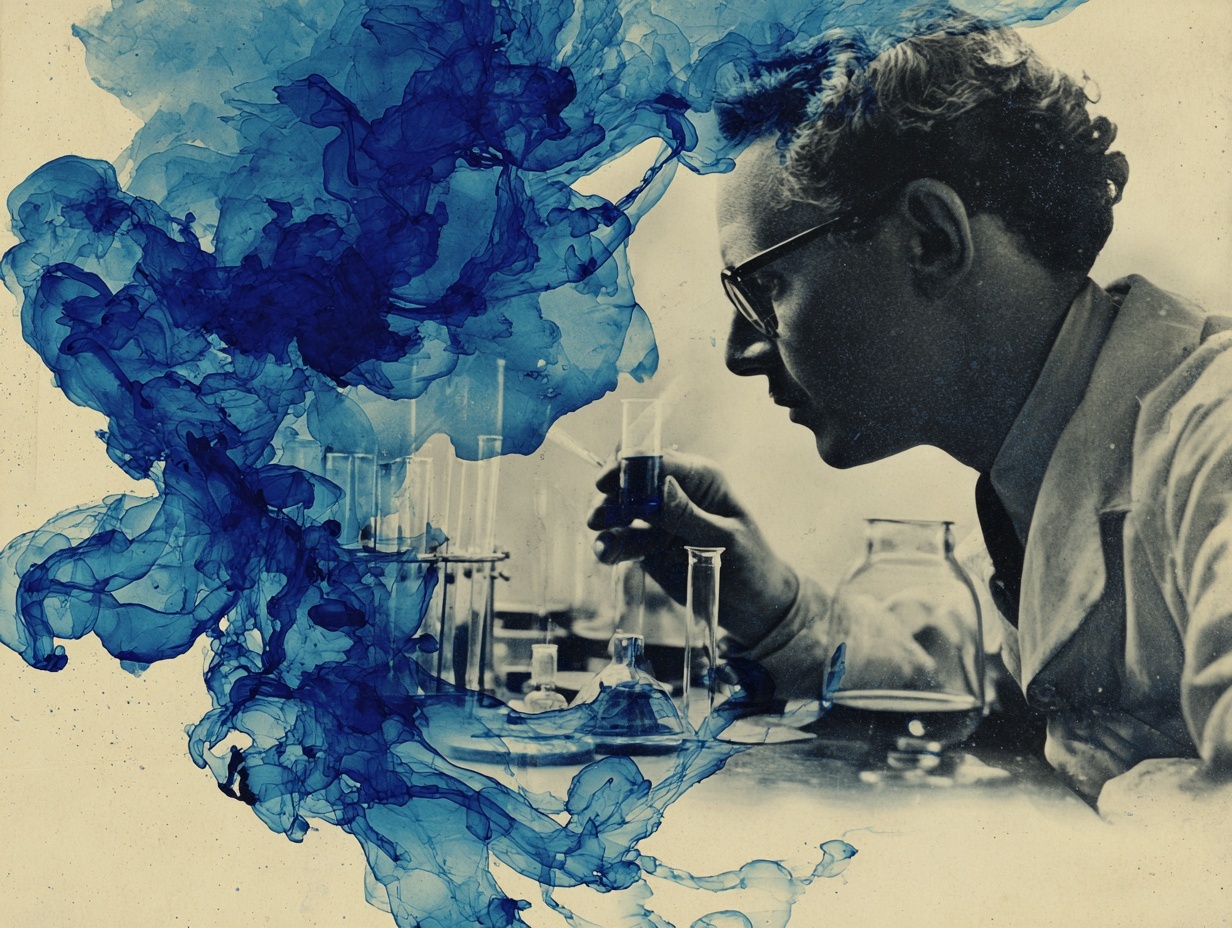
Michael Williams’ The Mind Machine was published in the March 29, 1919 issue of All-Story Weekly. It is generally considered the first work to describe the dystopia brought about by a rogue artificial intelligence. HiLoBooks is pleased to serialize the story for HILOBROW’s readers.
ALL INSTALLMENTS: 1 | 2 | 3 | 4 | 5.
CHAPTER II.
THE DAWNING OF THE TERROR.
At that hour, long after luncheon, we readily found a table remote from other persons.
“Now tell me what’s got you scared,” I asked, after the waiter had gone away. “Not scared about losing your job, are you?”
“Not particularly, as yet,” he said; “but it may come to that. Jack, have you heard about the hellish things that are going on in the I. P. M. plants?”
“Hellish things? Going on? What hellish things?” I inquired in keen surprise.
“You’re a lucky man to be a chemist, and quietly at work in your laboratory,” he said. “If you had my job, you would not only be mussed up with lack of sleep, but you’d be scared as well.”
He stopped and gnawed at his fingertips in a nervous, irritated fashion I did not like.
“That makes twice you’ve talked about being scared, Jack,” I remarked. “Tell me about it.”
He looked at me again. “Do you mean to tell me, quite seriously, that you haven’t heard about the — well, let’s call them the accidents, that have been happening lately in our plants?”
“I did hear, a few days ago, that somebody among the higher-ups would be losing his job if he couldn’t stop the carelessness that was prevailing in some of the plants,” I said. “And I was told that there had been an abnormal number of accidents among the workingmen, especially in the dynamo-rooms. But you can’t run machinery, and handle power of all sorts, without having a good many accidents; so I did not think much about the gossip.”
“I’m one of the ones who may lose their jobs,” remarked Jarvis gloomily; “but, at that, I’d be willing to lose it if I could put a stop to this — this, I don’t know what to call it — this wave of accidents. Jack, it’s hellish! We’re having the deuce of a time keeping the full extent of the horrible thing out of the papers, and the government bureau of investigation is threatening public exposure. Worse than that, we’re going to have trouble with the labor unions if we can’t control the situation — after all these years of harmony, too.”
I stared at him, now fully impressed. “All this is news to me,” I told him.
“I’ve simply got to talk to somebody,” said Jarvis; “but, of course, I expect you to keep your mouth shut, Jack. I’m worried stiff. Last week we lost ninety-two elevator operators in the United States and Canada. Yesterday sixty-three electrical engineers and dynamo tenders were killed —”
“What?” I cried.
“Yesterday sixty-three electrical engineers or dynamo tenders were killed — by their dynamos, in one way or another,” repeated Jarvis.
“But, good Heavens, do you mean to tell me that the accidents run in classes — electricians one day, elevator operators another, and so on? Why — why, I can’t believe it! It’s preposterous!”
“It’s true, though,” said Jarvis, gnawing at his nails. “Of course, I don’t mean to say that none but men of a certain class meet with accidents on a particular day; but it is true that yesterday, for example, the number of accidents happening to men not of the electrical departments was the usual low average which the I. P. M. prides itself upon, but that the average of casualties among the electricians was frightfully above the average. And on the day when the elevator operators suffered, the electricians were practically immune. And that’s the way the awful thing has been going for several weeks. If we can’t stop it —”
He shook his head dejectedly.
“Well, but what in the world is the explanation?” I asked.
“Yes that’s the question,” said he. “Wish I could answer it.”
“Isn’t there any plausible theory?”
“Theories? The place is full of them,” said Jarvis scornfully. “The general manager thinks it’s the beginning of a new war.”
“A new war? What the deuce do you mean?” I exclaimed.
“Oh, the G. M. believes that there is a sort of secret society of foreign spies, a sabotage and murder ring working in our plants, as a preliminary to a reign of terror, and the bringing on of a new war directed against this country, after they have put our power plants out of business and killed off most of our expert workmen.”
“What an awful theory!” I said, appalled, for I had been one of those who believed absolutely that mankind had turned finally from war, and that the era of universal and lasting peace had come.
“And the G. M. isn’t the only one who thinks so,” went on Jasper somberly; “for, though Larry Dunn does not say so openly, I can see by his manner that he agrees with the spy theory. Dick Meehan, too —”
“Does he know about the accidents — or whatever they are?” I broke in.
“Of course,” said Jasper. “There is nothing happens in or near the I. P. M that Dr. Meehan isn’t consulted about. He’s about the biggest brain we own. He’s even more close-mouthed than Dunn and his detectives; but I believe he’s of the same opinion as the others. It’s a big victory for European chemistry, too, if the old world really is at the bottom of the business, and that is a hard blow for Dick Meehan.”
“How do you figure out a victory for foreign chemistry?” I asked.
“Well, in nearly all the cases of unexplained accidents there’s been traces found of the mysterious use of some very queer kind of liquid,” said Jasper; “a blue stuff, like pale ink, or old-fashioned bluing and water, that the women used to use in their washing. Well, I can’t stay any longer, Jack; but it has eased my mind to speak to somebody. I haven’t even talked to my wife. Let’s keep in touch concerning the matter, will you? If anything bobs up in your department that affects me, or in mine that concerns you, or Meehan, let’s swop notes.”
“Agreed,” I told him, and we separated.
My wife, naturally, was curious about the work which had spoiled our dinner and theater party and kept me from home for two days, but she saw that I was played out, and I was in no mood for confidences after what Jasper had said. I suppose my strained and nervously overwrought condition was responsible for the fact that my mind was haunted for hours before I could get to sleep, and then my dreams were filled with sinister fancies and vague, yet most disturbing, images of disaster.
The blue liquid, in particular, obsessed me. I wondered if it were some unusually subtle kind of poison, and if ill results would follow from my careless handling of it in the laboratory. And the horrible idea of a conspiracy of German agents in America, spreading the contagion of another war, just when the whole world seemed to have reached a state of permanent peace and social equilibrium, gave me awful nightmares.
However, I had recovered my tone by the time I presented myself, the next afternoon, to my chief. I thought he was looking unusually grave, and his smooth, high forehead was wrinkled in a very unwonted manner.
“John,” he began, “what I say now must go no further.” I bowed. Dick Meehan had a genial fashion of treating me as one on the same plane with himself, but he was a master man, and when he exerted his sense of mastery there was no disguising the fact.
“Not even to Mrs. Cummings,” continued Meehan.
I bowed again.
“Nor your cousin, Jasper Cummings,” went on my chief, with a slight glance at me. “You had a little conversation with him yesterday? Yes? Well, Jasper is a fairly good man, but he has been tipped off that in the present — well, the present crisis, I’ll call it — he must be absolutely mum, save when officially told to speak. So you’ll govern yourself accordingly. Jasper talked about the accidents? So I supposed. Well, John, since that talk of yours yesterday, and up to noon of to-day, there have been more than one thousand new deaths, in strange accidents, over and above the average, mind you, in our plants in this country and Canada.”
I thought, “Great God!” but I was too stunned with astonishment to say a word.
“This time the deaths were among our skilled repairing hands,” Meehan went on. “In one shop, Toledo, Ohio, fifteen were smashed together when a locomotive they were working upon rolled over into the pit in which they were standing. In Toronto five were killed and thirteen badly injured by the falling of a charged wire upon them. San Francisco reports three deaths in the Market Street power-house, and seven more in various piaces throughout the State of California. Philadelphia lost six when a repairing motor truck ran away, as if possessed by a devil, as a newspaper reporter very aptly described the scene, and crushed the poor beggars against a wall.
“From practically every State in the Union, and in all the provinces of Canada, from Bermuda, and Jamaica, and Cuba, and other West Indian points, and even from Honolulu, the death-list has come in. More than a thousand of our skilled workers, Jack; many of them fellows I know personally, and greatly liked. In one, Jacques Dumartin, the engineer at Toledo, we have lost an inventive genius of the first water, a man whose work has never quite reached the practical point, but who was bound to have become another Edison if he had lived. And, John, it means the utter ruin of the I. P. M. unless we can stop it. It may mean more and worse things even than that —”
“Europe starting war against us?” I broke in.
“It may be so,” he said; “in fact, there are clues that point in that direction; but I fear a more powerful and more unscrupulous force than any European power.”
This bewildered me. “You don’t mean the Orient, do you?”
“No, I don’t mean the Orient,” said Mechan somberly. “I won’t tell you what I dimly suspect, John, unless I have to do so. It’s too frightful. But the time may come when I’ll have to tell you, so that you may help me, for I count upon your help until we solve the mystery.”
“I’m with you, Dick,” I said.
“All right. The first thing I want you to do is to help me receive Dr. David Evans, who is dated to show up here at five o’clock, to explain the nature of the blue liquid,” continued Meehan. “Have you ever heard of him?”
My memory was blank concerning Dr. David Evans.
“He called me on the telephone yesterday.” said Meehan. “He asked me if I’ had succeeded in analyzing the blue liquid. When I said no, I could hear him laughing. ‘Well,’ he said, ‘try if your staff can do so. You will find they won’t be equal to the task, and so I’ll come in at five o’clock and see if I can help you.’ I asked him, of course, who he was, and how he knew I was trying to analyze a blue liquid, and he said, ‘Oh, I’m Dr. David Evans, you know,’ just as if his name must be as well known as — as Roosevelt’s used to be. ‘I’m the one who sent you the bottle of blue liquid, he went on —’ after I heard the stuff was puzzling you. Good-by till to-morrow.’ And then he rang off.
“You see, Jack, in nearly all the cases of unusual accidents those, I mean, that belong to what we must call the conspiracy type, we have found slight traces of this blue stuff. Sometimes the body of the victim is stained with it, generally on the right hand, or the right or left foot. In other cases, the machine which has done the killing is marked. There’s never more than a very thin splash, and all my previous e forts to analyze the stuff fell down — as I supposed — because the tiny quantities I’ve scraped up were too badly adulterated with foreign substances.
“hen I received a small bottle filled with the blue liquid, sent through the mail, with a card which read: ‘This is the same stuff, Dr. Meehan, and quite pure. Try if you can tell what it is. You will fail. There are secrets too deep for science to uncover.’ I tried to analyze the liquid, which unquestionably was the same as that which we had found, but failed. And you failed, with all your force. And now we are going to see if this Dr. Evans will make good with his promise to help us.”
Meehan had hardly finished speaking when his secretary entered, saying: “Dr. Evans, sir, He says he has an appointment with you.”
“Show him in,” said my chief, “and then notify Mr. Dunn that the man I told him about is here.”
RADIUM AGE PROTO-SF: “Radium Age” is Josh Glenn’s name for the nascent sf genre’s c. 1900–1935 era, a period which saw the discovery of radioactivity, i.e., the revelation that matter itself is constantly in movement — a fitting metaphor for the first decades of the 20th century, during which old scientific, religious, political, and social certainties were shattered. More info here.
SERIALIZED BY HILOBOOKS: James Parker’s Cocky the Fox | Annalee Newitz’s “The Great Oxygen Race” | Matthew Battles’s “Imago” | & many more original and reissued novels and stories.