
MEDIA DIET
By:
April 27, 2026
A weekly series exploring the media “input” of a group of people — HILOBROW’s friends and contributors — whose “output” we admire.
Jonathan has been a valued HILOBROW contributor since 2021. His first post was on the topic of SAMURAI JACK. His most recent contributions to this publication include: GUTS.
Brooklyn…
HILOBROW: What forms of media do you “take in” the most regularly/frequently, during a typical day or week?
JONATHAN PINCHERA: The largest chunk of my media-diet pie chart is video, split equally between Instagram reels (short-form, TikTok-esque) and YouTube (long-form). I oscillate between the two pretty frequently, listening to youtube while I embroider or do chores and taking a break to check Instagram. My interaction with both could probably be described as compulsory, but I feel like I’ve been moderately successful in folding them into a creative cycle. YouTube for work, Instagram for play. This is reflected by the different content each platform’s algorithm feeds me. My YouTube is full of political commentary and theory whereas my Instagram reels exhibit an ever-changing slop consisting of memes, conspiracies, foreign curiosities, and schizophrenia. In typical Gen-Z fashion, I’m vastly more private with my YouTube consumption because of its ideological sincerity whereas my reels are incessantly shared with friends on the Instagram platform. Despite the many, many (many^infinity) downsides of short-form, scrollable content, I do really enjoy the casual tether it can facilitate. I have friends that I haven’t seen for years who I still exchange reels with. If nothing else, the discovery and exchange of micro-spectacles that address a specific friend’s humor feels like an empathetic exercise. Sending someone a reel implies genuine shared interest: I like this video and, based on my truest and most vulnerable speculation, you’ll like it too.
HILOBROW: What work of literature (old or new) would you recommend to someone trying to make sense of today’s world?
JONATHAN PINCHERA: Stanislaw Lem’s 1965 story collection The Cyberiad would probably be my first recommendation. The second would be the output of the CCRU (Cybernetic Culture Research Unit), conveniently collected in the MIT Press’s CCRU: Writings 1997–2003. Together these works offer a yin-yang of outlooks on the digital age while approaching shared themes of chaos, control, communication, logic, and collapse: essentially the main tenets of cybernetics. The CCRU’s Lovecraftian technohorror is definitely more relevant to contemporary internet/AI pessimism, but in certain moments this perspective fails to contribute anything other than bland doomsaying. The Cyberiad is more creatively successful because of its willingness to speculate beyond humanist fears into a realm of technoabsurdity.
HILOBROW: What’s the best movie you’ve seen recently?
JONATHAN PINCHERA: I’m a couple years late but I just saw Yorgos Lanthimos’ Poor Things and was floored by it. I loved the Edwardian steampunk biotech, Bella the Uberfrau contra Godwin the castrated God, the awkward CGI cruise ship, the textiles (in particular the quilted title sequence panels which later appear in Bella’s room), and Godwin’s burp machine. Mark Ruffalo plays a very good male victim, first getting sucked into then obliterated by a de-genealogized limitless feminine desire. I think most of Lanthimos’ movies feel similarly psychoanalytic — characters take on roles/archetypes defined by their relationship to sex and prohibition which then produces conflict. I don’t know much about psychoanalysis, but from the armchair I’m sitting in this seems to be a good formula for movie-making. Poor Things excels because it accepts this framework but isn’t afraid to play around with it a little, introducing sci-fi as a motor to ask “what would happen if you could collapse mother/daughter into one?” Also, I appreciated that the plot relies much less on moments of violence than some of Lanthimos’ other films. I’m looking forward to seeing Bugonia next, and if I stick to my current watch schedule I’ll have a review by early 2028.
HILOBROW: What’s the best TV series you’ve seen recently?
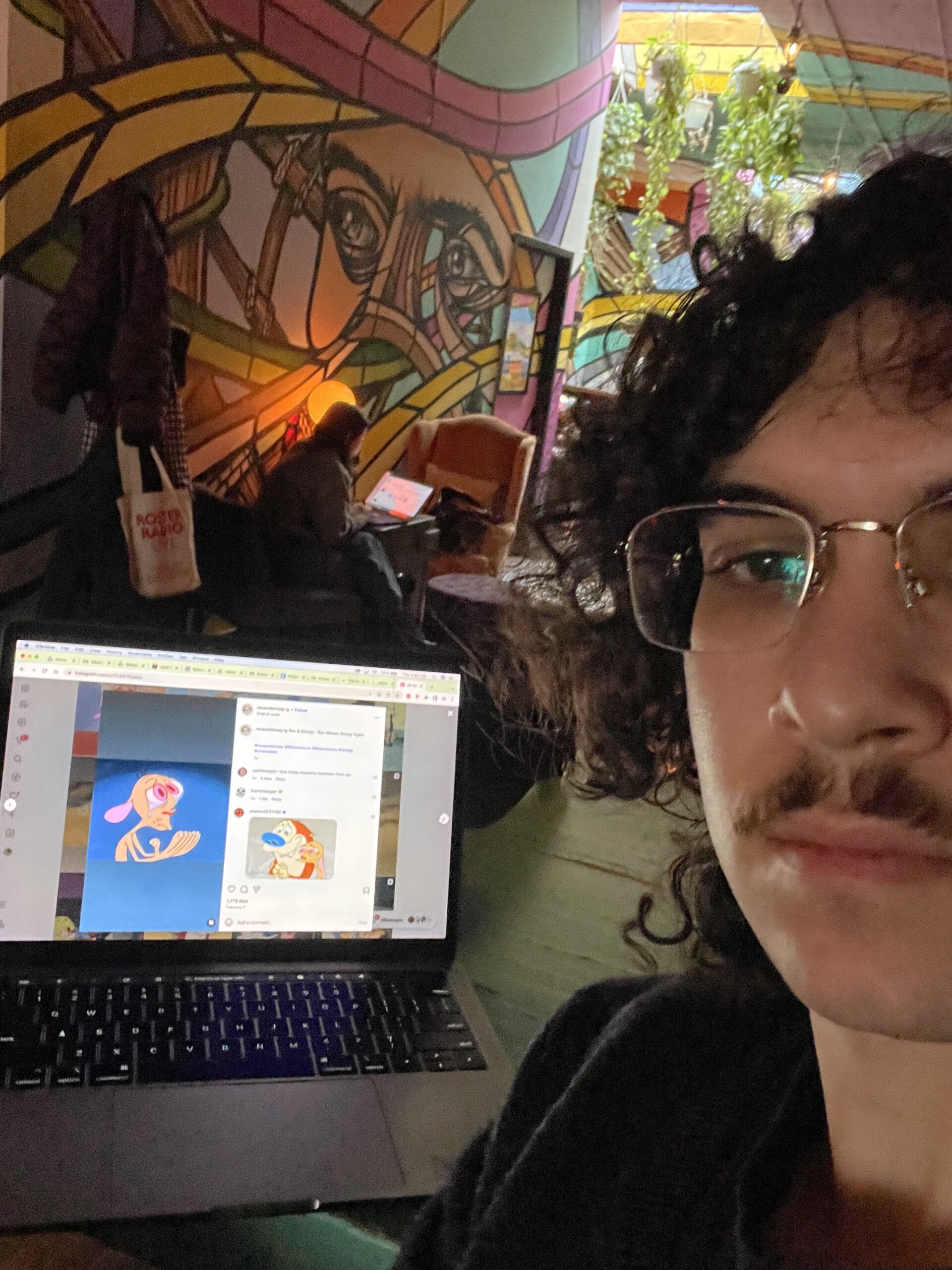
JONATHAN PINCHERA: I’ve been watching a lot of Ren & Stimpy clips on Instagram. I could barely stomach that show when I was a kid, and it’s well before my time so I didn’t encounter it much anyways. Even now the full episodes can be too much. It just really is bizarre and disgusting in a way that no cartoon really matches. I think the limits of it being nominally a show for children produce really creative workarounds to couch the insanity and grief. For example, there’s one episode where Ren and Stimpy are in the belly of a whale for some reason, and the shot cuts to the whale in a doctor’s office sweating and clutching his stomach in intestinal agony. The whale has an unaltered adult male voice, and he’s just completely tweaking, begging for the doctor to make the pain stop. There’s really no attempt made to hide the sound of raw excruciation, but under the umbrella of a gag it loses any seriousness. Obviously this strategy is just the basis of physical humor, but I really enjoy how Ren & Stimpy pushes it to an extreme. The later, “adult-oriented” Spike TV reboot shamefully loses this quality, desperately trying to assert transgressiveness through boring shock humor.
HILOBROW: What music did you love as a teenager? Do you still listen to it today?
JONATHAN PINCHERA: Hip hop was always my primary musical interest, and it’s still the bulk of what I listen to on a daily basis. However, as a teenager I was front row for the 2016 Soundcloud/Mumble rap boom and since then I haven’t been able to muster the same energetic engagement with the genre. That’s probably an experience most people have with their music consumption as they get older, but the 2016 era did feel particularly vibrant, sort of a renaissance moment that often gets compared to the birth of punk rock. I don’t listen to much of it now, I think it’s too personally attached to a specific time and place and doesn’t hold up very well. My exception to this is SpvceGhostPurrp and Rvider Klvn, who were actually more progenitors than actors in the movement. I still routinely put on the mixtapes Blackland Radio 66.6 and Tales from the Underground.
MEDIA DIET series: MATTHEW BATTLES | ADRIENNE CREW | HOLLY INTERLANDI | CAROLYN KELLOGG | MARK KINGWELL | FLOURISH KLINK | ADAM McGOVERN | CHARLIE MITCHELL | TOM NEALON | ANNIE NOCENTI | GARY PANTER | LYNN PERIL | JONATHAN PINCHERA | NICHOLAS ROMBES | CARLO ROTELLA | LUCY SANTE | SETH | MIKE WATT | JUDITH ZISSMAN | & many others! Visit the SERIES INDEX.