
A YEAR IN A DAY (7)
By:
March 29, 2026
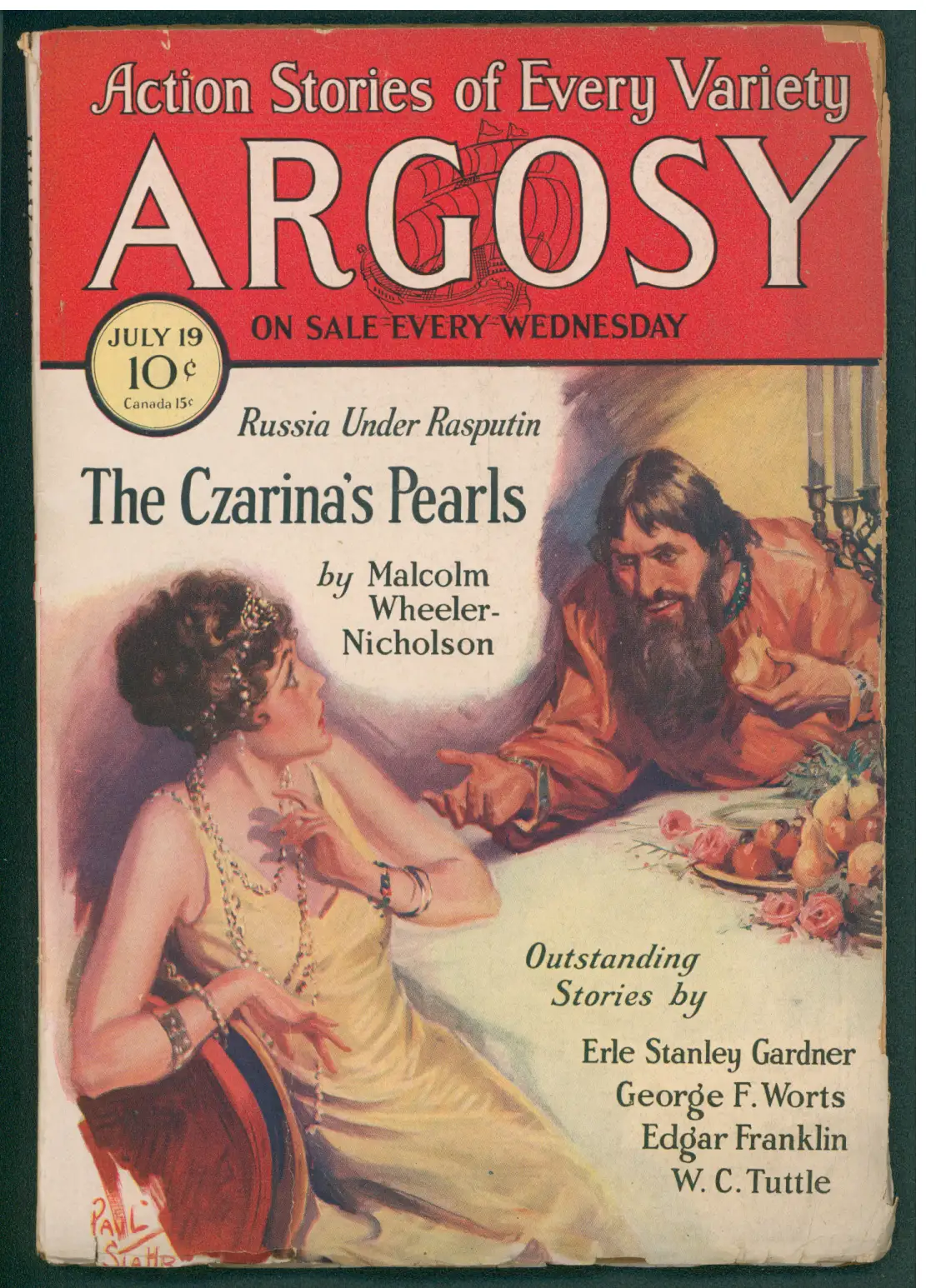
Between 1928 and 1932, the prolific detective fiction author Erle Stanley Gardner produced seven science fiction and fantasy stories for Argosy. “A Year in A Day” (July 19, 1930) takes the idea of invisibility-through-acceleration popularized by H.G. Wells’ 1901 story “The New Accelerator” and applies it to the framework of the crime story. Though Gardner is not one of the era’s most talented sf authors, here he anticipates everything from the Golden Age speedster comic-book characters the Flash (1940) and the Whizzer (1941) to Nicholson Baker’s 1994 erotic novel The Fermata. HiLoBooks is pleased to serialize the story, which enters public domain this year, for HILOBROW’s readers.
ALL INSTALLMENTS: 1 | 2 | 3 | 4 | 5 | 6 | 7.
CHAPTER 7
The Man Who Mastered Time
With a roar Nick Searle joined the conflict.
That was the determining factor. The men had hardly expected an equal battle. Having Swift down and getting ready to knife him was one thing; having that wiry young man on hands and knees grabbing at their ankles while another man swung lusty fists was quite another.
It took but four punches to decide the battle. The two bandits sprawled on the cement.
Swift was still on hands and knees, writhing in pain. But he had managed to tackle both of his adversaries with groping hands which had kept them from doubling up on Searle.
“Hurt?” asked Searle.
Swift made a wry face, gasping for breath.
“Wind — knocked — out.”
Searle helped him to his feet.
After a few seconds Swift got over the temporary paralysis of the diaphragm which had been induced by the blow he had received, and gave a wry grin.
“How’d you get here?” Art asked the reporter.
“Took some of the serum and started out. Found I wasn’t hopped up enough, so I put half a dozen of the small capsules into effect all at once.”
“How did you know you weren’t hopped up enough?”
“Because of the way things were whizzing by me. I tried to follow a man, and I might as well have tried to follow an express train. I figure we are living right now at a ratio of Around three thousand to one.” Searle seemed awed as he said the words.
“Not that fast.”
“Mighty near it.”
“The girl?” Art demanded.
“You mean Louise Folsom?”
“Yes.”
“That’s what worries me. They’ve managed to get her somehow, and they’ve carried her off. This looks to me like the final blow-up. The exposé in the Star has broken a lot of their power… You’ll forgive us for jumping at the conclusion you were the mysterious scientist who was at the head of the thing? Tell me how you got into it — but first let’s get these two chaps tied up nice and tight and see if we can’t locate where they were going.”
Swift nodded.
“There’s some rope on the truck. I’ll tell you the story while we truss ’em up. And I think I know about where headquarters are.”
“What truck? This one?”
“That’s the one. You’d better be careful with those suitcases. They’re all loaded with money and gems.”
“What?”
“Fact. They’ve lost their power to terrorize the nation and make the big executives bow to their will, but they still have their power to rob without the victim’s being able to guard against it. They’re stripping the city.”
“Humph. And there’s only two of us,” commented Nick Searle, as he trussed up one of the bandits. “Guns any good?”
“None whatever. The bullets could be dodged, and it takes forever and a day for the hammer to explode the shell. If we wanted to shoot one of these men when he broke loose, we’d have to start shooting the gun now. Then we could go about our business for a while, come back and see if the man had got the knots untied, and, when he did, trust the explosion of the revolver would happen somewhere along about that time.”
Searle laughed.
“You paint a gloomy picture.”
“It’s almost that bad. Notice the truck is backed up to a cellar. I have an idea that cellar is of some importance. Let’s explore in it a little.”
“Suits me. What’ll we do with the men?”
“Drag ’em in… Look out! Here come another couple! Lord, there are two more. Four of ’em. We’ve got to hide here in the truck, and when we start hostilities we’ve got to work fast. There’s a couple of stakes that’ll make good clubs.”
Swift crouched behind a pile of the strangely streamlined suitcases. Four men appeared, laden with loot. They called a greeting, started for the truck.
“Look out!” yelled one. “Somebody’s hiding here!”
“Let’s go!” shouted Art Swift. The young scientist and the reporter got into action.
One of the outlaws, doubtless forgetting the uselessness of the weapon, pulled an automatic from his pocket, leveled it, and pulled the trigger. Then he dashed it to the ground when the weapon failed to explode.
Two of the men had knives. One climbed on the side of the truck, the other tried the rear.
Thud, thump sounded the clubs, and the men drew off, one of them with a broken arm.
“Let’s go!” yelled Swift, for the second time, and they charged.
It happened that the two men had chanced upon the most deadly weapon available. Knives were limited as to range. Guns were of no use. Clubs, swung with terrific speed and force, were bone-breaking instruments of destruction.
Apparently these outlaws had never encountered resistance in the time-plane upon which they had learned to function. They had never experimented with various weapons, and the futility of their guns, the limited efficiency of their knives, left them helpless before the onslaught of the two men armed with clubs.
Searle surveyed the sprawled figures, grinned at Swift.
“Looks like a good job. Do we tie these up?”
“Sure thing.”
“How about headquarters?”
“Let’s investigate.”
“Attaboy! Better keep that club. We’ll probably run into some more trouble.”
They lowered themselves into a cellar, pushing themselves down the stairs because the force of gravitation was too slow to function, felt their way along a passage, and emerged into a lighted room.
A man sat in this room with telephone receivers clamped to either ear. He was tall, gaunt, dominating. His eyes held a restlessness that seemed unclean, unhealthy. The thin lips were compressed into a single razor-blade slash that cut from cheek to cheek. His jaw was bony, determined.
On the third finger of his right hand gleamed a ring of interlaced triangles. He glanced at the two men, looked at their clubs, half rose from the chair.
“Mr. Zin Zandor, I presume,” said Swift.
The restless eyes snapped to his face.
“So?” rasped the man, and fumbled beneath his desk.
“Stop him,” shouted Searle, and made a wild leap forward.
Swift lowered the point of his club and launched it through the air like a lance with every ounce of force of which he was capable.
At the same instant he became aware of a sickening sweet odor which permeated the room.
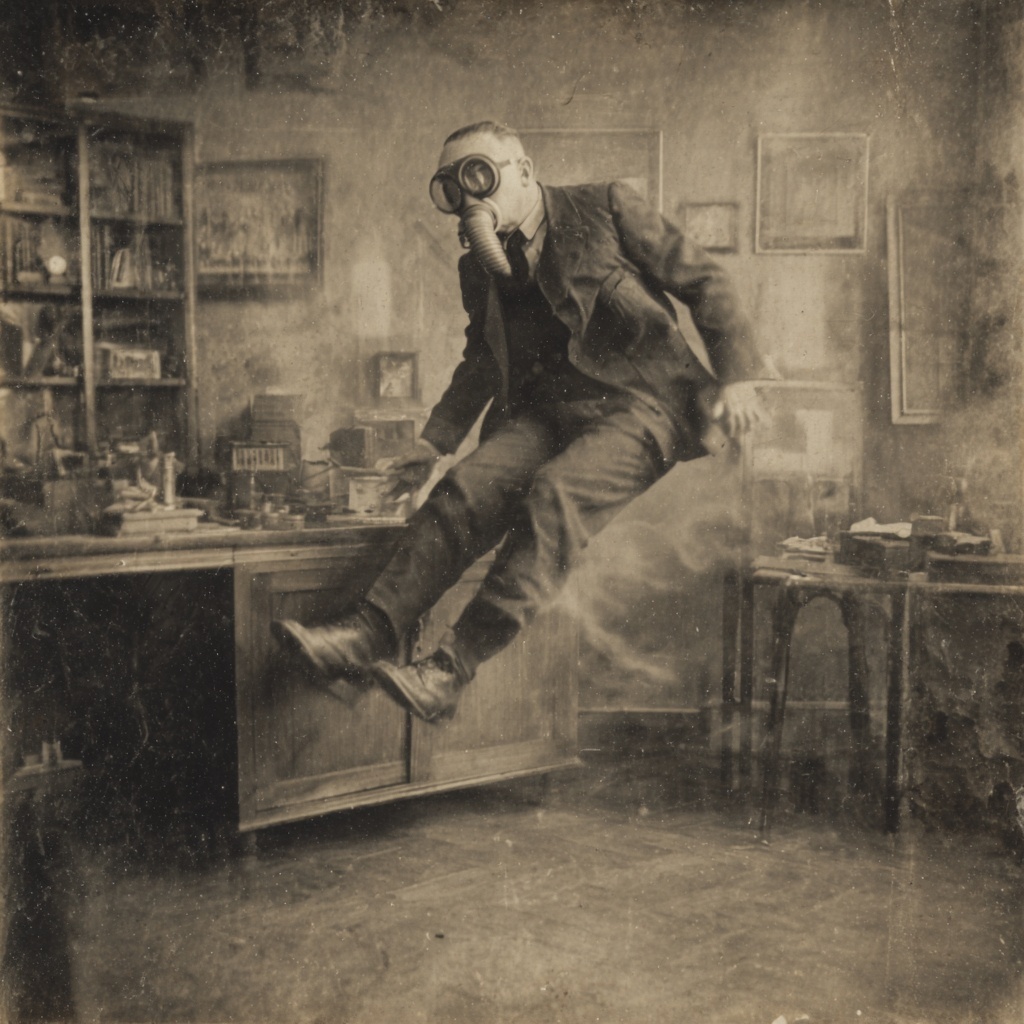
Zandor tried to duck. The hurtling club caught him on the forehead as he lowered his head, cutting an ugly gash, sending him staggering back.
His right hand flashed up. It held a sort of gas mask, which he tried to raise to his nostrils. But the impact of the blow had dazed him. His hands seemed to function uncertainly. He turned half purple in the features as congested blood mottled the skin.
“He’s holding his breath,” shouted the reporter, quick to grasp the situation.
Swift whirled. Together they fought toward the door, holding their breath, the sickly-sweet odor seeming to constrict the muscles of their throats.
Behind them they heard a peculiar scraping sound. They turned for one last look.
Zin Zandor was clawing at the top of the desk. The poison gas had got him now. His features were distorted, his mouth open. Even as they looked he went limp, and apparently remained suspended in mid-air.
“Dead and falling,” said Swift as he dragged his companion into the passageway, out to the open air.
They sucked in great lungfuls, feeling strangely dizzy.
“The girl!” cried Searle.
Without an instant’s hesitation, Swift turned and led the way back into the passageway.
“Take a deep breath and we’ll try for her. Probably the gas rises. Keep your head near the floor.”
They dived down and crawled along the floor. The sickening sweet odor was in their nostrils. At the corner of the desk, inclined at an angle of almost forty-five degrees, was the form of the man who had signed himself Zin Zandor. He was falling to the floor, and the force of gravitation was so slow, compared to the speeded-up life forces of the two men who watched him, that he seemed to drift downward with hardly perceptible motion.
There was a door to the left of the desk. Swift took a deep breath, reached upward, turned the knob. The door opened; they scrambled into the inner room.
Here was a Remington typewriter, doubtless the one upon which the blackmail letters had been written. Here, also, was stored great treasure, gold coins, currency, gems. And here they found the girl who had posed as messenger. She was bound hand and foot, gagged — Louise Folsom, captured, doomed to die.
Her eyes stared straight up at the ceiling of the room. She made no move when they entered.
“Living at a normal rate. Can’t see us,’ said Searle.
He drew a knife and cut the ropes. Even then she did not move. They watched her anxiously. The closed door was shutting out many of the poison fumes. But there was a chance she had already inhaled too many of them.
Searle reached out and gently touched the eyeball with the tip of his finger. The lid gradually — very, very slowly — commenced to droop.
“She’s alive,” said Swift.
The girl’s lips moved with such slowness that the motion was hardly perceptible.
“She knows we’re here, trying to talk.”
Searle nodded.
“We’ve got to get her out of here. That gas, you know.”
“The door’s closed. Remember, it disperses quickly. It takes a concentrated dose to produce death. He probably had it in the ring. He intended to liberate the gas from the poison ring and fill the room with it. Then he was going to put on some sort of a gas mask.”
“Yeah. Your blow with the club got him groggy, and he sucked in a mouthful of the concentrated gas before he knew what he was doing.”
“How about getting the girl out?”
“Let’s try to carry her. But pick her up gently or we’ll jerk her to pieces, and we’ll have to stop easy like or — wait a minute — I’m feeling queer!”
At that same moment Art Swift felt a peculiar sensation at the pit of his stomach.
“The gas!” he exclaimed.
“No,” said Searle. “We’re coming back to normal!”
There was a brief spell of vertigo, and then, of a sudden, things were normal.
The girl’s eyes were blinking; her lips were forming words.
Beyond the door that led to the other room something crashed — the body of Zin Zandor, just falling to the floor.
The girl’s rapid words rang in their ears.
“Hoped you would come. They were planning to make this the day of the big clean-up. They had all their men ready to bring on a reign of terror, and they were going to kill me.”
Swift pointed to a door that opened from one side of the room. He picked up a chair, crashed it through one of the panels.
“Let’s get out of here!”
They felt the tang of fresh air upon their faces, saw the street roaring with the busy life of a rush hour. The noise burst upon their ears. In the alley, motor running, was the truck, filled with the strangely shaped suitcases. Sprawled just inside the door, where the two adventurers had dragged them, were the bodies of the unconscious bandits, tied hand and foot.
There was no traffic in the alley, but the street just beyond was filled with activity.
“Load ’em in and start for headquarters,” said Searle, and grinned.
The girl climbed into the driver’s seat.
“I can handle the truck.”
They struggled with the men, got the inert figures into the truck.
“Let’s make a good job,” said Searle.
Swift caught his drift and grinned assent.
They returned to the cellar. The fumes of the deadly gas had dispersed. There remained only an odor, something like that given off by orange blossoms. The dead form of Zin Zandor sprawled on the floor.
They carried it to the truck. Then they loaded the stored treasure.
Then they started the truck.
“Go to the Star office,” Searle called to the girl. “We were the ones to blacken Swift’s character, and we might as well be the ones to laud him to the skies as the hero who saved the country.”
The girl flashed him a smile.
“Scientist Saves Day!” she said.
“That reminds me, where do you suppose Ramsay is?”
“Suicide,” said Searle. “We found him just before I met you last. He had blown his brains out and left a typical note — poor chap: ‘Reporter Reaps Ruin — Rum Ruins Ramsay!'”
They were silent for a moment.
“He was in on it from the beginning, of course?” asked Swift.
“Yes. He was the contact man. He actually switched the cigarettes. He faked an attack upon himself to divert suspicion.”
Swift sighed. “Man, but I feel sleepy!”
“Effect of the drug. We’ve been living rapidly, perhaps more than a year in the last few hours. It’s gone out of our lives.”
“A year in a day,’ laughed the girl.
Swift caught her eye.
“Then I’ve known you a year, Louise,” he said.
Her answering smile contained no trace of offense.
“We can call it that, Art.”
“A heck of a fast worker,” said Searle. “That goldarned scientist doesn’t need to have any one pep him up with a lot of extracts to make him work fast!”
All three joined in a laugh as the truck with its strange load swung to a stop before the Star office, the biggest scoop in a half century delivered at the very door of the newspaper.
RADIUM AGE PROTO-SF: “Radium Age” is Josh Glenn’s name for the nascent sf genre’s c. 1900–1935 era, a period which saw the discovery of radioactivity, i.e., the revelation that matter itself is constantly in movement — a fitting metaphor for the first decades of the 20th century, during which old scientific, religious, political, and social certainties were shattered. More info here.
SERIALIZED BY HILOBOOKS: James Parker’s Cocky the Fox | Annalee Newitz’s “The Great Oxygen Race” | Matthew Battles’s “Imago” | & many more original and reissued novels and stories.