
A YEAR IN A DAY (5)
By:
March 16, 2026
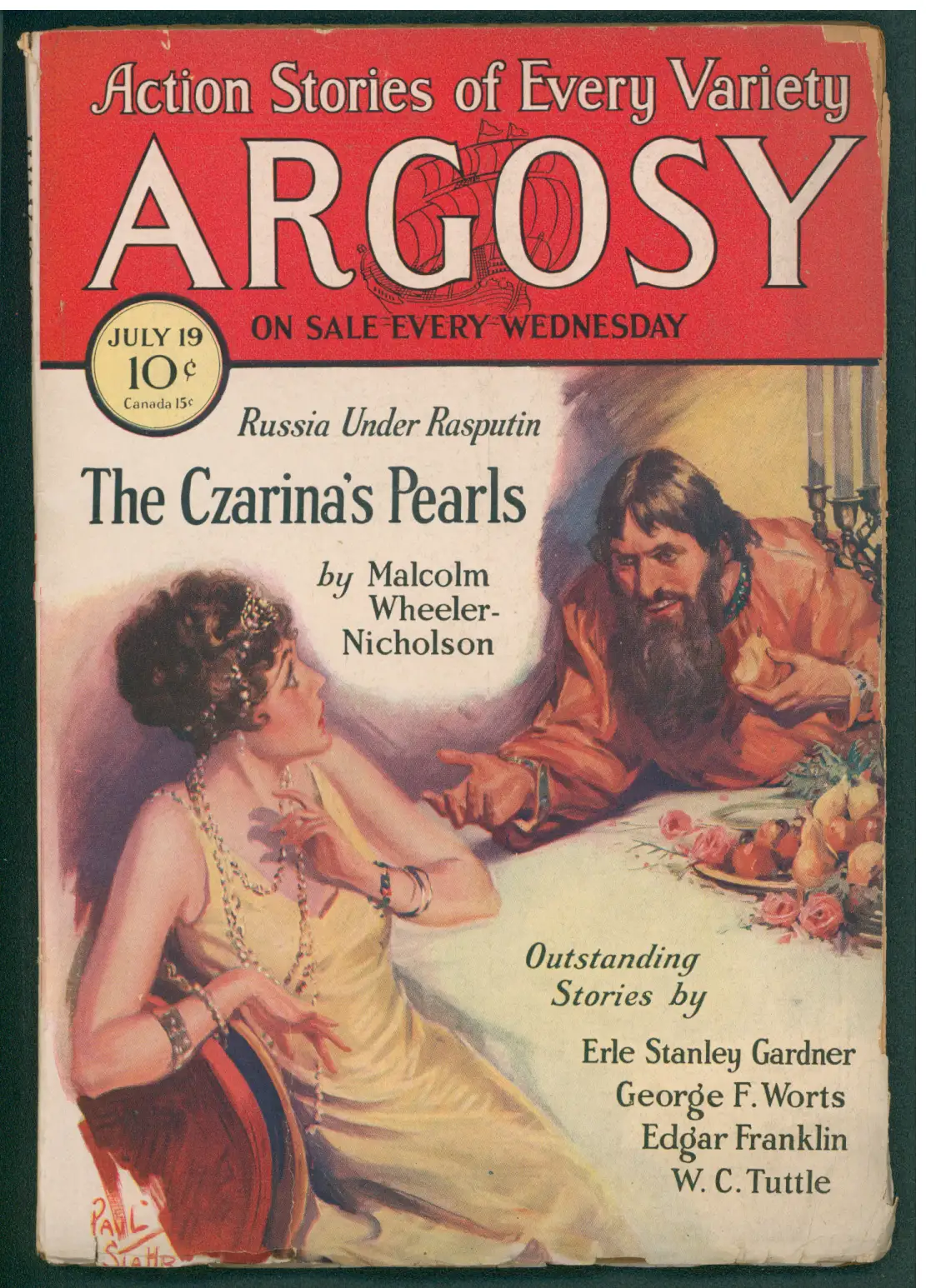
Between 1928 and 1932, the prolific detective fiction author Erle Stanley Gardner produced seven science fiction and fantasy stories for Argosy. “A Year in A Day” (July 19, 1930) takes the idea of invisibility-through-acceleration popularized by H.G. Wells’ 1901 story “The New Accelerator” and applies it to the framework of the crime story. Though Gardner is not one of the era’s most talented sf authors, here he anticipates everything from the Golden Age speedster comic-book characters the Flash (1940) and the Whizzer (1941) to Nicholson Baker’s 1994 erotic novel The Fermata. HiLoBooks is pleased to serialize the story, which enters public domain this year, for HILOBROW’s readers.
ALL INSTALLMENTS: 1 | 2 | 3 | 4 | 5 | 6 | 7.
CHAPTER 5
In a Frozen World
Searle’s voice was in his ears when he regained consciousness. There was a tang of jail odor in the air. His form was stretched on a prison pallet and the steel ceiling contained a single bright incandescent, which stabbed his throbbing eyes.
“From the looks of this telephone number, we figured it might be a lead. I got Louise Folsom to give a ring and stall along for information, and the conversation sounded promising, so i sent her up.
“She ran onto this Swift. Of course, she didn’t know him at the time. He was merely a certain Dr. Zean. But he proceeded to explain to her just how the murders had been committed and—”
He broke off as there was a commotion near the door.
“We knocked over that office and found a nurse tied and gagged in the closet, and a dead man in the laboratory. Looks like there’s hell to pay. Somebody had been in the place and cleaned it out, busted up bottles, pulled out drawers, and raised hell generally.” A red-faced sergeant was speaking.
There was the scraping of chairs.
Swift struggled to a sitting posture. “Can’t you understand, you fools?” he asked.
Hands grabbed his coat, jerked him forward.
“All right. Let’s hear your story.” Swift kicked with his feet.
“Take these handcuffs off.”
A clock, clacking off the seconds, pointed to three minutes to four o’clock.
“Leave him with a guard and let’s go see the office and the dead man,” said one of the officers.
“Triple handcuff him, then,” said Searle, “because he’s the man who pulled the murders. There’s no doubt of that in my mind.”
“It was Ramsay,” said Swift, striving to be patient. “I blundered on to this Dr. Zean, and —
“Save it!” snapped one of the officers.
“No, no, let him talk.”
Art Swift told his story. The officers looked at one another, incredulity stamped on their faces.
“There’s a chance,” said Searle, speaking judiciously, “just a chance that he’s right. But, Swift, how did you know about the idea of switching cigarettes, the mechanics of the murders? You told Louise just how to go about it.”
“Pure deduction, putting two and two together,” said Swift.
One of the men clicked a key in the lock of the handcuffs.
“Stand up here and we’ll make a search,” he said.
Swift moved to stand up, and, as he did so, felt as though a hundred needles were shooting into his hip. He jumped, gave an exclamation, then as it suddenly dawned on him what had happened, he frantically plucked at his hip pocket.
“The capsules!” he exclaimed. “They’ve spilled from the metal box, and I jabbed myself with them!”
He pulled out of his pocket the crushed capsules. He had given himself a terrific dose of the extract. Nearly all of the capsules were crushed. The extract had penetrated to his blood. Even the big, five-hundred-to-one capsule had discharged its contents.
Men moved toward him. “Maybe it’s a s … u …”
Searle was talking, but midway in the sentence, his mouth ceased to make sounds. The extract had taken effect, and Swift was speeded up to a terrific rate of activity. The men before him were arrested in mid-motion. One of the officers had been in the act of jumping forward. His feet, Swift noticed, were both off the ground.
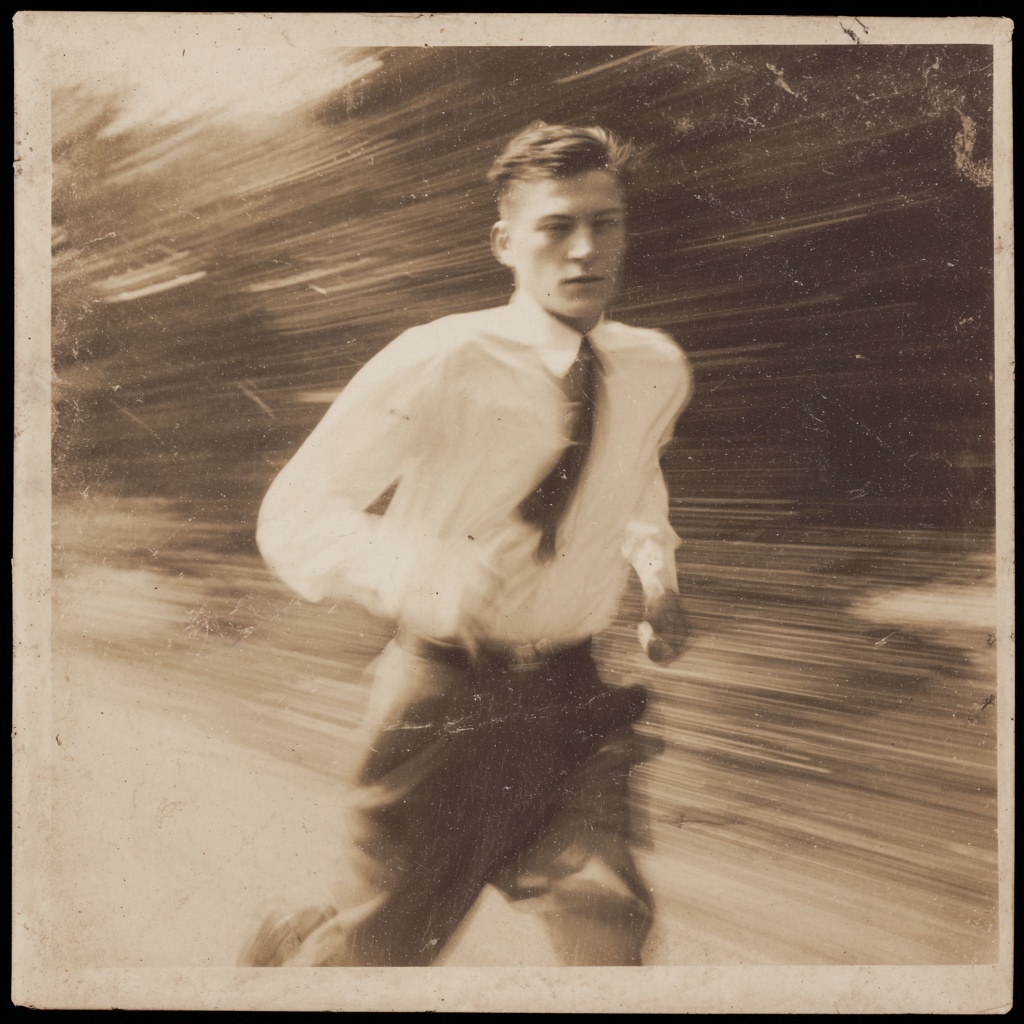
Art amused himself by walking around the officer, bending down and inserting his hand beneath the officer’s foot. He couldn’t feel the foot even moving.
He waited patiently for what seemed seconds, waiting for the situation to change. It remained unchanged. Men remained as they had been, their eyes staring, their mouths open. Every possible expression of surprise was depicted upon the frozen faces.
Swift realized that there was no use spending hours in that jail waiting for these men to dawdle through their slow motions.
He walked to the door.
Even when he walked as slowly as possible, the wind tore savagely at his garments. He knew then that he was speeded up many times faster than when he had taken his first, experimental capsule. He was living at a ratio of at least five hundred to one, perhaps much faster.
He worked his way through the jail doors.
At the outer door a guard was stationed and the officer who sat on a stool on the other side of the door was peering intently through the bars. The door was locked.
Swift reached through the bars, grabbed the guard by the coat collar, pulled him forward. He pulled so slowly that it seemed hours before he had the man against the bars. Yet he noticed even that slow motion was about to jerk the head of the officer from his neck.
He had to reach out with his other hand and pull the head of the guard so that it followed the body. Otherwise he would have broken the neck of the unfortunate man.
He searched the pockets, found the key, fitted it to the lock from the outside, manipulated it with the tips of his fingers, and heard the bolts shoot back.
He pushed open the door.
The guard was as he had left him, but, as Swift watched, he fancied he detected the faintest possible motion of an eyelid, the beginning of a slow flutter.
Swift waited for what was, as nearly as he could judge, five minutes, watching that eyelid. There could be no question of it, it was slowly moving.
“Evidently he started to wink when I grabbed him,” said Swift to himself, interested in the scientific aspect of the phenomenon. “It only takes a man around a fiftieth of a second to wink his eye, but I can’t even see the blamed thing move. I must be speeded up so fast I whiz like a bullet!”
That thought made him wonder how a bullet would appear. Could he see it leave the gun?
He took the revolver from the officer’s belt, pointed it at the steel wall of the jail and pulled the trigger.
Nothing happened.
He waited, watching, his wrist braced for the explosion.
“Something wrong,” he said, and lowered the weapon, put it back in the holster of the officer. As he did so, something unusual about it caught his eye. The hammer of the weapon was only halfway back.
“Must have forgotten to cock it, but thought I did,” he mumbled, and took it once more from the holster.
Then an explanation dawned upon him. The hammer was descending, ready to fire the shell. But that split fraction of a second which elapsed between the pulling of the trigger and the exploding of the shell was so multiplied by his speeded-up senses that it seemed an interval of minutes.
He looked around the jail for a while, watching the postures of the men who remained as living statues, motionless. Here was a man who had been about to sit down. Now he was suspended in mid-air, his body jackknifed, the weight on his heels.
Swift watched him for a while, then returned and took up the revolver. The hammer was just about to contact the shell. Swift moved to a place where the light was good, pointed the weapon, waited.
There was a faint jar, a slow impulse up his wrist. Then he saw something mushroom from the mouth of the weapon. It was the bullet, propelled by a little mushroom of fire and smoke.
He was able to follow the progress of the bullet from the time it left the gun until it struck the wall of the cell. He could even see it flatten against the steel and start dropping to the floor.
He knew it must be dropping because he could see that nothing supported it. But it remained in one position so long he was unable to detect motion.
He returned the weapon to its holster, walked back to the cell where the officers had been interrogating him. The men all remained in the same position. The officer who had been jumping forward still had his feet off the floor.
Swift turned and walked from the jail, out into the late afternoon sunlight.
The atmospheric conditions bothered him more than any other thing. There was a perpetual shortness of breath. It seemed as though his laboring lungs simply couldn’t suck enough air into his system. It was only when he was walking that he could breathe comfortably.
It must be that the rapidity of his progress forced the air into his lungs. But when he walked the wind pressure against his body was terrific. It tore his coat to tatters, and it was a physical impossibility to keep his hat on his head. He had the unique sensation of walking at a rate of speed that seemed to him to be somewhere around one mile an hour, and having the air pressure whip his hair straight out while his garments were torn.
And he was isolated in the midst of a busy world.
The street was crowded. People were starting for home. Street cars were jammed. Vehicular traffic was at its peak. The sidewalks were a seething mass of jostling humanity frozen into rigid inactivity.
Everywhere were people. Yet nowhere was motion. There was no sound. The universe was as silent as the midst of a desert. Occasionally there would be a faint buzzing sensation in Swift’s ears, and he realized that this was probably caused by sound waves which were too slow for him to interpret as sound.
He walked across the street, threading his way through traffic, and wondering how long this strange sensation was to continue. He thought of the words of the dead scientist that it might be possible for one to live his entire life in a space of five minutes.
What a terrible fate it would be to be left to go through an entire lifetime without any contact with other people, to go from youth to middle age, middle age to doddering old age, all the time in a city that was suspended in the rush hour of its traffic.
If the scientist had been right, it would be a horrible fate. There was a man getting in a taxicab. It might be that Swift would be an old man before that fellow had traversed the length of the block. He could amuse himself for a year, then come back and find the taxicab just starting; perhaps the cabbie would be in the act of closing the door.
When Swift got to be an old man he could come hobbling back to the corner and find that the traffic signal had changed and that the man in the cab was halfway across the street.
It was an appalling thought.
But Swift was glad he had not been imprisoned in a cell. He might even have been held in a dark dungeon. He paused to think of what it would have meant. He would have had no food or water. He would have starved to death in what would, to the ordinary mortal, have been but half a dozen seconds, perhaps not that long.
The air tugged and whipped at his garments. He crawled painfully along, thinking over the events which had led up to the strange position in which he found himself.
RADIUM AGE PROTO-SF: “Radium Age” is Josh Glenn’s name for the nascent sf genre’s c. 1900–1935 era, a period which saw the discovery of radioactivity, i.e., the revelation that matter itself is constantly in movement — a fitting metaphor for the first decades of the 20th century, during which old scientific, religious, political, and social certainties were shattered. More info here.
SERIALIZED BY HILOBOOKS: James Parker’s Cocky the Fox | Annalee Newitz’s “The Great Oxygen Race” | Matthew Battles’s “Imago” | & many more original and reissued novels and stories.