
A YEAR IN A DAY (2)
By:
March 2, 2026
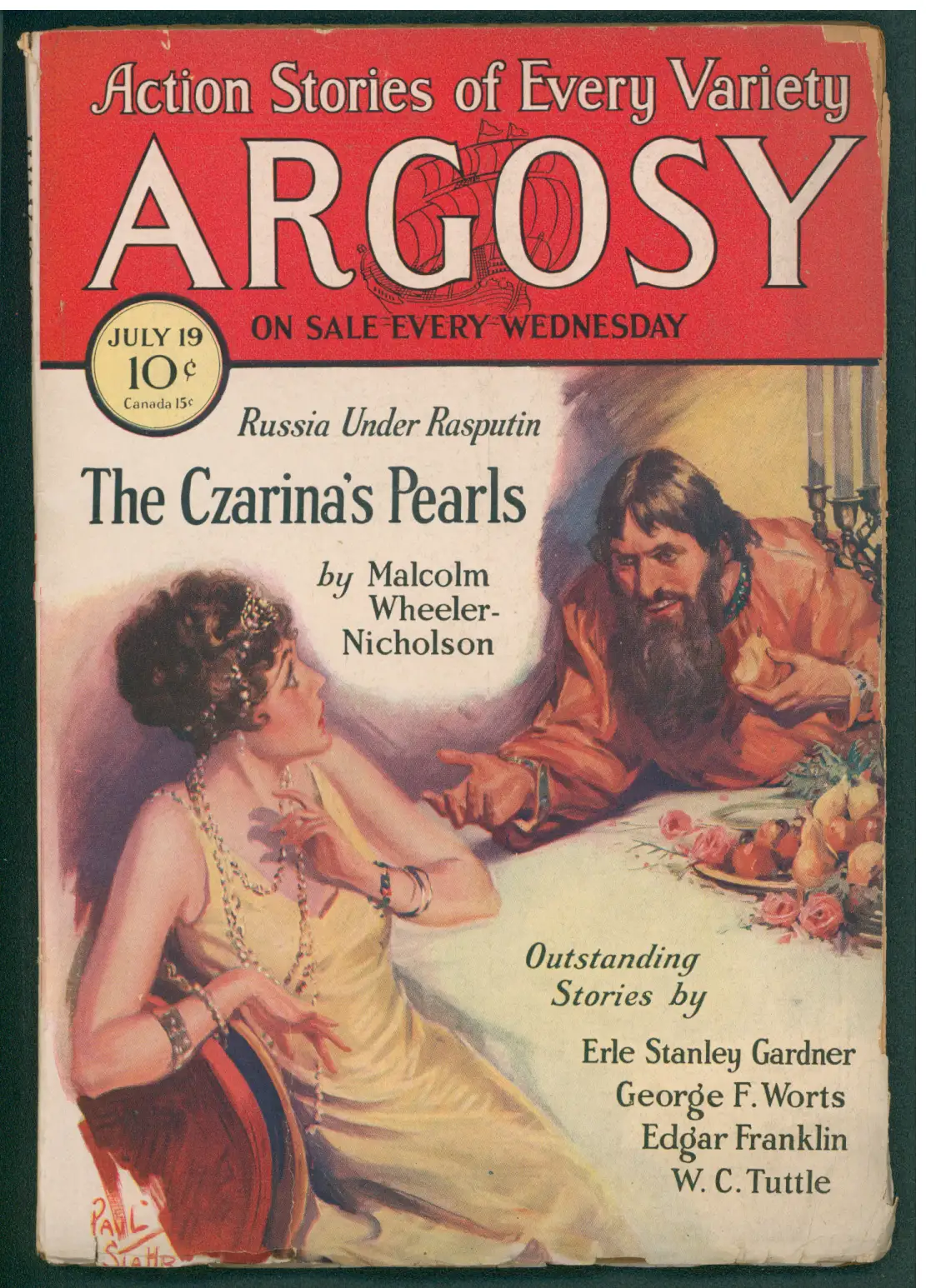
Between 1928 and 1932, the prolific detective fiction author Erle Stanley Gardner produced seven science fiction and fantasy stories for Argosy. “A Year in A Day” (July 19, 1930) takes the idea of invisibility-through-acceleration popularized by H.G. Wells’ 1901 story “The New Accelerator” and applies it to the framework of the crime story. Though Gardner is not one of the era’s most talented sf authors, here he anticipates everything from the Golden Age speedster comic-book characters the Flash (1940) and the Whizzer (1941) to Nicholson Baker’s 1994 erotic novel The Fermata. HiLoBooks is pleased to serialize the story, which enters public domain this year, for HILOBROW’s readers.
ALL INSTALLMENTS: 1 | 2 | 3 | 4 | 5 | 6 | 7.
CHAPTER 2
Trailing an Evil Genius
Events of the next two hours were crowded.
Six new letters had been mailed. Five had been to wealthy men. The sixth had been to none other than the President of the United States of America. Five of the letters contained a demand for money. The sixth letter demanded that the nation accept Zin Zandor as dictator.
The penalty in each case for refusal was death.
The millionaires were to begin paying tribute immediately. The government was given thirty days within which to comply with the demand. At the end of thirty days the President was to die, first of a series of martyrdoms only to be ended by surrender.
But sheer luck had given the law a break.
Post office employees had been instructed to note anything unusual in the mail, particularly anything unusual in the mail addressed to wealthy or prominent people.
One Steve Roscin, a mail carrier, driving to a mail box to pick up the mail, had noticed rather a striking figure striding away from the box.
It was a man well over six feet tall, thin, slightly stooped. The figure was muffled in an overcoat, despite the fact that the day had been oppressively warm. There was a long black beard which concealed the lower part of the face, dark glasses over the eyes, and a crush hat, pulled well down.
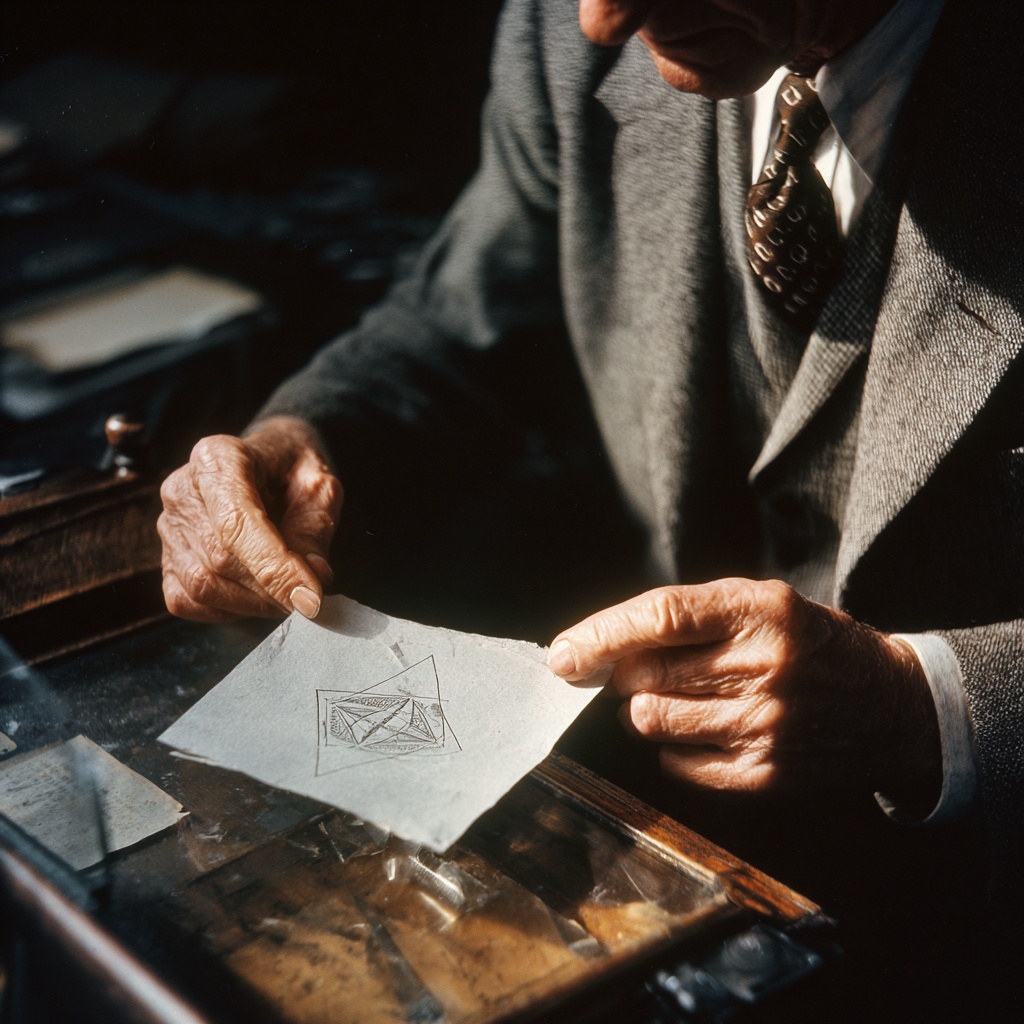
But the postman had caught a good look at the right hand. It was a peculiar ring on the third finger that had caught his eye. He described the ring as being carved in some grotesque fashion in the shape of interlaced triangles of white against a background of red.
The postman insisted that the ring was fully as large as a twenty-five cent piece, perhaps larger where it bulged out into a circle of mingled gem and design.
At the time he had paid no great attention to the man, noting only the overcoat, the beard, and the unusual ring. But when he had opened the green box, his eye had alighted upon six letters at the top of the pile of mail.
The uppermost letter had been addressed to the President of the United States of America. The other five letters were addressed to people of prominence in financial circles.
The postman had acted quickly. He had slammed the mail box shut, jumped into his car and whirled about in pursuit of the strange figure.
At the corner he was in time to see the man climb into a red roadster of speedy design, whose make the postman had been unable to determine. In the gathering dusk, the roadster had shot away from the curb and easily outdistanced the lighter car which the postman was driving.
He had abandoned the futile pursuit, and had telephoned to headquarters at once. Experts had appeared, examined the letters for finger-prints, opened them, found their terms, and had immediately started a search for the tall man in the red roadster who wore a peculiar ring and who wrote his letters on a Remington typewriter.
The police predicted an arrest within twenty-four hours, stating they would make a house-to-house canvass of the city if necessary.
Arthur Swift, caught in the excitement of the investigation, remained at the Star offices until nearly midnight.
By that time the telephones were ringing constantly, giving new clews, cases of arrest of suspects. Garages were combed for red roadsters, people were asked to report any tall figure with beard and overcoat that had been seen at or about the time.
The police adopted the theory that the beard was a disguise, that the overcoat was merely to prevent recognition, and that the man probably did not live anywhere near the place where the mail box was located, but had written the letters, then driven to some isolated section to mail them.
By midnight there were no fewer than fifty tall suspects incarcerated at police headquarters, awaiting a complete check of their activities for the day.
Arthur Swift caught Nick Searle for a short conference.
“Look here, Searle, there’s one thing about this business that’s strange.”
“Meaning?”
“The time those letters were mailed.”
“What of it?”
“They must have been already written, held ready for mailing, but the mailing was to be at a certain definite time.”
“The time?” asked Searle, smiling, rather patronizingly.
“The time was when the person who did the writing was certain the death of Tolliver Hemingway had taken place.”
Searle continued to smile, the smile of calm superiority.
“Wrong, Swift. The time was when the writer knew that the people had been advised of the death of Hemingway.”
Swift shook his head.
“No. You see it would have taken the letters twenty-four hours to be delivered at the very least. Therefore, had the writer been absolutely certain of Hemingway’s death, he would have mailed the letters, knowing the press would have the facts long before those letters were read by his victims.”
The smile melted from Searle’s features.
“By George, there’s a thought there! Then you mean the person who committed those murders wasn’t absolutely certain the murders had been committed. He only released certain agencies of destruction, knowing that they should work, but those agencies were not sufficiently certain to make him positive of their success.”
Swift, knowing that he now held Searle’s attention, nodded.
“That,” he said, “is one possible explanation. The other is harder to comprehend, but yet, in some respects, more logical.”
“Shoot,” said Searle.
“That the person who ordered the mailing of those letters was one of the persons who were in the room with Hemingway, and was, therefore, unable to communicate with his accomplices until after Inspector Hunter had released him.”
Searle dropped into a chair, as though his knees had suddenly weakened.
“Not that, Swift. That would make four of us suspects — and you, being of scientific training, would be the first they’d go after. They’d slam us in cells and start giving us third degrees that would make us wish we’d never been born. Why, we’ve been panning the inspector, calling him intoxicated and all that. Lord, how he’d delight in having some legitimate excuse to get us thrown in the jug and work us over.”
Swift nodded.
“I hadn’t thought of it from exactly that angle, but I was wondering about Ramsay.”
“What about him?”
“You remember I mentioned seeing something just before Hemingway’s death?”
“That’s right, you did.”
“Well, I’m going to tell you what that something was. It sounds incredible, but for a split fraction of a second, Ramsay’s hand vanished. The hand and the biggest part of the arm just melted into space.”
Searle knitted his brows.
“Listen, son, you haven’t batted around the way I have, and you don’t realize what tricks nervous strains will play on a man. They sometimes kick about the reporters being so hardboiled and calloused, but a man ain’t worth a damn as a reporter until he does get calloused. You were all worked up, and your eyes just started playing tricks on you. Even if they didn’t, how could anybody have managed to bring about the death of Hemingway without leaving any clew at all?”
Swift was stubborn.
“Somebody did. And it must have been done by unusual methods. Therefore, anything unusual —”
Searle surrendered the point. “All right. Let’s drop around and see Ramsay. We’ll ask him what he knows about it. That’ll convince you. Ramsay’s on the square.”
They got hats and coats, went out into the velvety midnight. They found Ramsay’s room, knocked on the door, got no answer, walked in.
Searle turned on the light.
Swift stood by the door.
The click of the switch showed a scene of confusion. Drawers were pulled from the dresser. The mattress had been slit in a dozen places, and the stuffing pulled out, strewn over the floor. The bedclothes were wadded into a knot. A suitcase had been cut open. The clothes closet showed a pile of garments, the pockets pulled wrong side out.
A letter file had been dumped in a chair, and the wind from the open window had sifted various letters about the room. All over the floor, even on the walls were drops of blood, and those blood-drops were scarcely dry.
Searle made a wry face.
“Another victim,” he said.
Arthur Swift made a hurried examination of the various letters and papers while Searle was telephoning the police. Among some of the more recent letters he found a bit of paper which contained a single word: “Tonight.”
That bit of paper was undated and unsigned, but, in the lower right hand corner was the imprint of a seal, an affair of interlaced triangles, the impression of which was visible only when the paper was held at an angle to the light.
Swift laid the letter or note back in the pile of papers.
“Know anything about rings?” he asked Searle.
That individual impatiently shook his head.
“To thunder with all that hooey. The thing that we’ve got to find out is the method of death. Then we can guard against it. And we’ve got to trace each individual victim. Imagine what it means when some individual can inflict death at will upon any certain man he may select, regardless of the precautions with which that individual is surrounded! Then he writes a letter demanding certain things of the government, threatening to take the life of the President.
“And he can do it, too. Make no mistake about that, Swift. I’ve seen ’em come, and I’ve secn ’em go. I know the work of the fanatic and of the bluffer. But this man is different. He works too efficiently, too damned efficiently. Imagine picking a time right after midnight to bump off Hemingway! He picked the very time when everybody was the most alert. He did it to show how little he cared for us or our precautions.”
“Maybe,” responded Swift. “But you’ve got to admit that ordinary measures get us nowhere in this case. Now there were rings made along in the fifteenth century that were known as poison rings. They were large, made especially to hold a quantity of poison, and I have a hunch such a ring figures in this case. I’m going to find out.”
“How did the murderer get the ring in contact with Hemingway?” asked Searle.
“Perhaps he poisoned him with a slow moving poison that was implanted in his system days before.”
Searle grinned. “Wrong again. He gave Hemingway the option of avoiding death at any time by simply paying out money.”
Swift made for the door.
“Anyway, I’m going to beat it before the police arrive. After the way you’ve being panning Inspector Hunter it’ll be only a question of hours until he figures out a scheme for getting you on the inside. I don’t want to be around.”
And he walked out, went to a nearby hotel, registered under an assumed name, took off his clothes and sank into deep slumber.
By morning he was ready to run down his theory. He called on certain antique ring dealers and made known his wants, a poison ring of large capacity, answering a general description.
There were five prominent dealers in such jewelry. Three of them gave him blanks. But the fourth scratched his head, consulted his books.
“It is possible we might get you such a ring. We sold one a little over sixty days ago to a man who makes a hobby of rings. He buys, holds for a while, then sells or trades.”
Swift whipped out a pencil.
“Give me his address. I’ll pay you a commission if I make a deal.”
“Marvin is the name,” said the dealer. “I’ll give you the address in a letter of introduction.”
Marvin was at home, genial, cordial. He was a little man with puckery eyes and perpetually smiling lips. He was hardly the type one would have picked as a murderer.
Swift broached the subject of rings, gradually leading the way around to various poison rings.
“I had a magnificent specimen a couple of months ago,” said the collector. “But my physician took a fancy to it and I gave it to him.”
Art Swift nodded, as though the information were of but casual interest, talked for half an hour, purchased a small antique ring, and finally announced an obscure physical ailment which had been bothering him for some time.
Marvin suggested a good physician.
“Don’t know any,” remarked Swift.
“Try mine. Dr. Cassius Zean.”
Swift yawned.
“Thanks, I may look him up. Well, I’ve got to be going. It’s been a pleasure to chat with you. Good morning.”
Dr. Zean! The name filled him with curiosity. The man whose name was Zean might well have adopted a name such as Zin Zandor.
He called a cab, went at once to the doctor’s office.
An office girl was busy at a typewriter. Swift moved over so that he could see the make of the machine. It was an Underwood. A white-uniformed surgical nurse bustled in and out of the outer office. She had Swift fill out a card with his name, address and occupation.
The doctor, it seemed, was in, but would see no one that day. It would be necessary to make an appointment. Art Swift made an appointment for the latter part of the week, but insisted upon an immediate interview. The nurse withdrew to take the message to the inner office. She was gone for some time. Swift felt the uncomfortable feeling which he experienced at times when he felt people were talking about him.
While he was sitting there, twisting his fingers, his brain racing with thoughts and conjectures, he heard the telephone on the desk at his elbow give a series of clicks.
The desk, he saw, was one where the surgical nurse held forth when not busy elsewhere. He wondered if the telephone was merely an extension of the telephone in the private office and if the clicking of the bell clapper denoted a conversation starting by the removal of the other receiver.
Casually, he half turned in his chair. The girl at the desk was clacking out letters on the typewriter. Her eyes seemed to be entirely occupied. Stretching forth an arm, moving with the air of one who is bored and restless, Swift inserted his hand under the receiver, cupped the palm and gently lifted the receiver so that the spring tension on the hook caused a contact.
Instantly he heard the metallic raspings from the receiver which showed a conversation was being carried on over the line. Swift was sitting in a chair which brought his ear not very far from the level of the desk. He managed to work a book under the receiver, holding it up a half inch or more from the hook. Then he slumped down until his ear was but an inch or two from the edge of the desk.
The conversation became faintly audible.
“Send a messenger after it right away. We need some…”
“Can’t let you have it for half an hour.”
“All right. They’re raising hell, making a house-to-house search of the city. Better be careful about mentioning that ring. Somebody may ask you about it.”
“No chance of that. Send a messenger directly to room 920, knock once, then pause and knock twice. Will I know this messenger?”
“No, this will be a new one.”
“All right. G’by.”
“G’by.”
There was a series of clicks from the wire. Swift slipped the book out from under the receiver. The girl at the other desk continued tapping the keys of the typewriter.
The surgical nurse appeared, frowning, to communicate the doctor’s refusal to see any one except by appointment. Swift acknowledged defeat and left the office.
His mind fairly reeled with the information he had received. The telephone conversation doubtless referred to the search that was being made for the tall man with the odd ring. It was very possible that Dr. Cassius Zean was none other than the mysterious and sinister Zin Zandor.
Swift debated whether to call up Searle, finally decided to do so. He went to a public telephone, called the newspaper office, and found that Searle was out. He left a message for him.
“Tell him I’ve got something hot. I’ll call again in half an hour. If he comes in, have him wait.”
RADIUM AGE PROTO-SF: “Radium Age” is Josh Glenn’s name for the nascent sf genre’s c. 1900–1935 era, a period which saw the discovery of radioactivity, i.e., the revelation that matter itself is constantly in movement — a fitting metaphor for the first decades of the 20th century, during which old scientific, religious, political, and social certainties were shattered. More info here.
SERIALIZED BY HILOBOOKS: James Parker’s Cocky the Fox | Annalee Newitz’s “The Great Oxygen Race” | Matthew Battles’s “Imago” | & many more original and reissued novels and stories.