
THE PURPLE FLOWER (2)
By:
December 16, 2025
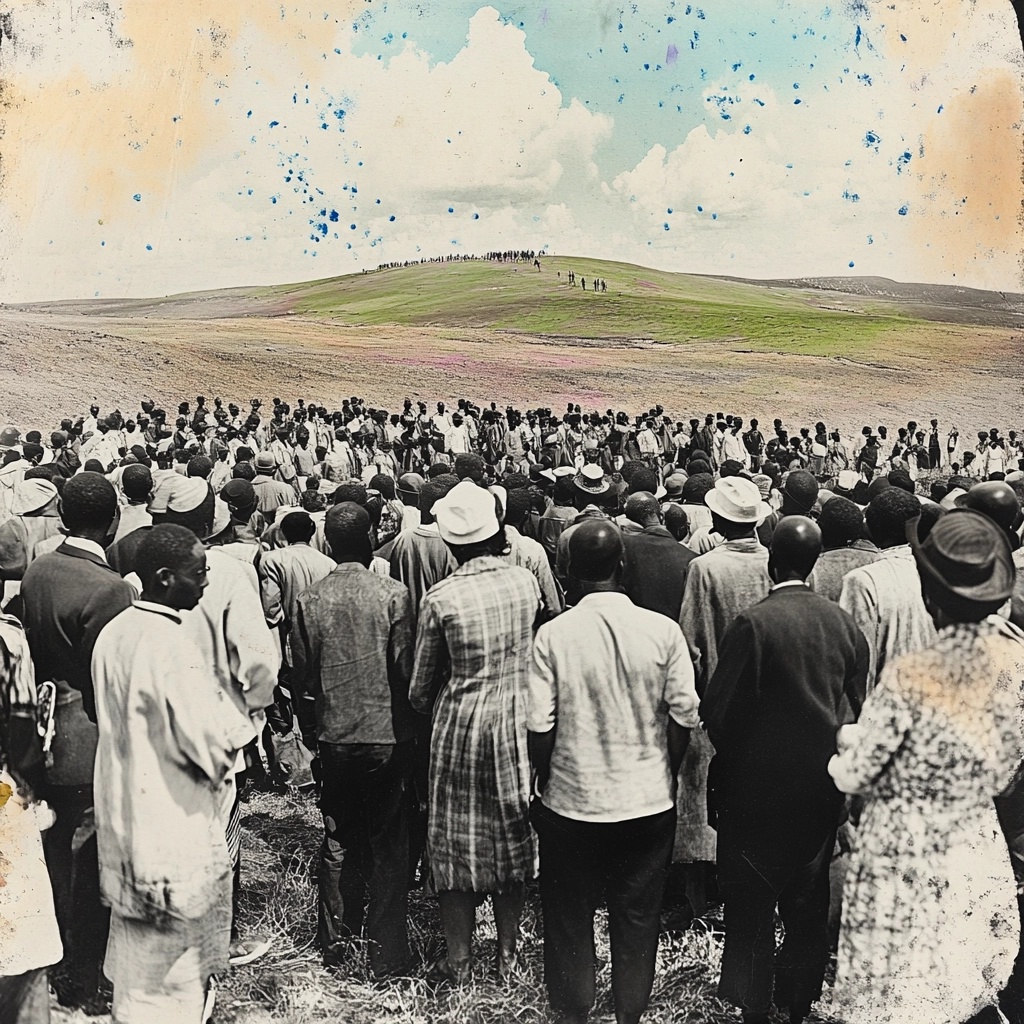
In Margaret B. Wilkerson’s Foreword to the anthology Black Theatre USA: Plays by African Americans, 1847 to Today, we read that Marita Bonner’s 1928 play The Purple Flower is “an allegory that portrays the final revolution when Blacks forcibly claim equality by overthrowing their oppressors.” We are pleased to serialize this story for HILOBROW’s readers.
ALL INSTALLMENTS: 1 | 2 | 3 | 4 | 5.
ANOTHER YOUNG US — Work doesn’t do it. The Us who work for the White Devils get pushed in the face—down off of Somewhere every night. They don’t even sleep up there.
OLD LADY — Something’s got to be done though! The Us ain’t got no business to sleep while the sun is shining. They’d ought to be up and working before the White Devils get to some other tricks.
YOUNG US — You just said work did not do you any good! What’s the need of working if it doesn’t get you anywhere? What’s the use of boring around in the same hole like a worm? Making the hole bigger to stay in?
(There comes up the road a clatter of feet and four figures, a middle-aged well-browned man, a lighter-browned middle-aged woman, a medium light brown girl, beautiful as a browned peach, and a slender, tall, bronzy brown youth who walks with his head high. He touches the ground with his feet as if it were a velvet rug and not sunbaked, jagged rocks.)
OLD LADY — (addressing the OLDER MAN) Evenin’, Average. I was just saying we ain’t never going to make that hill.
AVERAGE — The Us will if they get the right leaders.
THE MIDDLE-AGED WOMAN—CORNERSTONE — Leaders! Leaders! They’ve had good ones looks like to me.
AVERAGE — But they ain’t led us anywhere!
CORNERSTONE — But that is not their fault! If one of them gets up and says, “Do this,” one of the Us will sneak up behind him and knock him down and stand up and holler, “Do that,” and then he himself gets knocked down and we still sit in the valley and knock down and drag out!
A YOUNG US (aside) — Yeah! Drag Us out, but not White Devils.
OLD LADY — It’s the truth Cornerstone. They say they going to meet this evening to talk about what we ought to do.
AVERAGE — What is the need of so much talking?
CORNERSTONE — Better than not talking! Somebody might say something after a while.
THE YOUNG GIRL—SWEET (who just came up) — I want to talk too!
AVERAGE — What can you talk about?
SWEET — Things! Something, father!
THE YOUNG MAN—FINEST BLOOD — I’ll speak too.
AVERAGE — Oh you all make me tired! Talk—talk—talk—talk! And the flower is still up on the hillside!
OLD LADY — Yes and the White Devils are still talking about keeping the Us away from it, too.
(A drum begins to beat in the distance. All the US stand up and shake off their sleep. The drummer, a short, black, determined looking US, appears around the bushes beating the drum with strong, vigorous jabs that make the whole valley echo and re-echo with rhythm. Some of the US begin to dance in time to the music.)
AVERAGE — Look at that! Dancing!! The Us will never learn to be sensible!
CORNERSTONE — They dance well! Well!!
(The US all congregate at the center front. Almost naturally, the Young US range on one side, the Old US on the other. CORNERSTONE sits her plump brown self comfortably in the center of the stage. An Old US tottering with age and blind comes toward hers)
OLD US — What’s it this time, chillun? Is it day yet? Can you see the road to that flower?
AVERAGE — Oh you know we ain’t going to get up there! No use worrying!
CORNERSTONE — No, it’s not day! It is still dark. It is night. (for the sun has gone and purple blackness has lain across the Valley. Somehow, though, you can see the shape of the flower on top of Somewhere. Lights twinkle on the hill.)
OLD US — (speaking as if to himself) I’m blind from working—building for the White Devils in the heat of the noon-day sun and I’m weary!
CORNERSTONE — Lean against me so they won’t crowd you.
(An old man rises in the back of the ranks; his beard reaches down to his knees but he springs upright. He speaks.)
OLD MAN — I want to tell you all something! The Us can’t get up the road unless we work! We want to hew and dig and toil!
A YOUNG US — You had better sit down before someone knocks you down! They told us that when your beard was sprouting.
CORNERSTONE (to YOUTH) — Do not be so stupid! Speak as if you had respect for that beard!
ANOTHER YOUNG US — We have! But we get tired of hearing “you must work” when we know the Old Us built practically every inch of that hill and are yet Nowhere.
FIRST YOUNG US — Yes, all they got was a rush down the hill—not a chance to take a step up!
CORNERSTONE — It was not time then.
OLD MAN (on the back row) — Here comes a Young Us who has been reading in the books! He’ll tell us what the books say about getting Somewhere.
RADIUM AGE PROTO-SF: “Radium Age” is Josh Glenn’s name for the nascent sf genre’s c. 1900–1935 era, a period which saw the discovery of radioactivity, i.e., the revelation that matter itself is constantly in movement — a fitting metaphor for the first decades of the 20th century, during which old scientific, religious, political, and social certainties were shattered. More info here.
SERIALIZED BY HILOBOOKS: James Parker’s Cocky the Fox | Annalee Newitz’s “The Great Oxygen Race” | Matthew Battles’s “Imago” | & many more original and reissued novels and stories.