
A YEAR IN A DAY (3)
By:
March 7, 2026
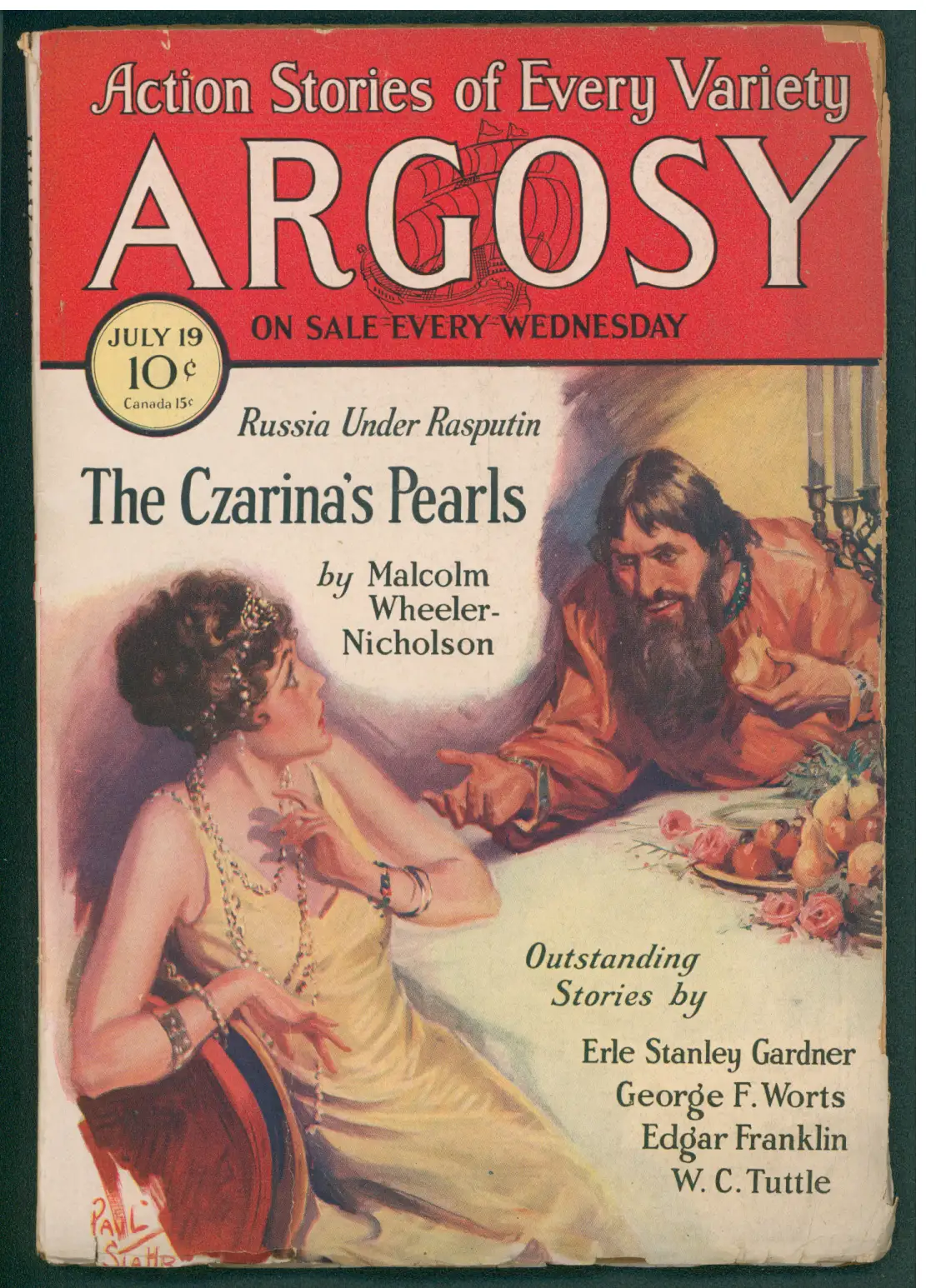
Between 1928 and 1932, the prolific detective fiction author Erle Stanley Gardner produced seven science fiction and fantasy stories for Argosy. “A Year in A Day” (July 19, 1930) takes the idea of invisibility-through-acceleration popularized by H.G. Wells’ 1901 story “The New Accelerator” and applies it to the framework of the crime story. Though Gardner is not one of the era’s most talented sf authors, here he anticipates everything from the Golden Age speedster comic-book characters the Flash (1940) and the Whizzer (1941) to Nicholson Baker’s 1994 erotic novel The Fermata. HiLoBooks is pleased to serialize the story, which enters public domain this year, for HILOBROW’s readers.
ALL INSTALLMENTS: 1 | 2 | 3 | 4 | 5 | 6 | 7.
CHAPTER 3
Unchained Lightning
As he hung up the telephone, a daring thought possessed Swift.
Why not stroll up to room 920, knock once, pause, and then knock twice? The voice over the telephone had said the doctor wouldn’t know the messenger!
The thought had no sooner entered Swift’s mind than it crystallized into action. He sprinted for the elevator, was whisked to the ninth floor and walked the corridor upon nervously impatient feet.
At 920 he paused, contemplated the plain door for several seconds, was painfully conscious of the throbbing of his pulse, and knocked. He paused, knocked twice.
There was a vague shadow flitting over the ground glass square. Then the shadow took bulk and sharpness of outline. Swift had visions of a tall, sinister figure with a cold eye, and was absolutely unprepared for the short, stumpy man with fleshy jowls who glared at him.
“Well?”
“Messenger. Told to get somethin’ here,” said Swift, slu ring his words together to disguise his nervousness.
The doctor glowered at him from eyes that were as twin chunks of polished ebony.
“Come in,” he said. “You’re early.”
“Am I?” asked Swift, striving to appear casually unconcerned. “I was told to come in half an hour. I walked around for a while, didn’t have my watch.”
The doctor grunted.
Swift noticed that he was slow and lagging in his movements, that his lips were a sickly blue, that the flesh sagged down in flabby pouches. There were pouches beneath the eyes, pouches below the cheek bones, a pouch below the chin, and a sagging pouch at the belt. The doctor was wheezing from the effort of walking toward the door.
He went to the door on his right, which Swift surmised must lead to the reception room, and locked it. Then he turned toward a door enameled a pure white.
“Just making a final test,” he said.
Art Swift got a glimpse of a long, well-lighted room. There were white tables, chairs, a long sink, a battery of test tubes, bottles, retorts, microscopes, and a cage full of canaries. These canaries sang in nervous, chirping voices, fluttering restlessly from perch to perch.
Dr. Zean left the door open as he entered the room.
“Sit down,” he wheezed over his right shoulder. “You must be the man that’s detailed to cover Washington.”
Swift resolved on a bold stroke.
“I am,” he said. “The chief sent me down here to get my stuff and get started.”
“Know how to use it?”
“Only generally. I understood you were to give me instructions.”
The doctor turned, frowned. His ebony black eyes bored into Swift’s features. The blued, flabby lips quivered.
“All damn foolishness trying to — Oh, well, you aren’t to blame.”
He reached in the cage. The birds fluttered their protests at the invading hand, flung themselves against the gilded bars. At length the fat fingers closed about a slim, yellow body. The bird gave a shrill cry of alarm, then was pulled from the cage, wings fluttering and flapping, occasional feathers drifting to the floor.

Dr. Zean raised a hypodermic, jabbed the needle into the fluttering bird. Almost instantly there came a rapid change. The fluttering wings began to move more rapidly. They gave forth a low humming sound.
“Watch,” said the doctor and liberated the bird.
The wings were moving so fast now that it was impossible to see them. They were like the wings of a humming bird, giving forth a low, droning sound. The canary hung for a split fraction of a second, poised in the air, then zipped into flight. Such a flight it was!
The bird seemed like a yellow streak, moving with incredible speed. Swift turned his head to follow the flight, turned it back again. Try as he would, he could not keep the bird in sight. Neither could he lose sight of it. The canary was merely a flash of yellow.
So rapidly did it move that the eye could see it only as a swift flicker of motion. Like an electric spark, it was impossible even to tell the direction of its flight. One time the bird seemed to be going in one direction, yet almost immediately it appeared in the opposite side of the room.
No direction in which Swift could direct his eyes but what that droning yellow streak zipped across his field of vision with such rapidity that it seemed there must be half a dozen of the birds in the air at once. In fact, there were several occasions when there seemed to be three different birds flying in opposite directions at the same time.
Swift rubbed his startled eyes.
The husky voice of the doctor took up a brief explanation, a word of warning.
“Time,” he said, “is an illusion of the senses. Space is an illusion. If there’s anything in infinity as an established fact, then there can be no limit to either time or space. To think of something that has no limit, yet has an existence, is absurd. Our finite minds place a limit on everything. So does existence.
“Therefore, the limitation of space and of time are the limitations and fallacies of the mind. It’s like a single tube radio set. It has a limited range. That doesn’t mean the radio waves that it receives are limited to that field. Same way with the human mind.
“Now some organisms live much more rapidly than others. Their concept of time is so radically different that the life energy is used up in a few hours.
“Naturally, if one could determine the particular gland which controls that time element it would be possible either to speed up life or slow it down. The dog uses up his allotted life energy in seven or ten years, the horse in a longer time. And there are cell organisms that live but a few hours.
“There’s no time for details. You wouldn’t understand them, anyway. But the point I’m making is that the extract I am able to furnish doesn’t do anything to give new energy. It simply directs the speed with which the existing energy is burned up. So you’ve got to be careful of the dosage. It’s barely possible that one could take a sufficient dose to live up a whole lifetime in five minutes.
“The effect of this extract is to speed up everything. It wears off as quickly as it takes effect. The muscles, the nerves, the brain, the heart, all function according to the new scheme of things. And your strength is multiplied accordingly.
“We don’t know what strength is. Take the elbow, for instance. It’s a fulcrum for the forearm. The raised forearm is a lever of the third class. The power is applied but a few inches from the fulcrum. Yet a strong man can raise a fifty- to eighty-pound weight in his hand without difficulty.
“Take a pencil and paper, calculate the moments of force and you’ll see that this calls for an utterly incredible amount of power to be applied to the forearm. In fact the bone wouldn’t stand such a strain. Take the forearm of a cadaver, put such a weight in it and raise it by mechanical means and the bone snaps.
“Therefore strength has something mental about it. The mind acts on the molecular structure in some way. Gravitation is the tendency of the molecules of all matter to draw together in proportion to the mass. Because of the greater mass of the earth it attracts an object many millions of times more than the object attracts the earth.”
The doctor ceased speaking and glared at Art with a look of hostility.
“Damn it, your mouth has flopped open as though the whole thing was strange to you. I’ve repeatedly warned those who sent you to see that this preliminary ground was covered first. I can’t be running a kindergarten here!
“Now here’s a box. That box contains two dozen little capsules and one big capsule. The little capsules contain enough of the extract to speed up your physical and mental processes at the rate of one hundred to one. Each capsule terminates in a hollow needle. When you are about to make use of a capsule take a deep breath, insert the needle, squeeze the capsule.
“Within the space of three deep breaths you will find your processes speeded up. You will move, think, breathe, talk one hundred times faster than normal. The small capsules last for about thirty seconds. Then the effects wear off. During that half minute you have lived fifty minutes of your normal life at a rate one hundred times as rapid as ordinary. Remember that your fast motions will be utterly invisible to ordinary eyes. If you talk, your speech will be unintelligible.
“It will be advisable to take two or three preliminary doses so you can accustom yourself to your new rate of life, and be able to gauge your motions accordingly.
“Now the big capsule is to be used only in the event of a major emergency. Every man is similarly equipped. It will speed up your life at the ratio of five hundred to one.”
There was an imperative pounding at the door which led to the reception room. Dr. Cassius Zean stifled an impatient exclamation, and wheezed his way to the door.
“I’m busy,” he said.
The girl’s voice that drifted through the panels contained some note of alarm. Art Swift could not hear the words. The doctor shot the bolt. The surgical nurse appeared in the crack of the open doorway. Art Swift kept his back turned.
There was the hissing of a sibilant whisper.
“Very well. I’ll attend to it at once,” said the doctor.
The nurse turned, paused, swung back. Art Swift could feel her eyes upon him.
“Turn around!” she cried.
Art turned, and, as he turned, he took a swift step toward the pair. The girl’s eyes burned into his own. Her lips parted in a screamed warning. “He’s a spy!”
Dr. Cassius Zean flung a hand toward his hip.
The girl jumped into the room and kicked the door shut. Her face was chalky white, the lips a thin line of grim determination.
“A knife!” she cried. “No noise!”
But Dr. Zean was lugging a heavy revolver from his hip pocket.
Art Swift was unarmed. The girl was coming toward him, fury blazing from her eyes. The doctor was raising the revolver.
Art made a wild leap.
The girl went through the air and tackled him with out-stretched arms, a tackle that would have done credit to a football star. Despite himself, the surprise of the attack, the weight of her hurtling form, threw Swift from his feet. He staggered, tried to catch his balance and crashed to the floor.
“Crack him!” he heard the girl say.
He saw Dr. Zean’s arm upraised, bringing down the weapon in a crushing blow, and flung up his knees, swung to one side.
The blow missed.
“Then shoot him, quick!” yelled the girl. “He’s breaking my grip!”
Even as she screamed the words, her hands slipped from the struggling body, and Art Swift lunged out with a circling arm, caught the ankle of the pudgy doctor, and gave a jerk. The foot slipped, the ankle gave, and the huge bulk came down with a thud. The girl’s hands had been busy. She was scratching at his face, biting, kicking.
Art rolled over, got to one knee, heedless of the fury of the nurse. He swung his right arm. The fist connected with the purpled jaw, but, even as he struck the blow, Swift realized that something was wrong. The flesh he hit was the color of fresh putty. The lips were blued, parted, gasping. The tongue protruded. Dr. Zean’s heart had given out, the excitement proving too much.
There remained the girl.
Swift flung his arms about her, held her helpless. He grabbed a roll of bandage that had become tangled in his feet and whipped it about her hands. She tried to scream then, but he stifled the sound, thrust the roll into the parted teeth. There followed a subdued gurgle. He tied the gag in place, endured the white-hot fury of her eyes, finished binding the wrists and ankles.
There was a closet opening from the room. He pushed her in there, gave a final inspection to the knots, closed and locked the door.
Then he turned to the doctor. He was dead, this pudgy physician who had isolated the extract that governed the tempo of conscious life.
As Swift started to search his pockets, there sounded a knock at the door of 920. A pause, two knocks. It was the messenger!
Art Swift grabbed the coat collar of the inert clay and dragged the pudgy form along the floor to the door of the laboratory. He pushed the man inside, closed the door, and walked toward 920. His fist was clenched. He was ready to strike the instant the man walked across the threshold.
He slipped the bolt, threw open the door.
“Come in,” he said, and then gasped his astonishment.
The figure that entered the room was that of a young woman, well-formed, beautiful. She smiled at him graciously.
“You are Dr. Zean? I was to receive certain things. Doubtless there is no explanation necessary,” and her lips parted in a smile.
Art Swift floundered in a confused greeting, invited her to be seated.
Should he tie and gag her? But she was so smiling, so innocent in appearance, so refined in her manner. Violence was unthinkable!
Then, as he hesitated, another thought flashed across his mind. Why not give her that which she sought, send her away, and follow? She would lead him to the rest of the gang.
He bowed deeply.
“If you’ll excuse me a moment,” he said, and went toward the door of the laboratory. He was careful to open it in such a manner that she could not see the corpse, and promptly closed it behind him.
He searched shelves, finally found that which he sought, a little pile of metal boxes in which were capsules similar to the ones the doctor had shown him.
He took a box of the extract, returned to the girl, and gave her as much of the doctor’s talk as he could remember.
“You look as though it was all news to you!” he stormed, just as the doctor had stormed at him. “I can’t run a kindergarten here. Why can’t they explain these rudimentary preliminaries to you before you come? Take this box and go.”
“Hadn’t I better try a capsule?”
He grunted, still keeping in the part of a testy scientist, impatient at having to explain fundamentals to an ignorant woman.
“I don’t care what you do!”
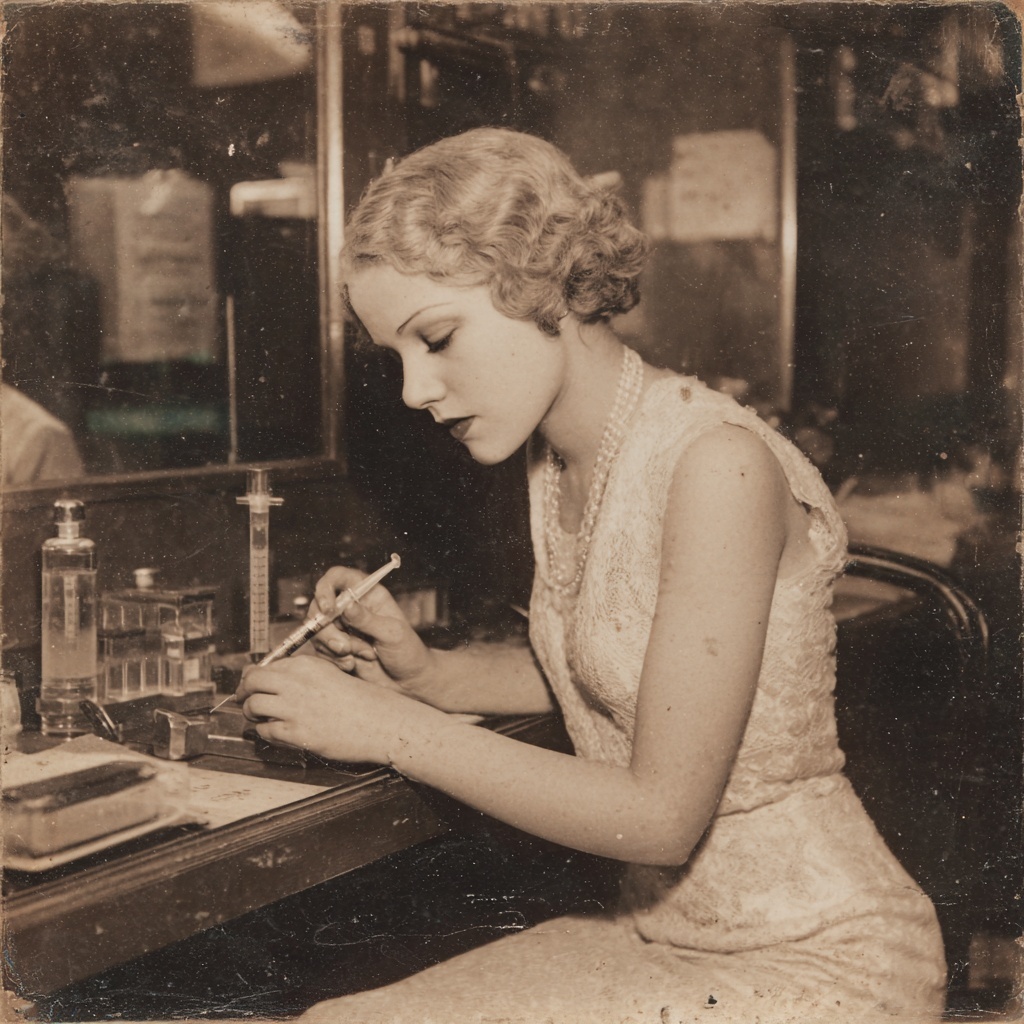
She flashed him a smile, opened the box, took out a capsule, took a deep breath, jabbed the needle into her arm, squeezed the capsule.
Then Art Swift realized that he, too, must test this diabolical extract of some nameless gland, or the girl would be able to vanish, moving a hundred times more rapidly than he could.
He grabbed a capsule from the box she held in her hand.
“I’ll take one with you,” he said, and took a deep breath.
The girl was breathing deeply. Her cheeks were flushed, her eyes were brilliant with excitement and with the stimulus of this strange substance.
Swift felt the bite of the needle, felt his blood tingle with the sting of the extract, and glanced at the clock on the wall. It was precisely two fifteen. The second hand of the mechanism was tick-tocking around its smaller circle. The minute hand pointed at the figure three, the hour hand at two.
The girl’s potion took effect first.
He suddenly saw her start to get up. Then it was as though she became a blur of motion. She walked, and her feet moved so rapidly the eye could scarcely follow. She talked, and her lips showed only as a filmy substance. The sound of her words was as the clatter of a watchman’s rattle.
She made toward the door, moving so fast that she was as a streak of whizzing speed, and then something clicked in Swift’s brain. Just as he was trying with leaden feet to move and intercept her, he suddenly saw her moving at normal speed, her hand on the door-knob.
“Well, I guess I’ll be going,” she said.
Swift wondered if the effect of the extract had worn off so quickly.
“Just a moment,” he said, sparring for time.
“Yes?” she asked.
“You felt the effect of the extract?” he wanted to know, curious as to her feelings.
“Just a slight dizziness. When does it take effect? It seemed to make you almost unconscious. You must have sat motionless for nearly five minutes. I talked to you and you didn’t answer. You seemed sick. I was alarmed.”
A sudden explanation flashed upon Art Swift. He looked at the clock. It was three seconds past two fifteen. The second hand seemed to have stopped in its motion. But there was a low-pitched sound coming from the clock, a long-drawn rasping of some sort of slow-moving mechanism.
He listened, attentively.
“T … O … C … K,” said the clock, and the second hand moved an infinitesimal fraction of an inch of crawling motion.
He pointed toward the clock.
“Can’t you see? You’re under the influence of the extract now.”
She regarded him with startled eyes, then moved toward the clock.
As she walked, Art watched her clothing. It was flattened against her figure as though pressed by some invisible hand. Then he remembered a strange, whizzing sound that had been in his ears as he had moved.
The girl modestly pulled at her skirt. It remained plastered against her limbs.
Swift laughed.
“The atmospheric pressure remains the same,” he said. “You are moving just one hundred times more rapidly than normal. Naturally, your speed through the atmosphere forces your clothing against you. There’s no use struggling with it. You’d have to remain still for some apparently perceptible interval to give the air currents a chance to adjust themselves.”
The girl laughed, a nervous, throaty laugh.
Swift found himself keenly interested in the various physical phenomena which surrounded them.
“Do you mean to say we’ve speeded up our lives so we live fifty minutes while that second hand clacks through thirty seconds?”
He nodded.
“And when I’m in the room,” said the girl, “and take the drug, then what do I do?”
Of a sudden, Art Swift knew exactly what she was to do.
“Simple,” he said. “Train yourself to sit absolutely still. Remain motionless with your body for minutes on end. Move only your right arm. That will enable you to put the poisoned cigarette in the hand of the victim without being detected. The motion of the hand will be far too swift for ordinary senses to detect. If any one should happen to be looking directly at you he will see your right hand apparently disappear. So be careful not to make the motion until every one is looking in some other direction.”
“But what if they should flash me a quick glance?”
“Quick?” He laughed. “The quickest glance they could flash you would be so slow that you would see their eyeballs move as though by slow clockwork.”
“And the cigarette?”
“Will have the extreme end of it filled with the poison. The victim inhales it fully into his lungs and dies. The other occupants of the room sense only the greatly diluted odor of the poison gas as a sickening sweet smell.”
“Goodness!” she exclaimed. Then, her eyes filling with some sort of emotion he could not fathom: “I must be going.”
She moved toward the outer door.
“I’ll see you to the elevator,” said Swift, and opened the door, taking care to slip a metallic box of the capsules into his hip pocket.
The outer office looked just as it had when Swift had first seen it. The furniture, the windows, the rugs. But as he opened the door he seemed pulling against a great weight, and he noticed the sudden vacuum swirl the rugs into bulging ripples of slow motion.
He understood then what he had done. He had jerked that door open with a motion one hundred times as swift as the ordinary opening of a door. It had disturbed the atmospheric equilibrium of the room.
Alarmed, he glanced at the stenographer to see if she had noticed it, to see if she would sense anything unusual in a strange man’s emerging from the private office, escorting a young woman to the door.
As he looked, she was about to glance up from her typewriter. She was striking the letters of the machine, glancing toward the door. Swift pressed the arm of the girl.
“Notice the mechanics of alarm,” he said.
They watched.
Slowly, the girl’s eyes swung upward. The lips sagged open in what was doubtless to be a gasp, but it was so ludicrously slow that they both laughed. The right hand pressed down on one of the keys of the typewriter. They saw the type bar slowly move upward to strike the paper.
The bar struck the paper, remained pressed against it for what seemed seconds, then slowly began to drop back. The carriage started a sluggish movement to make way for the next letter which was already being pressed, and still the girl’s eyes had not fully raised to the two figures who were watching her.
“Let’s move and see if she can follow us,” said Swift.
He grabbed the girl’s arm, darted to one side.
The typist’s eyes were raised now, but they stared in wide-eyed, frozen alarm at the place where they had been and not at the place where they were.
RADIUM AGE PROTO-SF: “Radium Age” is Josh Glenn’s name for the nascent sf genre’s c. 1900–1935 era, a period which saw the discovery of radioactivity, i.e., the revelation that matter itself is constantly in movement — a fitting metaphor for the first decades of the 20th century, during which old scientific, religious, political, and social certainties were shattered. More info here.
SERIALIZED BY HILOBOOKS: James Parker’s Cocky the Fox | Annalee Newitz’s “The Great Oxygen Race” | Matthew Battles’s “Imago” | & many more original and reissued novels and stories.