
A YEAR IN A DAY (1)
By:
February 23, 2026
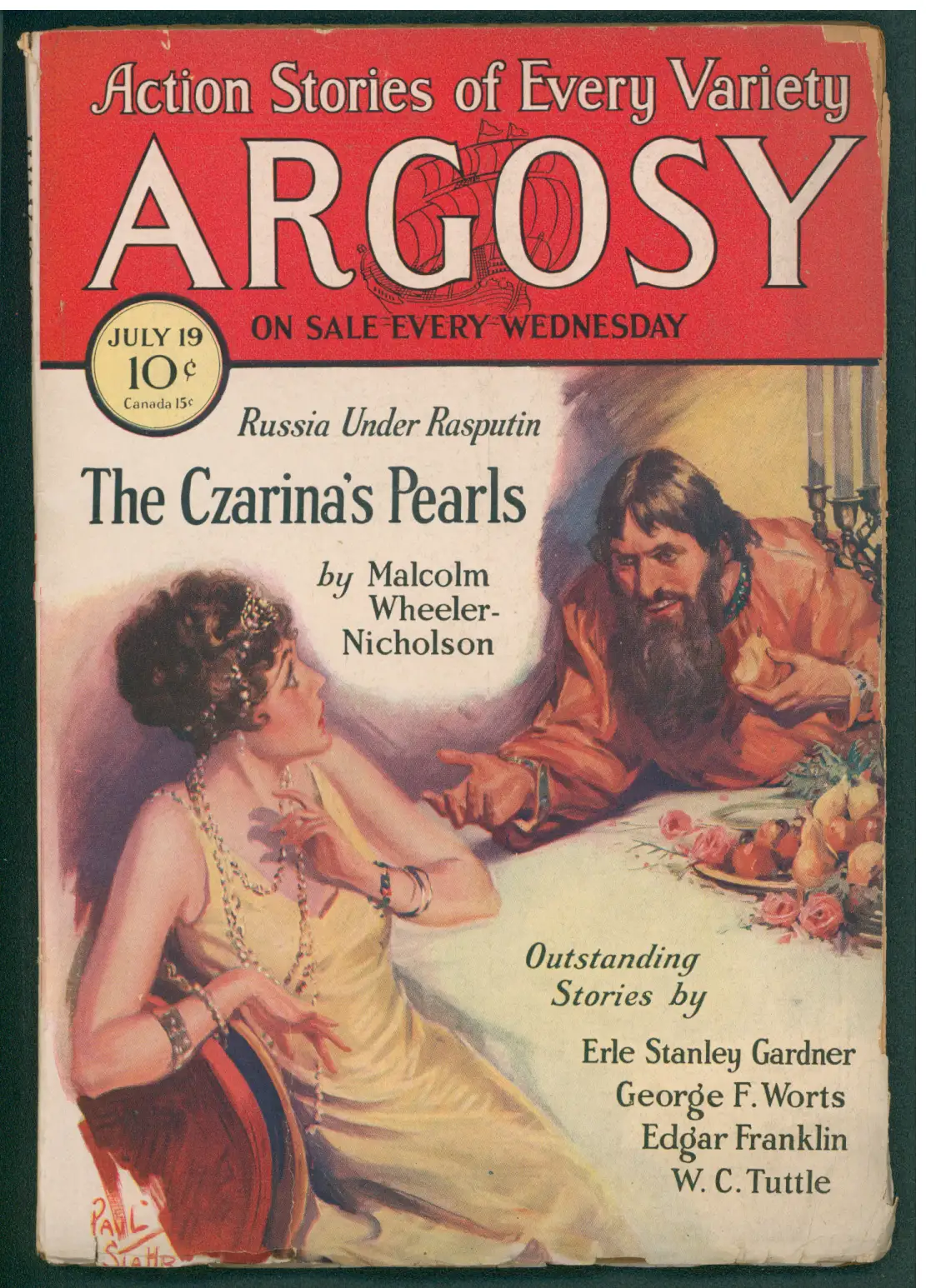
Between 1928 and 1932, the prolific detective fiction author Erle Stanley Gardner produced seven science fiction and fantasy stories for Argosy. “A Year in A Day” (July 19, 1930) takes the idea of invisibility-through-acceleration popularized by H.G. Wells’ 1901 story “The New Accelerator” and applies it to the framework of the crime story. Though Gardner is not one of the era’s most talented sf authors, here he anticipates everything from the Golden Age speedster comic-book characters the Flash (1940) and the Whizzer (1941) to Nicholson Baker’s 1994 erotic novel The Fermata. HiLoBooks is pleased to serialize the story, which enters public domain this year, for HILOBROW’s readers.
ALL INSTALLMENTS: 1 | 2 | 3 | 4 | 5 | 6 | 7.
A YEAR IN A DAY
CHAPTER 1
The Invisible Death
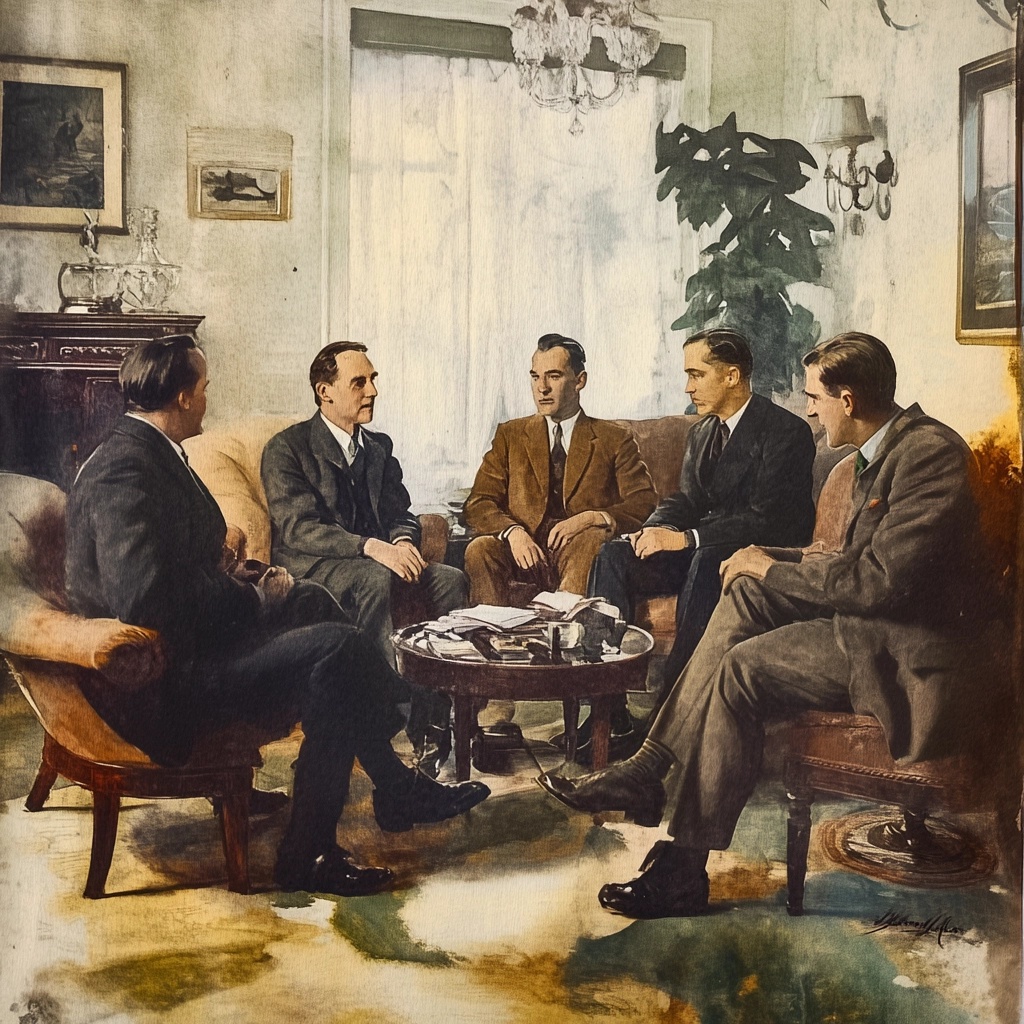
Of the five men who sat in that palatial room, Carl Ramsay had the gift of dramatic expression. He thought in blurbs, talked in motion picture subtitles.
The hour of midnight chimed from the expensive clock on the mantelpiece. Somewhere a cuckoo clock sounded.
“A new day,” said Carl Ramsay.
Tolliver Hemingway, multimillionaire, stirred uneasily.
“The day I am to die,” he said, and forced a laugh.
Nick Searle of the Star scraped a match along the sole of his shoe and grunted.
“One chance in a thousand.”
Inspector Hunter glowered about him, and his eyes were a challenge.
“One chance in ten thousand. One chance in a million,” he said.
No one contradicted him, but Carl Ramsay of the Clarion uttered another subtitle.
“The Death Day Dawns,” he murmured.
Arthur Swift surveyed the men in the room with curious eyes. It was his first experience with men of this type. Inspector Harrison Hunter, forceful, driving, alert; Tolliver Hemingway, multimillionaire, suave, polished, dignified, yet somewhat nervous beneath the external polish; Nick Searle, veteran reporter of the Star; Carl Ramsay, of the Clarion, who had been aptly described as “the man with the tabloid mind”; and, himself, a young teacher of physics in the state university. It had been Searle who had called him in, to cover the case for the Star from a scientific angle.
Yet Swift could see nothing to cover.
The room was locked, guarded. The five men were to keep a constant vigil for twenty-four hours within that locked room. Every bit of food they were to eat during that time had been hermetically sealed in cans. It would be consumed immediately after the cans were opened. Every bit of liquid they were to drink was contained in bottles that had been sealed and certified.
The room was on a third story. The windows opened out upon magnificent grounds, landscaped, cared for, and guarded. The side of the house was perfectly blank, devoid of any projection up which a man might climb. Searchlights played about the grounds. Floodlights illuminated the side of the building. A hundred armed deputies patrolled the place.
Such precautions seemed so elaborate as to be absurd. Under ordinary circumstances they would have been. But these were not ordinary.
Six of the richest men in the city had received letters on a single day. Those letters had been uniform in their terms. The men were to signify their willingness to pay a certain sum of money, which sum varied in each instance, or they were to die.
None of the men paid the slightest attention to those letters, save to turn them over to the police.
Then I. W. Steen, the millionaire head of a publishing company which included several magazines and two newspapers, one of which was the sensational Clarion, received a second letter. That letter announced the day and the hour of his death in the event he did not comply with the request. Steen turned that letter over to the police and took precautions against attack.
The precautions were in vain.
Seated in his private office, in conference with the heads of his various publications, a sickening sweet odor became noticeable in the room. Ten seconds later Steen was dead. No other occupant of the room suffered the slightest inconvenience, the slightest sensation of discomfort, although all of them noticed the peculiar odor.
Two days later C. G. Haymes received a summons through the mail. It was in the nature of an ultimatum. He was to signify his willingness to comply with the terms of the man who signed himself “Zin Zandor,” or he, too, was to die.
The hour of his death was not given. But the day of the death was announced.
C. G. Haymes had been frankly worried. He had placed himself in the hands of the police. They had isolated him in his home, surrounded the place with guards. He, too, had become good “copy,” and the newspaper reporters who enjoyed the confidence of the administration had been permitted to cover the case. They had done it with an air of boredom. Steen’s death had been due to fright, they felt; the autopsy disclosed no organic lesion. There was no chance that coincidence would repeat itself.
Yet, while the reporters were lounging about at ease, while the police cordon surrounded the place, while even the servants had been excluded, C. G. Haymes died, and the manner of his death was as the other’s. A sickening sweet odor that had been noticed by the other occupants of the room, yet had not seemed to affect them in the least, a cry of anguish from the millionaire, a sudden spasm, and death.
Three of the remaining millionaires had capitulated.
They had followed the routine indicated in the letter for showing their willingness to pay. And they were paying, transmitting the money to the dreaded Zin Zandor by means which they refused to divulge. For Zin Zandor had made it apparent that any information given to the police would result in death.
Tolliver Hemingway alone of the remaining men who had been threatened refused to be cowed. He hurled forth his defiance, and the mail had brought him the information that he would meet his death on the twenty-fourth day of June.
Now midnight had struck on the twenty-third of June, and the clocks clacked off the seconds of the fatal twenty-fourth.
“Well, we might as well have a drink,” said Inspector Hunter, pouring himself a stiff jolt from some of the prewar whisky the millionaire’s cellars had furnished.
“None for me,” said Hemingway. “I think I’ll go easy on the drink. One can’t tell…”
The inspector snorted.
“Don’t be foolish. You’re absolutely safe here. Every bit of food and drink in this room has been checked by two police chemists. I wouldn’t even waste the time to sit here with you, only the public are in a panic over this Zandor fellow, and we’ve got to show them how powerless he is in the face of adequate precautions. In the meantime our paper and handwriting experts are at work on those letters. They were all written on a Remington typewriter, and all on the same machine. The stationery has been traced to a job lot that went to one of the big stationery firms. It’s a cinch.”
He drained the whisky.
Carl Ramsay scribbled a sentence in a notebook, and, as he wrote, read aloud the words he jotted down for future reference.
“The Man Who Dares Not Eat,” he intoned. “We’ll run a picture over that.”
Nick Searle snorted.
“You’ve got a cinch with that yellow journal of yours, Ramsay. Wish I had things as easy.”
Arthur Swift stirred in his chair uneasily.
“You both have a snap compared to me. What am I supposed to do?”
Searle laughed.
“Look wise and feel foolish. Along about nine o’clock we’ll cook up a column or two for you to write about the scientific angle of the thing. I’ll dope out what I want, you can stick in a couple of high-sounding scientific terms, something about metabolism and the oxidation of tissue. We’ll run your picture at the head of the column. There’ll be a catchy headline, ‘Noted Professor Explains Hysteria,’ or something of the sort. The idea will be that there was something akin to hypnotic suggestion in the minds of the men who died.”
Carl Ramsay lit a cigarette.
“Better headline than that,” he said: “‘Scientist Pits Skill Against Death.’”
Searle stretched, yawned. “You ought to have the city editor I’ve got to go up against,” he said gloomily.
And Arthur Swift, watching Ramsay, suddenly saw a peculiar thing. The right hand of the reporter seemed to vanish. He rubbed his eyes. The hand was back in place.
But, for a split fraction of a second, the right hand of the tabloid reporter had simply vanished. It had not only dissolved into space, but the right arm, almost to the shoulder, had ceased to exist.
It could hardly have been a mere freak of the imagination. Neither could it have been an optical illusion. For Arthur Swift had been able to see everything else within that room clearly and with normal vision.
Tolliver Hemingway, the millionaire, was taking a cigarette from a gold case. Searle was biting the end from a cigar. Ramsay was smoking. His left hand was conveying the cigarette from his lips. Inspector Hunter was finishing the last of the generous drink he had poured.
Everything was entirely normal, save and except for that sudden disappearance of Carl Ramsay’s right hand. It had happened that Arthur Swift was watching that right hand. He had seen it suddenly become nothing. He had blinked his eyes, and the hand was back, reaching for a notebook. It could not have been more than a tenth of a second that the hand was gone, perhaps not half that long. Yet it most certainly had disappeared.
“Look here,” said Swift, “did you fellows notice anything just then?”
They looked at him, and as their eyes saw the expression on his face, they snapped to rigid attention.
“What?” asked Searle.
“Shoot,” said Inspector Hunter.
“Your hand,” said Swift, addressing himself to Ramsay, “it seemed sort of — er — well, sort of funny.”
And then a strange thing happened.
Ramsay opened his lips to make some reply, and the sounds that came forth were not words. They seemed a peculiar rattle of gurgling noise that beat with consonant harshness upon the eardrums, rattled against the intelligence with such terrific rapidity that they were like static on a radio receiver.
“What?” asked Swift.
Ramsay drawled slightly, in his normal irritating tone of voice, as he reached for the pencil and scrawled a line across the notebook.
“Guard Goes Goofy,” he scribbled, and said: “That’d look fine under your picture. It shows what hysteria will do. Sort of fits in with a general theory. Get a man to believe that a sickening sweet odor will produce death upon him alone, and then fill the room with such an odor, and the man who believed it would be fatal would kick off. Good thought that. I’ll write it up with a by-line by Professor Somebody-or-other: Scientist Suggests Solution.”
Inspector Hunter snorted. “Foolish to have amateurs in a place like this.”
Searle frowned. “One of the first things you’ve got to learn, Swift, in a situation of this kind, is to see things and see them accurately. Don’t go letting your imagination run away with you. Now all the Star wants is the use of your name and some scientific terminology. Maybe you’d better curl up and take a nap.”
But Tolliver Hemingway, accustomed to appraise character with unerring accuracy, leaned forward.
“Tell us what you saw?” he said.
Arthur Swift turned red. Under the rebuke of the reporter who had employed him, he realized how absolutely foolish it would sound for him to mention that the right hand and arm of a man had disappeared — had become simply as nothing.
“Why — I guess —”
The steady, keen eyes of the multimillionaire bored into the young man’s face.
“Yes. Go on. Nothing’s too absurd to be given careful attention.”
“Well,” blurted Swift, “if you’ve got to know; it sounds sort of goofy, but —”
He broke off as a cry of alarm burst from the lips of Carl Ramsay.
“The odor!” he cried.
And there could be no doubt of it. The room was filling with a peculiar odor, a something that was like orange blossoms, yet was not like orange blossoms. It was too sickeningly sweet to be pleasant, yet so cloyingly rich that it was not unpleasant.
Tolliver Hemingway was on his feet, his gray eyes snapping.
“All right, boys; don’t think I’m afraid, and don’t think any hysteria is going to get me. Inspector, I’ve one request. If anything should happen, search every man in this room, from his skin out. I have an idea this —”
He paused. A look of surprise came over his features. He clutched at his throat.
“I … am … not … afraid,” he said, thickly, speaking slowly as though paralysis gripped the muscles of his throat.
“It … is …”
And he swayed on his feet, lurched forward, flung out a groping hand. The hand clutched the rich cloth which adorned the table on which Inspector Hunter had set his empty glass, and on which the whisky bottle reposed. The cloth came off. The glass crashed to the floor. The bottle rolled across the room.
Tolliver Hemingway crashed to the floor.
He was dead by the time they managed to open his collar and take his limp wrist in their fingers.
Inspector Hunter rushed to the window.
Outside, the searchlights played silently across the darkness of the grounds, their beams interlacing, bringing trees and shrubs into white brilliance, casting shadows which were, in turn, dispersed by the rays of other cross-lights, flickering and flitting. The whole side of the building was covered by floodlights, and the inspector had no sooner thrust his head from the window than a voice from below called up.
“All right, inspector?”
“Anybody come near here?”
“No, sir. Of course not, sir. Our orders were to shoot on sight.”
“Who’s there with you?”
“Laughlin, O’Rourke, Maloney, and Green.”
“One of you sound the alarm. The others wait there. Shoot any stranger on sight.”
Inspector Hunter whipped a service revolver from his belted holster, and fired two shots from the open window, signal to the various guards. Almost immediately a siren screamed forth the agreed signal of death.
Inspector Hunter turned back to the room, then, suddenly snapped his revolver to the level.
“Get your hands up, Searle!”
The surprised reporter, in the act of shooting the bolt on the door, regarded the inspector with a puzzled frown.
“I’ve got to get to the paper. I can handle this so much better on the ground than I can over the wire. We’ll get out an extra —”
There was no mistaking the cold calm of Hunter’s voice.
“Get away from that door or I’ll shoot you like a dog. You know what this means. It’s the beginning of a reign of terror. This is once that the news comes second. You men will remain here. The murder will be kept absolutely secret until we’ve exhausted every possible clew.
“And every man in this room is going to be searched from the skin out. Everything in this room, including the very air, is going to be analyzed. Damn it, I’m going to get at the bottom of this!”
And Nick Searle, white-faced in his rage, slowly turned back from the door.
“The Star will break you for this,” he said, in a low tone, vibrant with anger. “You can’t pull a stunt like this and get away with it.”
“The hell I can’t,” said Inspector Hunter, his cold eyes glittering over the barrel of his service revolver. “Get back in the corner, and take your clothes off. Every damned one of you take your clothes off.”
He turned to the window.
“Green, send up some doctors, and two of the chemists. Let no one else come in to the grounds or the house. Let no one leave. Keep your mouth shut. Have two men come up here and knock on the door. Let them have their revolvers in their hands. Let them shoot to kill at the first sign of disobedience to my orders.”
And then Inspector Hunter slammed down the window.
The sickening sweet odor was still in the air, but it was not as noticeable as before.
“Boys, take off your clothes and stand over there in the corner, naked as the day you were born.”
Ramsay sneered. “Inefficient Inspector Insults Interviewer.”
Searle added another thrust: “Police Inspector Drinking at Time of Tragedy.”
Hunter whirled on him.
“You’d use that? After my pulling the wires to get you in here so you’d have an exclusive?”
“I’d use anything,” said Searle, his face still white. “The news comes first. You can’t hush this thing up, and you can’t stall it. The Star will get scooped by every paper on the street.”
Inspector Hunter shook his head, slowly.
“It won’t get out.”
“Aw, hell. It’s getting out right now. There were reporters watching the house, watching the grounds. Think they heard those shots and the alarm siren without putting two and two together? They’ll have extras on the streets within an hour announcing the death, and they’ll make a pretty shrewd guess at what’s happened afterward.”
Hunter lowered the gun slightly.
“The department will issue flat denials. We’ll deny the death. We can’t let this get out. It would rock the city. It would start a reign of terror. This means the police are powerless.”
“You can’t hush it up. Your denials will only get you in bad at the start, and give the other papers that much more prestige when you finally have to admit the truth.”
Hunter shook his head.
“This is an emergency the like of which has never faced the city before.”
He jerked up his revolver as one in whom the last vestige of indecision has vanished.
“Get over there and get your clothes off.”
“Hunter Has Hysterics!” rasped Ramsay. “Intoxicated Inspector Incarnate Inefficiency!”
“Get your clothes off!” yelled Hunter.
There was a double knock at the door.
His eyes squinting over the barrel of his revolver, Hunter threw open the door. Two uniformed policemen with drawn guns stood gaping on the threshold.
“Boys, see that these men strip!”
Nick Searle moved slowly, reluctantly.
“You’ll strip, too, damn you,” he said, “or I’ll write an article accusing you of the murder.”
“Examiner Evades Equal Examination,” sneered Ramsay, moving, however, toward the corner indicated by Hunter.
“No. I’ll join you. That’s fair. That’s what I wanted these boys up here for,” said Hunter, throwing down his gun, and taking off his collar and tie as he moved to the corner.
The police chemists found four naked men and a corpse in the room. They made a minute examination of every article in the room. They analyzed every single thing that they fancied might have played a part in the tragedy. They examined even the tobacco in the cigarettes, the paper with which they were tipped. They found nothing.
Dawn found the men working frantically.
It also found extras on the streets, intimating that there had been a tragedy despite the vigilance of the police. It found a crowd surging about the streets which bordered the spacious grounds of the millionaire’s mansion.
Noon found Hunter throwing up his hands in helpless despair.
Three o’clock found him pleading with the reporters to be reasonable and give him a break. But Searle and Ramsay, insisting upon the right of the press to print the news, were obdurate.
They were released from custody at three fifteen.
Searle took Swift to the Star offices. There they wrote frantically. Swift was given a rewrite man. He gave a few scientific terms covering possible causes of death, made some comment upon atmospheric poisons, and then read the proof on an article that was more wildly speculative than any thoughts he had dared to formulate or utter.
“Celebrated Physicist Hints at Atmospheric Poisoning,” he read, then, lower down, in smaller type: “Mysterious Ray Penetrates Walls and Locked Doors. Possibility that Radio May Act as Transmitting Medium. Scientist Confirms Report that Intoxicated Inspector Delayed Transmission of News to Eager Public.”
The cashier handed Swift a check that was three times the amount of a month’s pay at the state college.
“We’ll want a follow-up to-morrow. You’ll get the same rates,” he said.
“In the meantime?”
“Do anything you want. Keep in touch with the office.”
Swift bowed, reached for his hat.
At that moment the telephone shrilled sharply. One of the men barked excitedly as he listened to the sounds that rasped through the receiver.
Another reporter came in, breathless.
“Here’s a photo of the letter,” he said, and rushed to the dark room.
“Better stick around, Swift,” said Searle. “Hell’s to pay.”
RADIUM AGE PROTO-SF: “Radium Age” is Josh Glenn’s name for the nascent sf genre’s c. 1900–1935 era, a period which saw the discovery of radioactivity, i.e., the revelation that matter itself is constantly in movement — a fitting metaphor for the first decades of the 20th century, during which old scientific, religious, political, and social certainties were shattered. More info here.
SERIALIZED BY HILOBOOKS: James Parker’s Cocky the Fox | Annalee Newitz’s “The Great Oxygen Race” | Matthew Battles’s “Imago” | & many more original and reissued novels and stories.