
THE PURPLE FLOWER (1)
By:
December 13, 2025
In Margaret B. Wilkerson’s Foreword to the anthology Black Theatre USA: Plays by African Americans, 1847 to Today, we read that Marita Bonner’s 1928 play The Purple Flower is “an allegory that portrays the final revolution when Blacks forcibly claim equality by overthrowing their oppressors.” We are pleased to serialize this story for HILOBROW’s readers.
ALL INSTALLMENTS: 1 | 2 | 3 | 4 | 5.
(TIME: The Middle-of-Things-as-They-Are. [Which means the End-of-Things for some of the characters and the Beginning-of-Things for others.]
PLACE: Might be here, there or anywhere—or even nowhere.
CHARACTERS:
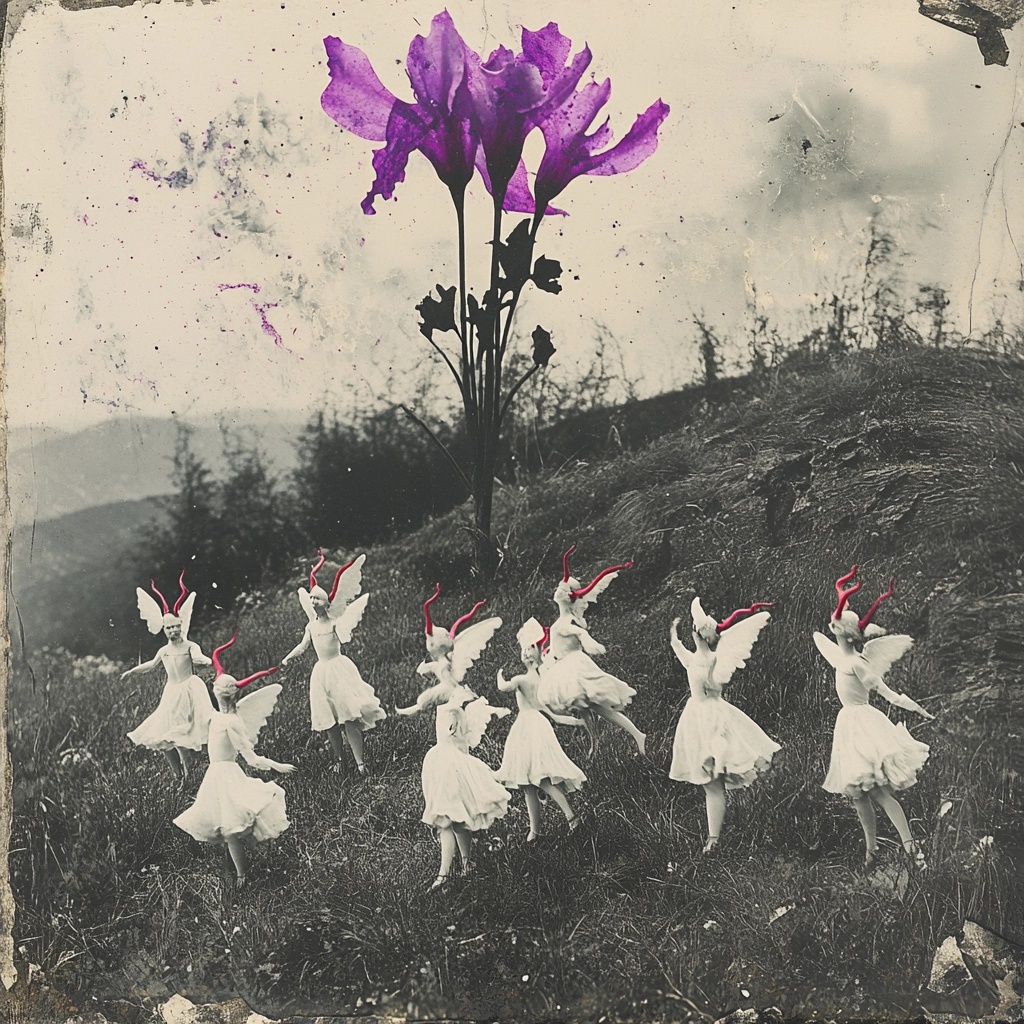
SUNDRY WHITE DEVILS. [They must be artful little things with soft wide eyes such as you would expect to find in an angel. Soft hair that flops around their horns. Their horns glow red all the time—now with blood—now with eternal fire—now with deceit—now with unholy desire. They have bones tied carefully across their tails to make them seem less like tails and more like mere decorations. They are artful little things full of artful movements and artful tricks. They are artful dancers too. You are amazed at their adroitness. Their steps are intricate. You almost lose your head following them. Sometimes they dance as if they were men—with dignity—erect. Sometimes they dance as if they were snakes. They are artful dancers on the Thin-Skin-of-Civilization.]
THE US’S. [They can be as white as the White Devils, as brown as the earth, as black as the center of a poppy. They may look as if they were something or nothing.]
SETTING: The stage is divided horizontally into two sections, upper and lower, by a thin board. The main action takes place on the upper stage. The light is never quite clear on the lower stage; but it is bright enough for you to perceive that sometimes the action that takes place on the upper stage is duplicated on the lower. Sometimes the actors on the upper stage get too vociferous—too violent—and they crack through the boards and they lie twisted and curled in mounds. There are any number of mounds there, all twisted and broken. You look at them and you are not quite sure whether you see something or nothing; but you see by a curve that there might lie a human body. There is thrust out a white hand—a yellow one—one brown—a black. The Skin-of-Civilization must be very thin. A thought can drop you through it.
SCENE: An open plain. It is bounded distantly on one side by Nowhere and faced by a high hill—Somewhere.
ARGUMENT: The WHITE DEVILS live on the side of the hill. Somewhere. On top of the hill grows the purple Flower-of-Life-at-Its-Fullest. This flower is as tall as a pine and stands alone on top of the hill. The US’s live in the valley that lies between Nowhere and Somewhere and spend their time trying to devise means of getting up the hill. The WHITE DEVILS live all over the sides of the hill and try every trick, known and unknown, to keep the US’s from getting to the hill. For if the US’s get up the hill, the Flower-of-Life-at-Its-Fullest will shed some of its perfume and then there they will be Somewhere with the WHITE DEVILS. The US’s started out by merely asking permission to go up. They tilled the valley, they cultivated it and made it as beautiful as it is. They built roads and houses even for the WHITE DEVILS. They let them build the houses and then they were knocked back down into the valley.
Scene: When the curtain rises, the evening sun is shining bravely on the valley and hillside alike.
The US’s are having a siesta beside a brook that runs down the Middle of the valley. As usual they rest with their backs toward Nowhere and their faces toward Somewhere. The WHITE DEVILS are seen in the distance on the hillside. As you see them, a song is borne faintly to your ears from the hillside.
The WHITE DEVILS are saying:
You stay where you are!
We don’t want you up here!
If you come you’ll be on par
With all we hold dear.
So stay—stay—stay—
Yes stay where you are!
The song rolls full across the valley.)
A LITTLE RUNTY US — Hear that, don’t you?
ANOTHER US — (lolling over on his back and chewing a piece of grass) I ain’t studying ’bout them devils. When I get ready to go up that hill—I’m going! (He rolls over on his side and exposes a slender brown body to the sun.) Right now, I’m going to sleep. (And he forthwith snores.)
OLD LADY — (an old dark brown lady who has been lying down rises suddenly to her knees in the foreground. She gazes toward the hillside) I’ll never live to see the face of that flower! God knows I worked hard to get Somewhere though. I’ve washed the shirt off of every one of them White Devils’ backs!
A YOUNG US — And you got a slap in the face for doing it.
OLD LADY — But that’s what the Leader told us to do. “Work,” he said. “Show them you know how.” As if two hundred years of slavery had not showed them!
RADIUM AGE PROTO-SF: “Radium Age” is Josh Glenn’s name for the nascent sf genre’s c. 1900–1935 era, a period which saw the discovery of radioactivity, i.e., the revelation that matter itself is constantly in movement — a fitting metaphor for the first decades of the 20th century, during which old scientific, religious, political, and social certainties were shattered. More info here.
SERIALIZED BY HILOBOOKS: James Parker’s Cocky the Fox | Annalee Newitz’s “The Great Oxygen Race” | Matthew Battles’s “Imago” | & many more original and reissued novels and stories.