
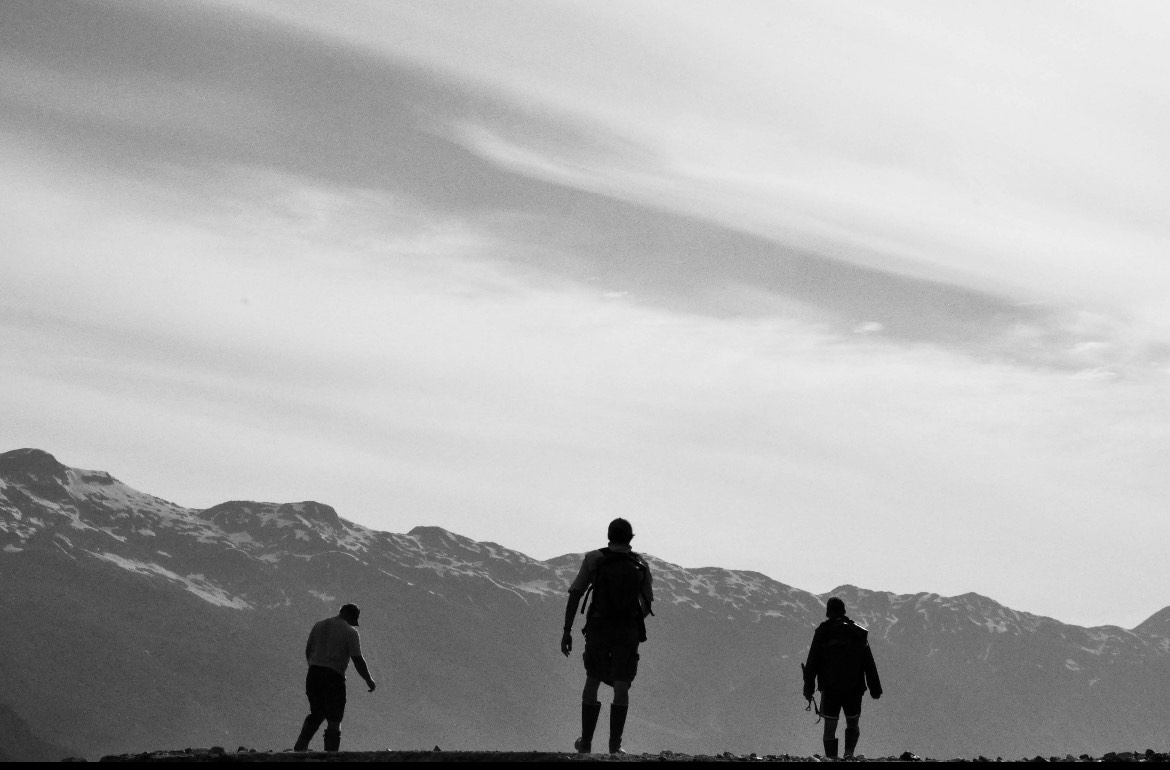
 Photo Credit: Jesse Wiles
By Charlie Mitchell
Serialized January– March 2026 at HILOBROW
“At least you won’t smell like goat shit til next Wesacc,” Virgil pokes at his small and glum friend. Little Dog kicks at a pine cone, looking everywhere but at his tall and collected friend.
The two hold that space for a moment. Bells clink in a soothing hubbub. Bleats steam out above the herd. Frozen dew crunches with every step amid the staging grounds. The able bodied Kindred prepare. Provisions double checked; gear inventoried; a caring eye set on the sheep and goats, and a wary one vigilant on the treeline. An initiated gaggle of adolescents shiver equally from cold and anticipation. Their hands are swatted away from over-fidgeting straps and buckles.
“Little Dog, aweh, big man,” Virgul nudges again. The smaller friend rocks back and forth on his heels. His eyes glaze over on one of the billy goats; the ungulate meets his stare with grinning kiltered blankness.
“Who knows brother, maybe just one more year and you might be freezing your tits off like we’ll be.”
Little Dog turns to take Virgil’s eye. “Bullshit! Baba said the same thing last spring. Everyone says the same thing every spring.”
“Well somebody has to listen to Baba drone, somebody’s gotta shovel the sh— ouch ah ah, okay okay, too far. I’m sorry big man, I couldn’t help it.”
“Fuck you!” Little Dog hisses, below adult earshot. “What am I even supposed to do?” he whines. He cranes around to see if Baba was watching from the farewell party of Kindred. Seems to be having last words with the Bodhisattva.
“Anyone fun is doing Transhumance, just the babies get left behind. Just me and sniveling kids or adults who have just me to boss around – oh I hate stitching. And when River’s in charge of lessons. Or what if marauders come while you’re gone? It’s not just boredom and bad chores y’know, but real danger out there.” Little Dog summons all the words he can, but stands like a boy complaining and little else.
Virgil laughs and jerks his hand as if masturbating. “Then good thing brave Little Dog will be there to hold things down. You’ve had plenty of springs to figure something out, squealer. No one’s gonna come while we’re gone – promise. Just don’t monkey in the wilds alone,” he frowns.
“Hungry things come out in spring. You know it. And be easy on River, she adores you, and does her b–”
The Bodhisattva’s horn cuts Virgil off. The horn sounds a pall of a passed eon and it settles around the Kindred, permeating this highland valley. Little Dog was never surprised by its ability to still everyone, even animals. It always spoke to something primordial that he found impossible to put into words. The closest Little Dog has heard was an elk bugle in the dawn hour before the sun had risen to burn the fog off the valley floor. It was tears knocking from behind eyeballs, blood surging stronger in his arms, a focus like the first snowmelt stream surging down his spine.
Virgil catches Little Dog dazed and squeezes the enraptured friend tight, and before he grasps it all Virgil is absorbed into the departure. When the horn ends and the call dissipates, the Transhumance – led by the Bodhisattva, with Virgil and the other teens, the chaperone Kindred, then the two hundred-head herd of sheep, their dogs – wordlessly begin the two-moon trek.
Hands clap down on Little Dog’s shoulders. He cranes up and there is Baba; beaming as ever. Warm hands and starlight in the eyes. Little Dog, Baba, and about a dozen Kindred remaining home watch the Transhumance mount the ridge out of the valley.
Now that the snow drifts began to flee fir shade with spring, the corridor west to the grazing valleys in the southern Saltese Uplands are finally free from winter’s maw. The sheep were scrawny under their shag and wool, sure, but it wasn’t all about regaining summer fat. The Transhumance is a rite of passage; grounds to plant oneself in circumstances outside of the Heart Cave. In a word, as Baba put it, to put oneself in the world, sans self. Little Dog knows best that not everything can be lectured. It still has its dangers – sometimes Kindred didn’t come back.
The last cloak and backpack, dawdling bellchime, vanish around the butte overlooking the valley. They leave a trail pummeled out of frost into sallow grass – a snake scaled out of their memory, Little Dog thought. Soon to be either daubed over by another snow or swallowed altogether with the melt. Kindred began rousing, blinking from some trance and walking back to the Heart Cave.
“Come on, Little Dog,” Baba squeezes his shoulders again. He realizes that they were the last to linger here on the valley floor.
“There’s plenty to do back home, and a full day ahead of us.”
The pair start the ponderous way back down the other end of the valley. Little Dog lets Baba’s long legs carry him ahead a ways. Something still festers in his craw, but he has long since learned to keep it in unless he wants a browbeating of unsolicited wisdom. His eyes move over Baba, the trail, the stones and creaking pines. Baba’s broad back and shoulders; simian gait fluid around clawing pine branches. Monumental but somehow part and whole of the world. He turns; leathery face flushed, breath curling out from his dark depth of beard.
“Will you walk beside me? I don’t like it when you hang back.”
Little Dog grumbles and plods along the trail. Baba slides forward and matches his pace.
“You’re stoppered up – and you’re only quiet when you’re mad,” Baba murmurs. His legs slowly plant themselves around roots and stones. The elder’s probing only buries whatever’s stuck in his craw even deeper.
“I’m still only a kid to you. How come?”
Baba arches an eyebrow.
“Me and Virgil are the same age. River went when she was even younger than us,” Little Dog exhales sharply. Blood pumping faster. Eyes fixed on the trail. Cheeks hot while chewed by cold – he feels angry words frothing up his throat.
“I – we – we all grow up on the stories by the fire. I’ve even seen more winters than some of the kids going this year. But you pass over me. I feed, post, shear, weed and till, even shoe, I’m healthy and my senses are sharp. You pass over me every year and they say I’m not ready but there isn’t a thing I don’t do at Heart Cave. How am I not ready?”
The tirade hangs in the air between them and the droop of pine needles. He feels his heart thudding. He regrets most of his words. So it went when he did things out of anger; even as relief slowly kneads its way into the vacated places. Baba strokes his beard as they walk on, immovable as ever, nodding somberly.
“Remember the ice cream Khyber churned last summer?”
Little Dog flung up his hands; here came the browbeating.
“No no really, how brutal the heat was by solstice? How cold – mm, hard to envy cold now – but the honey in every mouthful, the small grains of ice. After working under the sun all day,” Baba smacks his lips, craned upwards. “Wonderful thing that, something all the Kindred can enjoy together.”
“It was pretty good.” He remembers – he ate too quickly and got a brain freeze but so did Virgil. Sticky hands caked with dirt and sugar viscous. Cream sludge filling his belly to the brim, followed by a killer thirst, slurping down gourd after gourd. Sated; water sweet from the cedar cask it slept in. There was some specific charge to that high summer dusk; he knew it wasn’t wholly the ice cream that had hallowed it in his memory.
Little Dog restrains any physical tell while Baba yarns on about the impermanence of ice cream – he pastes his sight on the trail ahead. He’s come to loathe anything short of plain talk; something is powerfully condescending in a metaphor lesson.
Baba’s expression is placid. “Are you starting to see where we’re headed? Smelling what I’m stepping in?” He winks a goad at Little Dog, who is not looking at Baba.
“In short pal, it is a privilege, and because you can count on it there’s no good reason to rush it until you’re ready. And when you’re ready, you’ll understand why there can’t be a rush; like any good task, if you hustle through it there’s bound to be consequences.”
“For fuck’s sake I’m not desper – for ice cream? If I am desperate it’s–”
“Language. I never said ‘desperate.’ Man bellysick with desperation – you could put a knife and fork into that sort of aura – that’s different. I think you want to go for the stories you’ve heard, and not the calm the Kindred have when they come back. How many times have you imagined yourself on Transhumance as some sort of badass?”
This is the first time Little Dog has ever heard Baba cuss; he blushes and tucks his face in the neck fold of his hood. Baba nods slowly.
“I know – I was your age once too. And at your age, nobody reckons that elders were ever anything but elders. It’s so urgent for you because you’ve made it out to be about glory, which is a commodity and pal, Transhumance is anything but commodities. Nature doesn’t cater to glory. As much as we’re part of her, she doesn’t care a lick about things like that,” Baba sighs.
“Sarah gored by a bison she tried to swoon ‘because she felt its heart’ – River carried her back for the next two weeks. Chema caught and crushed in an avalanche with no business above the alpine line – who we found only after the thaw. The only two I’ve blessed and felt gray about; a maiming and cycling, and both weigh on my heart every day. In the end they weren’t ready, and they weren’t ready because they had an expectation they brought to Transhumance. So I can’t, won’t ever, send someone who isn’t ready.”
Baba’s tone is gentle; no shred of accusation but his words still split Little Dog open. And out tumbles those past fancies of Transhumance. Spearing marauders, saving some warlord or president’s daughter, taming wolves and befriending bears he would ride. Fancies Little Dog never saw harm in, all tumble into a grave and are entombed in seconds.
Little Dog walks on with Baba in a shamed silence. Something is hollowed out in the youth and he struggles for any words at all to tell off Baba or describe what has just fled and leaves a hole behind. This was some defilement. To barge into someone’s mind and demean dreams – and to seat them alongside something especially juvenile like ice cream. How had Baba done this? It’s possible that Baba was right; he had just been his age once, too. Regardless of the route or purpose it feels like transgression.
Light is steadily trickling into the forest – the youth maintains the pace because it’s the mature choice, and the elder will never even suggest abandonment.
“Few wolf tracks right there,” Baba points a few feet away off the trail. He raises his eyebrows. Little Dog can’t budge. Chickadees and a few passerines start up as the sun breaks over the mountains to warm the loftier reaches of pine boles.
The trees begin to thin out as the pair approach the Heart Cave. Sun glaring off the main lodges’ tin roofs squints Little Dog’s eyes. Plumes of steam from the thermal spring and smoke from stoves rise up thick as pillars in the crisp vault of sky. Faint echoes of barking dogs and the clang of toolwork.
Blithely, the elder waxes and wanes and waxes again on the poetry of spring, hinting at the work to be done around Heart Cave with winter’s ceding. Little Dog tunes him out – his jaw feels like it’s been wound shut with iron.
The youth walks his own way back to the Heart Cave and the elder lingers there at the treeline to think for a while. Eventually he takes the path the rest of the Kindred pummeled out of the snow.
Little Dog winds around the outbuildings – fences, barns, sheds and yurts to find his own. The few mutts who lacked herding instinct swarm him jumping and nipping. Welcome back, welcome back; they were never hard to listen to. Hens chuckle low in their huts. Ahead Kindred kids shriek, chasing each other in circles since it’s too cold to chase the chickens. They’re bundled up in furs to the point of clumsy waddling, falling over one another; pain in the ass to supervise, Little Dog thought. He smells skunk of burning ganja before he sees River ‘supervising’ the runts. She’s perched on top of a dormant apiary and waves at Little Dog.
“You shouldn’t sit on those, you might break it and freeze the colony.”
She laughs and hawks phlegm.
Even more reason to head straight for his yurt. River could always sus out when he was feeling tender, and usually made sport of it. Never like a kid flaying some small creature at her mercy, but to needle at the very heart of his tenderness. She calls this sport Small Potatoes. Little Dog hurries on.
Something feels fit to burst. When he finds his yurt, Little Dog ties the flap shut tight behind him. He circles the space. He can’t yet enjoy this luxury of solitude. He can’t help the sensation welling without the Kindred social eye. Hot base anger, stifling Kindred silence, the shame garnered by the closest figure he has to a father, it all roils pressurized and acrid like the depth of a geyser. His first cry is choked. He’s on his knees and soon after all fours. He’s lanced a boil and from it runs tar. He holes up for the entire day in the yurt until the tar has run its course out from him.
This black tar of something innate in people – blossoming hormones like new limbs to be accounted for, aching and writhing in some tactile twilight of bramble and barbed wire. Some spell is broken. Family’s inadequacy and just how human they abruptly are; putrid buds of dogwood. Inchoate sense of belonging, of self and value, of who Little Dog wants to be in the world – barely tolerating his own name. All of it eventually froths up and out of Little Dog. No one has told him that every human heart is engineered to pump rancor on the backs of platelets. Thorns brustling and scratching along veins from arms to feet and face. He takes long looks at Virgil’s unsettled sleeping furs. He stares at the kindling smoldering in the stove. In his culture, there is no easy equivalent or understanding of ‘pout’. He paces more. No one has called him for dinner.
There isn’t any other recourse but to continue. He thinks of an old bison whose knees buckled with arthritis; instinct led it away from the herd. Then wolves come like funerary monks, he thought. They condemned and tore down that old bull even if the arthritic body thrashed like it had no idea that its time had run its course. He sees a stark two-prong path from here. On one he resigns like that bison. He’ll be embarrassed by this allegory of his in just a few moons.
On the other, he grits his teeth. He can’t imagine a life outside of the Kindred. There’s no dividing words like ‘family’ or ‘friend.’ These people compose his lexicon and thoughts like solid ground underfoot. And there are so few hands and so much work to do.
So he works. He works until summer breaks through the cruel deception of a Rocky Mountain spring, until the rest of the Kindred return.
Little Dog rises in the milky light of predawn. His body shivers him awake then he and Khyber tend to the fence lines. He’s not big enough to hammer posts alone, but holds them in place while Khyber thwacks them deep into the frosted earth. He loves Khyber. The man who drives in the fence posts is half grizzly bear. The same dormant force in all his brawn makes ice cream for kids, brushes and shoes horses, marvels at the hiemal bloom of wildflowers, models for Little Dog’s new diligent silence. A quiet reflection of the world.
When the sun crops up he returns to the main halls and heads towards the greenhouse. He’s grateful for the apricity, to be out from the frosted shadow of the hill line. He kneads blood back into sore hands and sifts the beds for weeds. There’s relief in the soil. In truth they don’t need him there too long but everyone has to know how and what fills their plates. Endive, celery, carrots, peas, broccoli, asparagus, mirriam, garlic – the greenhouse is a vault of life. Insulated, alien, unforgivingly economic with its tiered beds. This vault buoys the Kindred out of the food chain.
The sun has warmed the earth for a couple hours; alone, Little Dog tills the plots hemming the greenhouse. There’s three acres to cover for first seeding and enough snow has melted. His hoe is old but he picks this one out of the shed because of its splinters and roughness. It chafes his hands raw but he grits his teeth for calluses. With each thwack and scrape of the frozen earth he burns thoughts.
He’s starving by noon and again before supper. In the dining hall, what little he says in between bites and slurps concerns what has been done and needs to be done before the true thaw. Eyes glazed over. Anything more is curtailed and guarded from his own people. He’ll meet Baba’s eyes, who tries to remember what he felt at the youth’s age, such a long time ago in such a different place.
Little Dog jumps to chop firewood for whoever runs low. Another ritual of thought burning and hand chafing. The sight of looking strong. Satisfaction of a good cleave, the sounds of the timber splitting and clattering apart. Only now he’s careful to suppress boyhood lapses; no more imagining that he’s splitting open a marauder’s skull with the ax, or any other sort of fancies.
He soaks in the hot spring at the end of every day – he likes watching the elusive forms of Kindred slither in the dark; the vagary of River pale and naked. Something swirls in his gut. The sulfur kneads out the working day. He submerges his head – thermal gushes in cadence with the earth’s heartbeat. Little Dog imagines this leviathan heart, arteries leaking out from rocks and cleft mountains; children bathing in black loveblood. Lanterns mark the path back towards the yurts.
His sleep is dark and dreamless. He likes the exhaustion of fighting for warmth, relishes that he’s trusted to look after himself in the lonesome of his own yurt. A rhythm is set. Curled up in furs, he feeds the stove and thinks of where the Transhumance might be.
He wakes up shivering; he quaffs the water bladder kept warm by his body. The embers have died out completely and he does his best to knead warmth back into his joints. He fumbles to pull on his layers in the dark. Something feels off – he keenly recalls sealing the vent on the stove. There’s no good reason the embers died. He blows warmth into his digits and undoes the entrance knots.
For a moment he’s blinded and recoils back inside.
Fresh snow smothers the valley again. Wind has lashed snow up against the yurt flap and it spills inward. “No,” he wails, craning his head out into the cold.
“No, no, no.”
He kicks back what he can back out into the crisp oblivion before setting out. The sun is almost worse coming off the shields and dunes of snow which now mute the land. Once again there’s two planes – sky and white, broken by Kindred dwellings. Something sinks in the youth. Robbed of spring, like time has been wound back.
He knows too well what it means. The tilling he’s done is now for nothing; and Baba will compare it to a mandala. More dreadful than that waste is now idle hands. Plenty of firewood already split. The fence posts are all replaced. Instead of assuaging him, these assurances – good staples to have in any season – only vex him worse.
Despite the pit in his stomach he heads to the dining hall. The last thing he wants to do is socialize – suddenly he needs a shovel. His stride is wallowing in the drift. Someone has to make clear paths in between the dwellings and main lodges.
He stops in his tracks when the main lodge bell is rung. Pausing to listen, he counts four timed clangs.
Visitor – stranger. Little Dog breaks into a run towards the Heart Cave green.
The snow threatens to swallow his boots with every step, and works his lungs well, but he makes it to a gathering of Kindred. The rough dozen throng up by the hall awnings talking in hushed tones or shushing children. River waves at him but puts her cowl up against the chill. Little Dog doesn’t care to make out else who’s gathered – he’s chipped his attention in with the rest of the gathering.
Out on the green Baba is stroking the muzzle of a placated palomino while parlaying with its rider. The man atop the palomino nods and shrugs, smoking – there is a taste of something copper.
The rider reminds Little Dog of a live red-tailed hawk he had found snarled by a barbed wire fence. Little Dog has never seen the pattern of the horse’s blankets, the stranger’s clothing or stark baggage, but recognized the sheath of a gun tucked into the saddle. His gaze moves past to the opposite side of the green where Khyber stands still by the dining hall; he has a hatchet in loose grip.
The Kindred, including Little Dog, have no idea what customs this stranger has. They keep such safe distance that the wind steals away whole strings of anything that could be eavesdropped.
The stranger swings his leg over and dismounts, facing Baba. Something is static between the two men – and it breaks. They bear hug in raucous wheeling foot to foot. The Kindred stir; Little Dog sees Khyber tighten, then all loosens as it dawns on the audience that what they’re hearing is laughter.
Both amble over to the gathering and Khyber is nowhere to be seen.
“This is Dalton,” Baba announces and claps the stranger’s shoulder.
“He’ll be our guest til enough snow melts for better passage. Right,” Baba claps his hands together and takes a sweeping look at no one in particular.
“Someone take Dalton to the stable, and the rest of us will fix up lunch.”
Little Dog springs out to grab the palomino’s bridle. He doesn’t notice the hesitancy among his family as they start moving, and neither does their patriarch. He’s leading the horse away before he thinks any of the other Kindred can bog Dalton down.
“So where were you going, Dalton? Also they call me Little Dog, I run most of the day work around here,” he states. “If you need anything or anyone gives you guff, come find me.”
Dalton is smiling and ambles alongside Little Dog, letting him guide the horse towards some distant stable. He suspects that this youth, a downright spitting profile of ‘Baba’, will take the laziest route despite the zip in his step.
“It’s real nice to meet you, Little Dog. You the Baba’s kid?”
Little Dog knit his eyebrows. “What do you mean?”
“Like are you his? Who’s your Ma?”
“We’re all Baba’s, like we’re each other’s.”
Dalton pauses, nodding in slow understanding.
“Shallow gene pool.”
“What? We soak at night here, no clothes,” he retorts. The tone sounds fanged, and he earnestly wishes that this stranger would make sense. He feels embarrassment color his face.
The stranger raises his hands in a calm plea. “Hey hey, just joking – I wasn’t sure just what sort of show he’s running here, and now I got a better idea.”
Dalton speaks like there’s marbles tucked in his cheeks, and the phantom of something rasping behind his ribs.
“I take it you don’t get visitors too often,” he mutters, craning back towards the slowly dispersing people, their wary eyes, and a beaming Baba.
“No, we do not. You’re the first I’ve met up-face. One sheltered with us during a bad storm a long time ago, past my memory. Did not end well for anyone – a girl caught him in the pantry. He tried to mute her, I reckon he did, by opening her neck. Then Khyber split him like a piece of timber.”
Little Dog hopes that this cautionary tale evokes some reaction in Dalton. He imagines a game of tug o’ war, that he must win back lost ground in misunderstanding this outsider.
“Bad way to cycle, eh?”
Dalton’s face is placid. “Count your stars if you… cycle peacefully in bed. It’s a good cautionary tale; your Khyber did good by everyone, no two ways about it. What was the girl’s name?”
“Nayana. I noticed your boomstick in the saddle, what do you kill?” he transitions casually.
He looks sideways at the youth and his face breaks into laughter. “You sure do dig a good palaver, don’t you pal?”
Little Dog nods, guessing that ‘palaver’ meant perceptive and wise. He notes that Baba is the only other person who uses the word ‘pal’. Dalton seems to brush off the observation.
“I’m heading further west on behalf of some people that hold water.”
“What for, why? Which people?”
“Well,” Dalton mulls. “For people and their exchanges, and I went because I’m light-footed.”
This mediated answer only wracks Little Dog further. The man’s mere presence hinted at a vast unknown outside the Heart Cave – life beyond menial Cave labors. In the first few days, any prods, devices, angles, or schemes in Little Dog’s arsenal of curiosity was parried away by Dalton’s smugly concealed hand. “Keep yappin, pal,” he’d say, which drove Little Dog into a frenzy.
Dalton was accepted without terms, integrated into their life like oil to water. Chopping vegetables, greenhouse weeding, dressing animals, reweaving nylons and mending tarps – unsettled suspicions, curiosity and anxiousness singed every single conversation orbiting Dalton’s first week. What are his intentions; if he doesn’t steal from us now, will he signal marauders? River claimed that Baba always sees the best in folk, making Little Dog scoff. It’s not ganja, what’s that he smokes and why doesn’t Baba let us partake? What’s that garb he wears – hasn’t Khyber seen marauders wear that same thing? How does he know Baba from Forewhen, what makes him trust this Dalton so deeply? What do the two of them talk about deep in the night? Will the Transhumance come back before anything terrible happens? This last point undulated beneath all other concerns – here now, late in winter and missing most capable hands, the Kindred felt most vulnerable.
Dalton’s mannered opaqueness did little to soothe the Kindred’s worries – none of whom knew the right words, tone, or register to politely dissect the man’s brain. Little Dog surmised that the Kindred just felt out of place to challenge Baba’s judgment or friendship, in especially poor footing with an outsider who, so far, has been harmless. Dalton tended towards Baba’s advocacy, seeming intent on not disturbing any political or spiritual order to which he was a guest. Maybe the traveler learned a long time ago to stay calm and quiet at a fraught cultural boundary. Hence, every dinner was a waltz of tempered questions and answers, spaced out by crushing silences and spoons clinking bowls. Pleasant as anyone could be, anxiety never dragged into light.
But sometimes one on one, Dalton dropped the waltz. One afternoon he finds Little Dog perched on the post of a vacant sheep pen, whittling a branch.
Chk – chk – chk.
“Howdy, LD. Yer gonna catch a cold if you don’t put a hat on.”
“Pfft. That is a lie.”
“It ain’t.”
Chk – chk.
“So nobody fell ill come winter?”
Little Dog’s knife rests at the neck of shaved wood. “Hm, no, just babies. Two cycled this winter, and that was sad but it happens. And sometimes Kindred cycle in the birthing pool. Then there is hay fever in the spring but wearing a hat won’t stop that. Honey-garlic might, though.”
Dalton nods sagely, and hoists himself up next to Little Dog. “Don’t lemme interrupt,” he gestures at the instruments in hand. “Seems I’ve caught you deep in thought.”
“Sorta,” he tucks away the branch and whittling knife. “Rather not say the thoughts out loud, no offense,” he mutters and hangs his head low.
“None offense t’all, young man. Chores all done?”
Little Dog nods with an incredulous look. Who did Dalton take him for?
“Right on – off the clock, time to kick back. Besides whittling, how d’you blow off steam?”
He studies Dalton intently; he chews on each phrase, playing with the phonetics behind his teeth – clicking of clock, kick back. “Like fun things?”
Dalton grins, nods.
“Ah fuck,” he breathes out, giving a cautionary look at Dalton – good, he’s fine with cursing. “Well, you get sick of ball-in-a-cup quickly. If enough are free for teams we can play Shoot Score. Drawing and painting are good, but nothing like stories by the fire. Chopping firewood. Whittle, make something I guess. I miss fishing a lot, that’s the best part about thaws.”
“Fly or spinreel?”
“Fly fishing.”
“Attaboy. Kid like you don’t hunt?”
Little Dog sucks his teeth. “Ahm, I dunno. Baba weighs your heart and sees if you’re ready to cycle another being or not. Otherwise you taste the Fear in the meat and then get sick with it. I’ll help with butchering but I never returned something to cycle.”
“But you fish, you cycle what you catch or put em back?”
“No, Baba says I can cycle and clean fish now but it wasn’t always like that.”
Dalton spits. “Gymnastic.”
“What’s that word?”
“Flexible, in a coupla senses. How come yer called Little Dog?”
He shrugs. “It’s my name – I dunno, I was shorter than all the other kids for a long time. Then it stuck good but there wasn’t any other name before that anyways. Sometimes Kindred make their own one on Transhumance, or the Bodhisattva reasons one.”
“How bout Small Dalton? Plenty of good fellers yer age who’d kill for that name.”
Little Dog cackles.
“So why ain’t you on this pilgrimage?”
It steals Dalton’s breath at how quickly the kid’s delight gutters out. Little Dog takes out his knife and branch. “Got to mind my ice cream.”
Chk – chk.
It continued to snow. Winter had no intention of loosening its grip on the land. The Transhumance could be anywhere, while Baba and Dalton continued their reclusive ventures. From their yurts Little Dog, River, Khyber, most of the Kindred prick ears to cackling and animated stories deep into the night.
Something shifts one night – their tones are lower, harsher; defensive and aggressive in curt ebb and flow. Little Dog strains to listen now, contemplating prowling out into the cold for a better ear but his furs are too warm.
… go of that anger, it’s cancerous…
… -d’s shattered; you bar him and feel like a big man?…
… -up playing God in this little garden? Like it or not the world will come to you…
… -ether you look it in the eye or not…
… not your affair, brother…
… -alk out of place, no idea what you talk about. This is sanctum, part and of the wo…
… where a child is clubbed down for meat? The one you eloped outta?…
… -ral backbone of a fuckin twinkie. ‘Of and part’ suck m…
… … …
… -ch is it, friend? Poor job of selling your world to my Kindred…
… to feel regret, guilt? Is that it? Quite a trade you ply…
… -nly one left who can, and oughtta. Don’t you dare shrug’n gu…
… way of the world. I’m telling you what it is, what y’all opted ou…
… re’s a whole lot more, bright’n ardent than ostriching, aban…
… some Eden. There’s a lot more than cesspools, settlements whe…
… can deliver birth safely, with old world doctoring, literacy…
… … …
… … …
… If you sat on yer samsara, and instead it just wound back…
… -ife as you lived it to the tee, could you sit with it all? …
… Did you veil a goodbye we missed, brother? …
… … …
… You have always been a part of me, D …
… never left you – like rivers meet the sea …
Little Dog rises to meet the day – as bright and bone-aching as the one of Dalton’s arrival. Before he makes his way to the dining hall for breakfast, his head snaps to answer a piercing whistle.
Dalton himself is beckoning Little Dog over to where he tends his horse, by the apiary. He’s fully bundled, and is hitching a sled to the palomino who is already wearing dromedaries and satchels. Two pairs of snow shoes jut out next to a hive box. When Dalton turned his attention again to the youth, Little Dog was surprised to see his eyes hidden behind sunglasses.
“Top of the morning, LD. Get yer shit – we’re going on patrol.”
Little Dog blinks. “What?”
“Hunting. We’re gonna at least try our luck. It’s about time I pulled some weight than just splitting wood and hairs – so seems that I am in need of a local guide. You game?”
He nods, nearly jumping to pivot back the way he came for a daybag. But he stops after a few steps. Something is off-balance. Little Dog turns and asks, “Wait, are we wolf-safe with just us two?”
“We’ll be wolf-safe,” Dalton pats the oiled stock of the sheathed gun in the saddle. “You just go pack enough to be cozy out there for the day – and stop by the dining hall and see if you can’t rustle up some grub.”
“Does Baba know?”
Little Dog doesn’t know if Dalton has heard him but watches him finish tethering the sled. “Yep – he knows. Might not like it, but tough titty. He’ll light signal fires if we’re not back before dark.”
A daybag is easily thrown together – mittens, knit cap, two pairs of dry socks, nylon-stitch shell, lighter with wick and matches, extra dromedary, tourniquet belts, two bandanas, spare knife. He ties his water bladder to his bare back under his layers and snakes the hose-and-nipple up to his coat collar.
He enters the kitchen first to avoid being seen at the dining hall main entrance. Little Dog knows right where the pemmican is kept and wraps up a weighty portion in a bandana. Something is off, gnawing at him. Something ill about being furtive in his own home, in a sacred place where they share the ritual of eating. Instinct leads him out the swinging doors of the kitchen to the dining hall, where Khyber hunches over a bowl, alone in the vast space. His spoon halts halfway to mouth, his gaze falling on the bundle of pemmican in the youth’s hands.
Little Dog freezes and neither says a word. He feels like one of those wide-eyed rabbits cornered against a fence. The spoon slowly sinks back down into the bowl; enough is said without words now. Why does he feel like that rabbit? This pemmican is everyone’s. Sun beams outline Khyber’s form, dust and fine hairs and umber edges of his beard – his left hand is clenched into a fist on the table. His head is turned towards the youth but his face glowers in shadow. That ax rests to his right on the table. It’s just a hunt, with Baba’s friend – yes he’s not Kindred, yes he knows more than he says out loud. The hunt might render more pemmican and more than that. The spoon has remained in the bowl. He has never seen this wordless contempt, never felt it pollute a space in such miasma. The giant’s silence perturbs in a way Little Dog has never felt before.
He bolts out of the hall. He’s panting and seething before he tosses Dalton his share of pemmican, and ties on the snowshoes. Khyber’s silhouette in the dining hall – the whiplash pivot of love to guilt and fear – will forever inform the youth’s social tact and trust. He’ll gnaw on that confrontation on the hunt, and then on many nights lying awake in a bedroll when sleep won’t come until he cycles.
They strike south out of the valley with the palomino in tow. Buttes give way to snowed-over riparian gorges and white sage swathed out like an old man’s stubble. Here and there a barren lodgepole spared from wildfire. Every direction is framed by low slung mountains in some distance, the curved spines of great dormant behemoths. A raven croaks. Robins, chickadees and starlings flit about the melt-freeze. Caught fast again in winter there’s still berries and reasons to sing.
He peppers Dalton with questions.
“Dalton, what’s the fastest car ever to go?”
“What did a sinth-sizer sound like?”
“Did plastic grow or did you dig for it like metal?”
“Shh – yer gonna scare any game off.”
“Sorry,” he drops his voice. “And is it true you could live in a car?”
It goes on like this. He is not ignoring the youth. The old man has turned towards his inner world and peruses the rolodex of rubble and regret – would the boy even grasp ‘rolodex’, let alone the concept of address? Unravelings of a dead and tattered social contract.
What use is there in telling this kid who’s summed up from this fresh new world? It’ll never come again. How much longer can you stretch out ammo and synthetic fabric? How many canned goods still survive, or the hoardings of corn-based food immune to rot? How can you articulate the Internet – sigils writhing behind glass and how it balkanized entire empires, like a spiderweb of fracturing glass despite its best potential, to an adolescent who’s amazed by an old Cold War film reel? Why shoulder the trauma of what you had to do while it crumbled, and how could you paint it as a good and comfortable life when you knew the butcher’s bill.
Global travel and transatlantic flights, that at one point an airplane was more than a granary, even the notion of nation or statehood. Little point. Give them a new mythology, burn the old sacred texts (or let them stay charred and dead) and stitch up something new. Say for example that airplane chewed by rust and bearded by lichen hunkered down on a weed-riven tarmac. A great eagle who bore people in its belly over mountains and river valleys, deserts and lakes, into cloud kingdoms and across seas, with such a splitting roar. Kids always ask why they’re roosting for good now; ‘engine’ connotes more like ‘soul’ or ‘purpose’ in more than one community nowadays. Funny how it all’s reckoned and panned out.
Prostrate and weep – I’m sorry, I’m so sorry that the weight of it all caught up and crashed down and now you’re fucked in the rubble, that you don’t even know the full depth of just how deeply we failed you – but only Dalton and Baba remember what the rubble once was. Great way to unneededly alarm a kid.
They plow a trail on top ridgelines, where there are clear lines of sight and surefoot passage. Dalton leads the horse ridden by a tuckered Little Dog. The sled track conceals their number. Do you want to know the horrors, LD?
And who are you, he asks himself. Where do you fit in this mess?
Everyone else is gone.
“Dalton?”
The bones of the world didn’t care. Shook civilization off like a flea. He’s surprised that winter still comes and settles honestly; relief for that relic of a man and just plain tribulation for the youth. Not a shred of irony lost. Though it isn’t a mess to this boy – his world is crisp and bright and warm with chinook gushing through pine needles and juniper. His Baba had given him that. On the other hand – Baba had read the portents, wordlessly withdrew from civilization, from his friends, to carve out his own kingdom. Judas Iscariot – or Moses. Again, Dalton had seen worse communes. Much worse.
“Sure you could, but it was a low thing. Plenty better places to live in. But there were homes you could hitch onto the back of some cars, called trailers and campers. That was a mighty fine way to live. Your Kindred have a couple, at least skeletons done patched up. Toss me some pemmican – thanks.”
There’s that auspicious sound of water babbling. He leads the horse, kid, and sled down the ridgeline and into a creekbed marked by four bare willow trees. The kid stays quiet only while he chews on what the once-stranger had said.
Pellet droppings stud the snow not far from the creek stones.
“Dalton, can I ask you a question?”
It’s a careful calculation. No doubt – he wanted to know as much about Forewhen as he could. Old Kindred swatted off such proddings as if they nursed tender wounds. So far, Dalton was just quiet and misty-eyed. Even his sparing answers had plenty of meat on their bones. All in preparation for the real nexus of curiosity, for what could never be understood from nights of eavesdropping.
He sighs. “I could nearly hear the wheels turning in yer head. Shoot.”
“Why did you come find us?”
The man stops, disappointed that he had not prepared an answer despite anticipation, one hand still in the creekwater filling the palomino’s dromedary. At last – here is the question not quite tied to the old world.
“And how? We aren’t on a river.”
Dalton rises, rubs the stiffness out from his knees, hawks phlegm. He gestures to the pellet droppings. “Pick em up.”
“Huh?”
“Shit questions – shit prizes,” Dalton growls.
Little Dog swallows, wishing his stupid dry tongue would wriggle down into his stomach. Then Dalton’s face breaks, keeled wheezing laughter.
He wipes his eyes. “Sumbitch. Your face, kid. But really, pick one up – it’s not a trick, safe to touch. Look,” he bends to pick one up with his bare hand. Little Dog stays a little askance, one brow arched.
“Behold – turd. You might learn a thing er two today,” Dalton puts his open palm forward, breaking apart the dark smears of clod and cud. Still glistening from snow or freshness.
“Can you tell me why this is safe to handle?”
“Mm, because she doesn’t eat meat?”
“Good. How old? Give er a sniff,” Dalton extends his palm a bit further. Little Dog begins bending towards the shit in hand before he realizes the angle.
“Ha okay, good reflexes. You weren’t born yesterday after all. But it’s still pretty darn pungent right, and still dark as the anus it came outta.”
“So recently – this morning?”
“Very good. One last lesson from our great prize. The pellet isn’t too mushy; it’s grainy, plenty of shell when I put my thumb to it, and fresh this morning to boot,” he points at some of the matter in his palm. “That’s sapling twig, and you can almost see leaf veins – we call that browse. So riddle me this – where are we most likely gonna find this beaut?”
“The forest?”
“Three outta three, great work,” he wipes his palm on his jeans. “But there is extra credit – can you track em?” He puts a corn husk in his lip, readying a thumb and forefinger of tobacco; Baba forbids its cultivation and casual use. Little Dog has picked it wild, and has only smelled it during vassa rites.
Ungulate prints and more scat, same diet and freshness, weave through the riparian brush towards the nearest bosom of woodland hills.
“You haven’t told me why you sought us,” Little Dog presses. He’s panting, trying to place one cumbersome snowshoe after another over obdurate brush, careful to not smother any tracks. He stumbles, unsettled at being kept in the dark by yet another idol.
“True enough – you’n your pals ever collect sheds after the melt? This valley’s a goddamn whitetail quinceañera,” he exhales the last drag of the cigarette and pockets the roach.
“Dalton. They, Baba loves you but they’re afraid, don’t know–”
Little Dog’s verbalization is half-formed but something is making him bellysick. He loves the windburned squint of Dalton’s face, dimples and wrinkles with every joke, a sad light underneath the contours of crow’s feet like a low winter sun. Smoked lungs, cussing and coarse charm in his tongue and teeth. The musty salitter of someone cut out from the bole of a cottonwood. And Little Dog is not confident that Dalton is safe among the Kindred anymore.
“Of course they are. Good reason to boot. Gallant yet terrifying.”
“I’m not making jokes. I think Khyber is going to cycle you,” his voice breaks. He feels his cheeks flaring again and his thoughts are stormed by exhausted patience with adults. Ignored even while he tries to save this man, a once-stranger; it dawns on Little Dog that he loves him. Dread inches in towards his wrung lungs and heart – that there is no quarter of this world where he will not feel wasted and secondary.
The man stops and watches Little Dog for a moment. The youth has stopped and is clearing his throat, hunched, facing away.
“Son,” he says carefully, warmly. “Nobody’s gonna cycle me anytime soon – no way, no how. Wanna heater?”
Little Dog spits and rubs his eyes. “What’s a heater?”
“A bad joke. Hop on the horse and I’ll track where you left off.”
He will protect this boy at all costs.
Give him yard to relish what’s left in childhood, give him enough to navigate his own way.
Little Dog watches Dalton, waiting, as he furrows inward picking words carefully like sinew off bone.
“Don’t hold it against your folk, pal. Fear is a funny thing. It’ll keep you alive better’n most but is downright virulent, cripples some and chews others right to the core of being til it becomes a blackness coloring everything in yer noggin. And for what it’s worth there’s no being brave unless yer afraid,” he muses, picking his way along the scrabble.
He speaks slowly, evenly. Little Dog listens; filling in the spaces left by suspect cognates.
“Wild as the prospect may be you’ll one day find yourself wrinkling and it’ll flit by before you know it. You’ll tread the world and see things wonderful to tell. And in the same breath you’ll ache and hurt so bad that dying loses its teeth – good God how do you sum it all up? The paths of people you love will break off from yours, and you’ll hurt and bleed and wonder why it happened but there’s nothin else to surmise than hoping those paths meet up again, that them paths broke and forked not for anything you did. That’s the worst part – running up are the ones gone and you will never see again. Plenty do meet up in time, plenty fine to leave meandering their own way, and sometimes it takes years – decades, even, through hell and high water.
“I came to see an old brother – to shuck some callouses from my heart – to see such a feller like yourself with my brother’s big blue eyes and goofy fuckin ears.”
Little Dog considers all of this and studies the man’s driftwood lankiness – there’s a contrast. Again he doesn’t have words like uncle, godfather, padriño, and so forth. Quietly he reassures himself that Dalton is mistaken about paths gone for good, ending; though he still feels a vast pit open up of unknowable depth inside himself. He will indeed wrinkle, and think back on that hunt in the woods when he hears the crack in a pubescent voice. The pair share a silent confidence in one another well into the great quiet of the coniferous forest.
“Reckon I did just sorta draft you up out of camp – never gave too much room for objection,” Dalton muses and casts a side eye at Little Dog.
“It is a damn good day for a hike, should you wanna color it as such. We’ll keep going for as long as you want, buddy.”
He understands what’s implied. True – it wasn’t about the buck. Little Dog never understood what their quandary was. Larders still had decent stock. He simply jumped at the opportunity to sate his curiosity about the once-stranger.
And he realizes he’s never put any living thing back into cycle besides trout. Did paths ever really conclude, did they not make their way back around Sam’s Great Wheel? Surely they did; but that fresh pit howling in Little Dog still made him shiver.
The rite of culling and hunting was for Kindred who finished Transhumance. Even then it always smelled like a heavy responsibility, something distant, distinctly adult. He didn’t like it. When a goat is cycled it stamps and screams like a person and cuts short if done right, panic swimming in eyes while restrained – he hates every step of the rite. Or the gruesome aftermath of what wolves do to living things. He hauled away a calf this winter surprisingly light with so much void inside the ribcage. He hates the way her glossy eyes look up at him, that her face is still sweet and innocent – look down and all but her spine, ribs, and legs have been cleaned out. He hates the metallic smell and stickiness of blood, the slippery weight of organs, especially intestine ropes, when helping a butcher. He never eats meat on the same day. There’s an autumn nightmare where Little Dog is all alone on the green at night, and all the meat slithers out of the larder on its own accord and knit themselves into an amalgam of an elk.
But it isn’t really about the meat. Barring famine, the Kindred won’t even accept it if either of them, spiritually untempered, made the kill.
This is Dalton’s life, and for the first time in his life Little Dog is unsettled by the thought of going back home. Where one question was answered he had three more. One underslung all the rest – do you do things because they’re hard? It was unimaginable to leave the Heart Cave until one step further follows another. Easier to imagine seasons following rivers and tributaries, wild people along them, the ways they speak, what they eat, how they love. Wear another name. Who knew if he would be taken back if he left – he only hoped Virgil and River might understand. Ignorant to peril and consequence Little Dog grits his jaw and determines he would rather commence his own Transhumance rather than be passed over another year.
“No, I think we should, I think I’m ready.”
Dalton nods. “Alright then. Keep yer eyes peeled for scrapes,” one hand clawed to mimic scraping soil. “They’ll rummage down to dirt’n mark it with piss – like how you’n me read stone cairns. Sometimes you can read rubs on tree trunks but this time of year, they got nubbins at best.”
Keeping silent, the sun still crowns high by the time they find their prey. He’s grazing on the buds of an aspen limb. Fur chipped and ashy like the remnants of a fire start to give way to a tawny sheen across mature and well-fed hinds and fores. In between twitching ears are the velvet-mossed stalks of budding antlers.
The horse is hitched at a good distance and Dalton and Little Dog prowl like cats and shimmie over rough lichen rock to the top of the crag and study the buck down below. The older man closes his eyes, enjoying the downwind passage and sunlight bathing his face. The youth marvels at the buck’s magnitude held so wary and gentle and it finally settles on him fully – if he fires the gun and cycles this life his path will break from the Kindred’s. This is it, this is the threshold; you are part of the world – reckon it now, a voice not quite Baba’s or Dalton’s.
When Dalton opens his eyes, he hands Little Dog the rifle. He shows him the safety switch, the bolt slide, where to place the eye and shoulder.
“Wait til he turns and shows you vitals,” Dalton whispers. “A gutshot bleeds bad and’s a worse way to die.”
Little Dog has never held a firearm. The black metal has stolen the cold; faint gun oil oddly sweet yet inedible. It’s no light weight, and he tries to wrestle his thudding heart still.
“It’ll kick. Wrap the leather round your wrist to brace it. Good. Big breath in – and when you let it out, just gently squeeze the trigger.”
He triangulates where he feels his lungs are in between iron sights. He can hear the breach and snap of green tree limbs twisted free and buds masticated.
Little Dog’s quarry collapses cleanly cycled below the boughs. The shot shakes loose snow from branches above; the chickadees and starlings quiet as if they sit in wake for their brother buck. And the pit inside him is no less empty — as mysterious as new stars sprung up to scorch the night. Abiding in the silence of the forest and the world, Little Dog lays there with his own agency chartered out.